


Portable EV Charger 101 : A guide for buyers in India
Wouldn't it be cool if you could charge your EV just the way you charge your phone? Just carry a charger in your bag, find a socket, and plug in. No searching for charging stations, no scheduling, no queueing, no functionality check required. It's more freeing than even ICE vehicles, where you still have dependency on petrol pumps. No doubt, portable EV chargers are becoming popular among Indian EV enthusiasts, and if you're looking for one too, this guide is here to answer all your questions.
What kind of portable charger is right for my EV?
While there are multiple portable EV chargers in the market, 2 factors essentially determine the kind of charger that'll work for you:
1. Battery Capacity of the EV
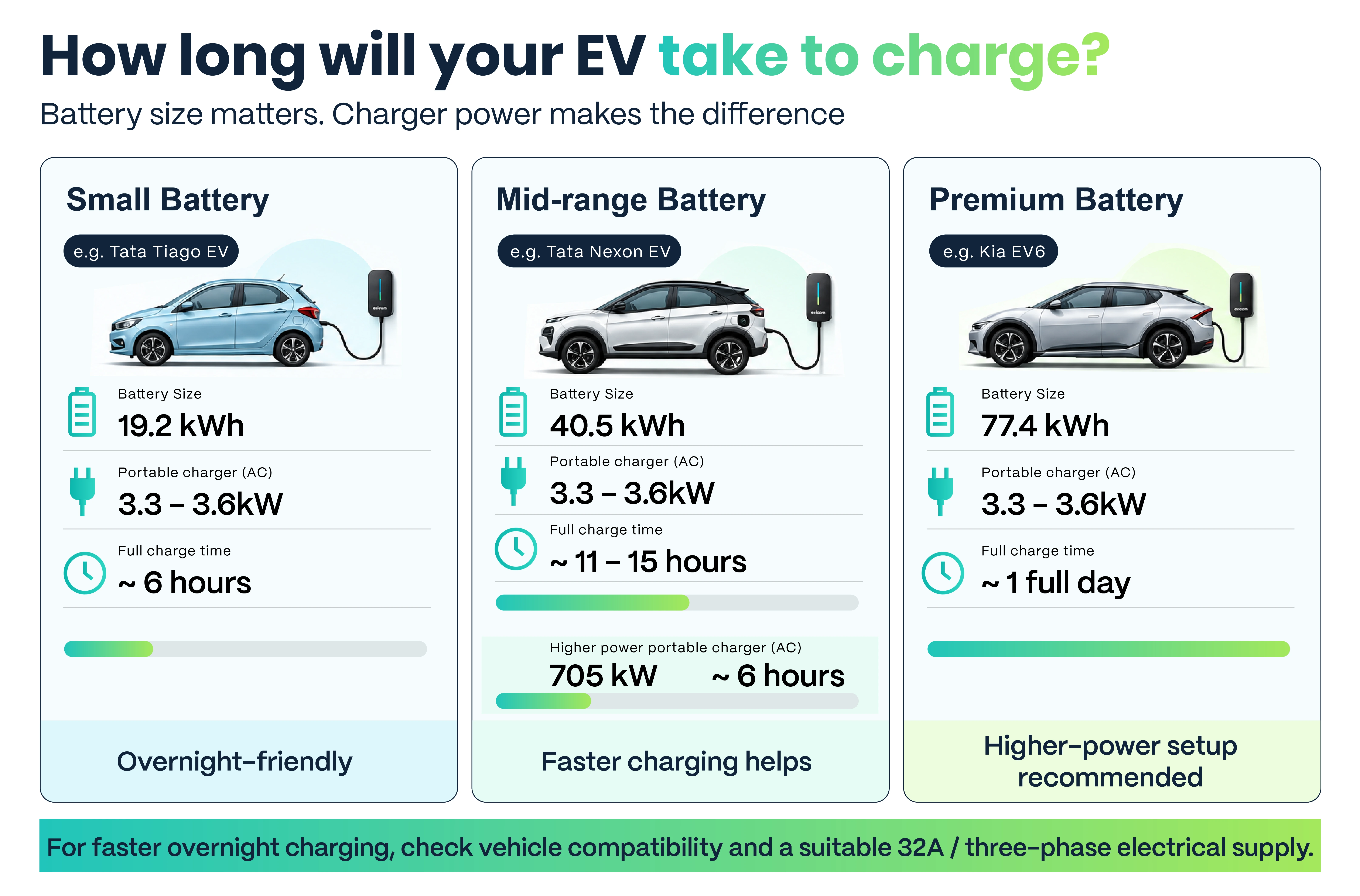
Your battery size decides how much electricity you need to reach a full charge. A smaller battery fills up fast. A large SUV battery requires a more powerful EV charger to charge overnight.
2. Available power output
The available electrical connection limits the charging speed of your EV. A standard 15A wall socket delivers up to 3.6 kW of power, which will need 6-20 hours of charging depending on what battery capacity is to be charged.
Let's understand this through examples of common Indian EV models. If your EV has a small battery (e.g., a Tata Tiago EV of 19.2 kWh), then a standard 3.3-3.6 kW portable EV charger easily charges it overnight in about 6 hours. If you have a mid-range battery, (e.g., Tata Nexon EV - 40.5 kWh) then the same charger will take around 11 to 15 hours for a full cycle. If you drive heavily, a 7.5 kW portable unit (charging in ~6 hours) makes sense. However, if you drive a premium EV (let's say a Kia EV6 with a battery of 77.4 kWh), then a standard portable charger needs nearly a full day. To reliably charge overnight, you need a higher power setup, a 32A line, or a three-phase connection.
Now, the elephant in the room:
How much will a portable EV charger cost?
Portable EV charger costs vary according to power outputs, you should go for the model that is most suited for your commute requirements.
A. 3.3 kW to 3.6 kW (Slow AC / Level 1): INR 13,000 to INR 16,000
These are standard portable units designed to plug into normal 15A or 16A Indian residential sockets (the same kind used for air conditioners or geysers).
- Power Setup: Runs on a standard single-phase 230V connection and draws up to 15-16 amps. You do not need a special meter or an upgraded load.
- Charging Speed: Adds about 10-15 km of range per hour.
- Battery Match: Ideal for small EVs (like the base Tata Tiago EV with a 19.2 kWh battery) or plug-in hybrids. For mid-range EVs (like the Tata Nexon EV with a 30 kWh to 40 kWh battery), a full 0-100% charge takes roughly 10 to 15 hours.
- Best For: Overnight charging and commutes under 40-50 km.
B. 7.2 kW to 7.5 kW (Fast AC / Level 2): INR 18,000 to INR 23,000
These EV chargers cut charging time in half, but they require dedicated electrical infrastructure. Manufacturers use thicker copper wiring and heavy-duty industrial plugs to manage heat dissipation, which drives the price up.
- Power Setup: Operates on single-phase electricity but draws a heavy 32 amps. You will need a dedicated 32A industrial socket (CEE socket), heavy-duty wiring (usually 6 sq mm to 10 sq mm copper cable), and a 40A MCB. You must also ensure the total sanctioned load of the place you're charging in can handle the extra 7 kW.
- Charging Speed: Adds roughly 30 to 40 km of range per hour.
- Battery Match: Perfect for mid-range and premium EVs (battery sizes from 30 kWh to 60+ kWh). A 40-kWh battery will be fully charged in about 6 hours.
- Best For: Drivers who cover longer daily distances and need their EV fully charged overnight without fail.
C. 11 kW and above (Fast AC / Three-Phase): INR 28,000 to INR 35,000
These chargers are rarely portable in the traditional sense, as they require complex industrial wiring, which may not be present in every location.
- Power Setup: Requires a three-phase electrical connection, spreading the load across three separate 16A lines (for 11 kW) or 32A lines (for 22 kW).
- Charging Speed: Charges a 60 kWh premium EV battery (like a Kia EV6 or Hyundai Ioniq 5) in about 5 to 6 hours.
- Vehicle Limitation: Your car's onboard charger dictates the maximum AC speed. If your car has a 7.2 kW onboard charger, plugging it into an 11 kW or 22 kW charger will still only charge it at 7.2 kW.
Before you make a purchase, you'd want to know the durability of any product, and this concern isn't any different for an EV charger.
Is a portable EV charger safe in the long run?
A portable charger is exposed to all sorts of parking situations and weather conditions, but high-quality portable EV chargers are built to last for years if you choose the right model. A premium portable EV charger will easily survive 5 to 10 years of daily use. Good portable EV chargers use IP66 or IP67 rated enclosures. This means they are completely sealed against dust and can withstand heavy monsoon rain or direct water jets.
Now that you see the appeal of a portable EV charger, a natural question can come to your mind.
Can I use a portable charger in place of an AC/DC charger?
If you are driving moderate distances in a small-mid end EV, why bother with public charging/at-home wall box units? Won't a portable EV charger suffice? It would, but there are some trade-offs to be aware of. A portable charger is technically an AC charger, but it functions differently than a hardwired wall box or a commercial DC fast charger.
If you are renting a house with no provision of AC charging, with a commute of around 50 km average per day, or if you are a free bird and travel frequently to remote locations, then a portable EV charger is perfectly suited for your needs. You get overnight charging without paying for a permanent wallbox installation or having to look for a charging station.
What you sacrificed in the process would have been charging speed. But... not anymore.
Exicom Spin Free 2 brings the portable advantage at wallbox speed
The Exicom Spin Free 2 completely eliminates the classic speed compromise by introducing a dual-plug adapter system. It comes equipped with two interchangeable power cords: a standard 16A (3.3 kW) socket plug for emergency top-ups at any regular wall outlet, and a heavy-duty 32A (7.5 kW) industrial Type M plug for maximum power.
This means when you are visiting a friend or staying at an Airbnb, you can use the 16A plug to grab a slow overnight charge. But when you are at your house or a workshop equipped with a 32A industrial socket, you just swap the adapter and pull the full 7.5 kW of power. You get the exact same charging speed as a permanent wallbox, without ever having to bolt a single piece of hardware to your wall.
Readyto charge on your own terms? Pick up the Exicom Spin Free 2 portable EV charger and keep your battery topped up anywhere you park.
Frequently Asked Questions
Lorem ipsum dolor sit amet, consectetur adipiscing elit, sed do eiusmod tempor incididunt ut labore et dolore magna aliqua. Ut enim ad minim veniam, quis nostrud exercitation ullamco laboris nisi ut aliquip ex ea commodo consequat. Duis aute irure dolor in reprehenderit in voluptate velit esse.
Lorem ipsum dolor sit amet, consectetur adipiscing elit, sed do eiusmod tempor incididunt ut labore et dolore magna aliqua. Ut enim ad minim veniam, quis nostrud exercitation ullamco laboris nisi ut aliquip ex ea commodo consequat. Duis aute irure dolor in reprehenderit in voluptate velit esse.
Lorem ipsum dolor sit amet, consectetur adipiscing elit, sed do eiusmod tempor incididunt ut labore et dolore magna aliqua. Ut enim ad minim veniam, quis nostrud exercitation ullamco laboris nisi ut aliquip ex ea commodo consequat. Duis aute irure dolor in reprehenderit in voluptate velit esse.
Lorem ipsum dolor sit amet, consectetur adipiscing elit, sed do eiusmod tempor incididunt ut labore et dolore magna aliqua. Ut enim ad minim veniam, quis nostrud exercitation ullamco laboris nisi ut aliquip ex ea commodo consequat. Duis aute irure dolor in reprehenderit in voluptate velit esse.
Lorem ipsum dolor sit amet, consectetur adipiscing elit, sed do eiusmod tempor incididunt ut labore et dolore magna aliqua. Ut enim ad minim veniam, quis nostrud exercitation ullamco laboris nisi ut aliquip ex ea commodo consequat. Duis aute irure dolor in reprehenderit in voluptate velit esse.