


Your Tenants, Employees, and Guests Are Going Electric. Is Your Property Keeping Up?
The real estate sector has been pushing boundaries for livability for years now. Indian properties are so much more than just a space for living, working, or vacationing.
A residential development needs to support changing resident expectations. An office needs to keep pace with how employees commute. A hotel needs to make the guest experience work from arrival to departure.
Electric mobility is adding another layer to that expectation.
The question for property owners and developers is therefore moving beyond, “Should you be installing EV chargers?”
It is becoming:
Is your property ready for EV adoption?
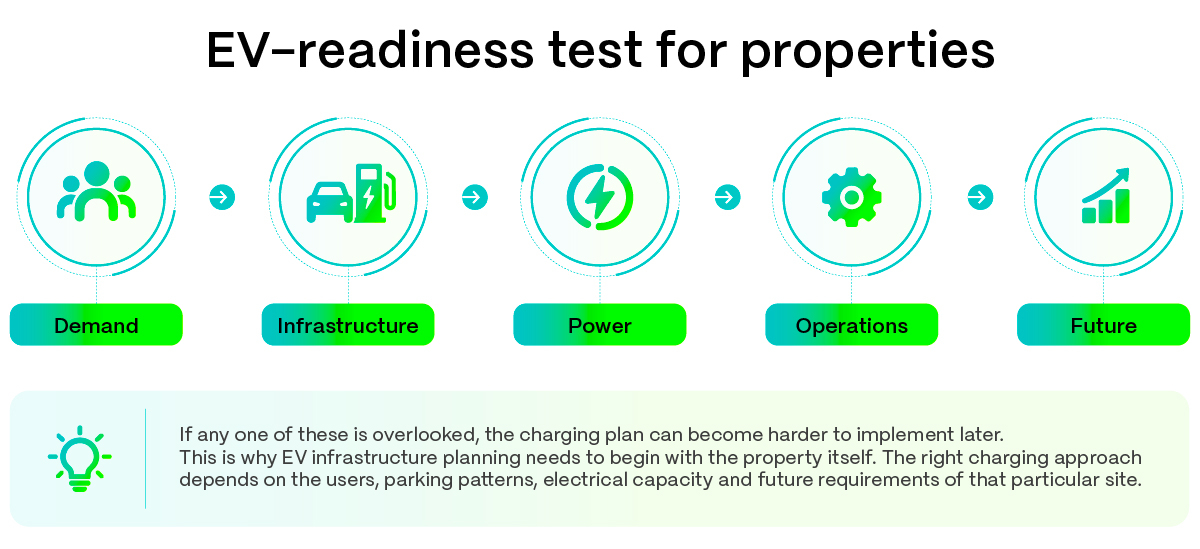
EV readiness starts well before a charger is installed. It involves understanding who will use it, where vehicles will charge, how much power the property can support, how charging will be managed, and whether today's infrastructure can accommodate tomorrow's demand.
And the answer will look different for a residential building, office campus, hotel, or shopping mall.
That is the starting point for the EV-Ready Buildings Index 2026.
Why properties need to start thinking about EV readiness
Electric mobility is gradually becoming part of everyday movement. Residents, employees, guests and shoppers are increasingly likely to arrive at properties in electric vehicles, making parking and electrical infrastructure part of the mobility experience.
Policy direction is reinforcing this shift. Delhi’s Electric Vehicle Policy 2020 required 20% of vehicle-holding capacity or parking in new homes and workplaces to be EV-ready, with conduits and power-supply infrastructure for EV chargers. The new Delhi Electric Vehicles Policy 2026 builds on this infrastructure focus, supporting the expansion of a comprehensive public and private charging network across the city.
Maharashtra has gone further, with its 2025 EV Policy requiring new buildings to have 100% of their parking spaces equipped with EV-charging facilities.
Also, given the scale of EV adoption, properties will need to prepare for future demand.
The question is therefore less about how many chargers can be installed and more about how prepared the property is to accommodate EV demand.
What changes when a property starts planning for EV readiness?
This distinction matters because EV charging demand is closely tied to where people spend time.
According to the IEA, home charging remains the most popular way for EV owners to charge globally, a pattern that is also reflected in India. That makes residential properties an important part of the charging conversation. Workplaces, hotels, and retail destinations then become relevant wherever vehicles spend predictable periods of time.
So what exactly makes a property EV-ready?
The five dimensions of an EV-ready property
EV readiness is not a charger count. It is a combination of 5 dimensions that need to work together.
A property that considers all 5 can move from simply responding to requests to making infrastructure decisions with a longer view.
EV readiness for real estate: Is your property prepared for tomorrow's buyer?
For residential and commercial real estate, infrastructure decisions can stay in a building for decades.
That makes EV readiness particularly relevant during planning and development. Parking layouts, electrical infrastructure, and space allocation are easier to consider when the property is being designed than when residents or occupants are already using it.[Text Wrapping Break]The cost difference can be significant. According to the U.S. Department of Energy's Alternative Fuels Data Center, adding EV-ready elements after construction can cost 4–6 times more than incorporating them during construction or a major renovation.
For developers, the case for planning early is therefore not just about future-proofing the property. It can also mean avoiding costly structural and electrical changes later.
What should developers evaluate?
The broader real estate opportunity around the EV transition is also significant. The Savills India Report estimates that the Indian real estate sector will see USD 7.5 to 9.0 billion in total real estate investments by 2030 to support EV manufacturing facilities and charging stations. As EV adoption creates new demand across the built environment, developers can consider EV readiness as part of their broader property planning. In order to make EV charging for real estate a part of broader property electrification, developers should follow a structured approach:
Step 1: Understand who will use the property and how charging demand could evolve.
Step 2: Map parking and electrical infrastructure before deciding charger quantities.
Step 3: Create a charging-ready backbone that can accommodate phased expansion.
Step 4: Plan power management rather than assuming every charger will operate at maximum power simultaneously.
Step 5: Build monitoring and maintenance into the infrastructure plan from the beginning.
The objective is to make charging part of the infrastructure plan, rather than a separate addition that has to be fitted in later.
EV readiness for offices: Is your workplace ready for employees who drive EVs?
The office has one advantage that many other destinations do not: predictable dwell time.
Employees typically arrive, park, and remain at the workplace for several hours. That makes workplace EV charging a natural extension of existing parking infrastructure.
It also creates a very specific challenge for facility teams.
What happens when 5 employees need charging? What happens when that becomes 50? Does the building have enough power? Who gets access? How is charging monitored? And how much involvement does the facility team need?
Workplace readiness therefore has to balance employee demand with the realities of the building.
The office readiness checklist
The key question is:
Can your workplace support growing EV demand without adding operational complexity?
For captive offices, office EV charging needs to work within the building's existing infrastructure. AC charging can suit longer workplace dwell times, while intelligent charging and smart solutions like Exicom’s Dynamic Load Management can help manage demand within available power. It allows available power to be distributed according to charging demand rather than treating every connected vehicle as if it needs maximum power at the same moment.
EV readiness for hotels and hospitality: Can your property support EV-driving guests without turning charging into an operational burden?
Many travel booking platforms are adding EV-charger availability as a filter, highlighting the growing importance of EV-ready hotels and hospitality properties.
Hotel EV charging may look very different from resort EV charging or Airbnb EV charging. The infrastructure has to reflect the length of stay, parking arrangement, property size, and guest profile.
This is already becoming relevant in tourism infrastructure. As reported by Down To Earth, Himachal Pradesh is developing EV charging corridors and encouraging hotels to install chargers as it works to reduce emissions from road-based tourism.
Destination charging can therefore become part of how a hospitality property positions its experience. An Expert Market Research study describes destination charging as an increasingly important element of brand positioning and customer experience, with malls and hotels using EV charging to cater to affluent, environmentally conscious consumers.
EV readiness for retail: Is your property ready for the charging needs of tomorrow’s shopper?
A shopper may spend 30 minutes at a store or two hours at a mall. That makes retail charging different from charging at an office or residential property.
For retail properties, EV charging infrastructure therefore has to work around shopper behaviour rather than operate as a standalone amenity.
A useful retail readiness assessment should look at:
The retail readiness matrix
Dwell time also shapes the charging experience. A customer spending several hours at a mall may be comfortable with slower charging, while someone making a quick retail stop may value faster charging. Matching the charging model to the time customers already spend on the property can make the infrastructure more useful without requiring them to change their plans.
Four property types. One readiness question.
The property types are different. Their readiness requirements are different too.
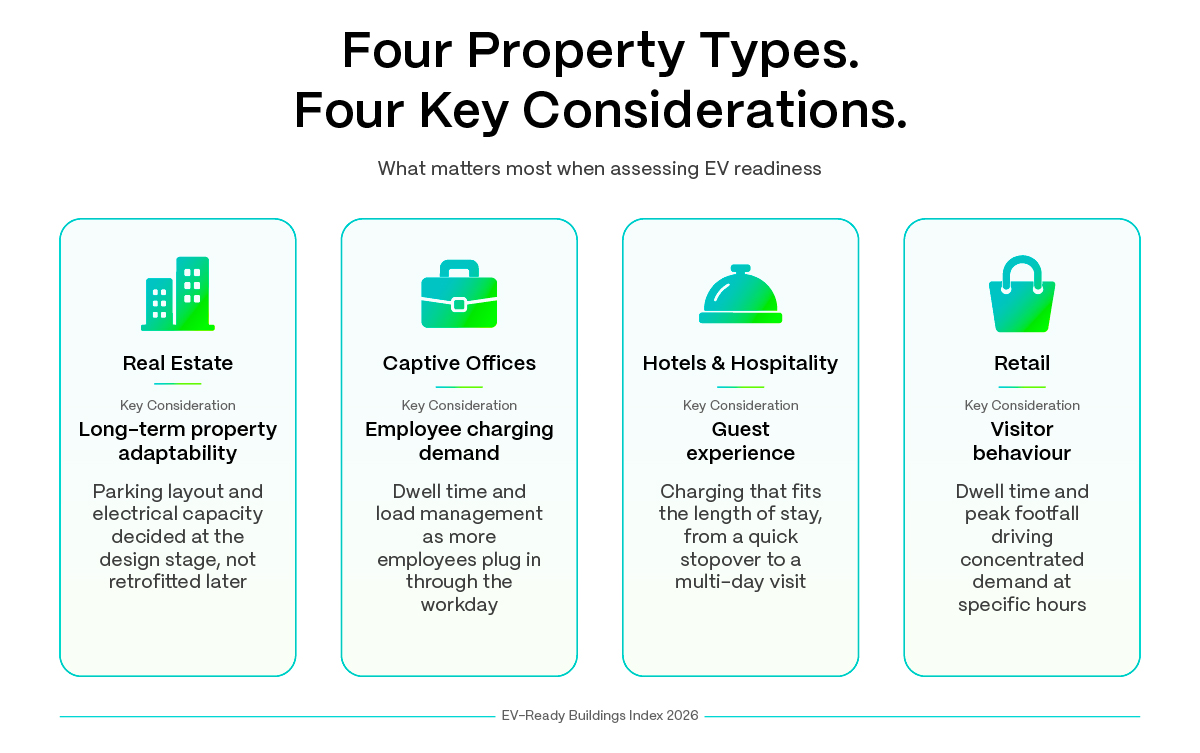
That is why there cannot be a universal EV charging solution.
There can, however, be a universal readiness process.
The property EV-readiness journey
This is where Exicom's role fits naturally into the readiness journey. Smart EV charging, AC and DC charging infrastructure can be matched to different property needs and dwell times, while Dynamic Load Management helps distribute available power across chargers without exceeding site capacity. Ring Topology enables inter-charger power sharing for maximum efficiency and throughput in dense commercial spaces, while RMS predictive diagnostics provides remote visibility into charger performance and helps identify potential issues early.
Exicom One: One partner from planning to operations
For builders and property owners, EV readiness involves more than selecting and installing chargers. Exicom One is a turnkey solution that brings site assessment, electrical planning, charging infrastructure, installation, monitoring and ongoing service together under one partnership. This gives property owners a single point of coordination across the lifecycle, reducing the complexity of managing multiple vendors while making it easier to maintain, monitor and scale the charging infrastructure as requirements evolve.
Frequently Asked Questions
Lorem ipsum dolor sit amet, consectetur adipiscing elit, sed do eiusmod tempor incididunt ut labore et dolore magna aliqua. Ut enim ad minim veniam, quis nostrud exercitation ullamco laboris nisi ut aliquip ex ea commodo consequat. Duis aute irure dolor in reprehenderit in voluptate velit esse.
Lorem ipsum dolor sit amet, consectetur adipiscing elit, sed do eiusmod tempor incididunt ut labore et dolore magna aliqua. Ut enim ad minim veniam, quis nostrud exercitation ullamco laboris nisi ut aliquip ex ea commodo consequat. Duis aute irure dolor in reprehenderit in voluptate velit esse.
Lorem ipsum dolor sit amet, consectetur adipiscing elit, sed do eiusmod tempor incididunt ut labore et dolore magna aliqua. Ut enim ad minim veniam, quis nostrud exercitation ullamco laboris nisi ut aliquip ex ea commodo consequat. Duis aute irure dolor in reprehenderit in voluptate velit esse.
Lorem ipsum dolor sit amet, consectetur adipiscing elit, sed do eiusmod tempor incididunt ut labore et dolore magna aliqua. Ut enim ad minim veniam, quis nostrud exercitation ullamco laboris nisi ut aliquip ex ea commodo consequat. Duis aute irure dolor in reprehenderit in voluptate velit esse.
Lorem ipsum dolor sit amet, consectetur adipiscing elit, sed do eiusmod tempor incididunt ut labore et dolore magna aliqua. Ut enim ad minim veniam, quis nostrud exercitation ullamco laboris nisi ut aliquip ex ea commodo consequat. Duis aute irure dolor in reprehenderit in voluptate velit esse.
.webp)