


How Remote Management Systems Can Enhance Profitability for EV Charging Installers

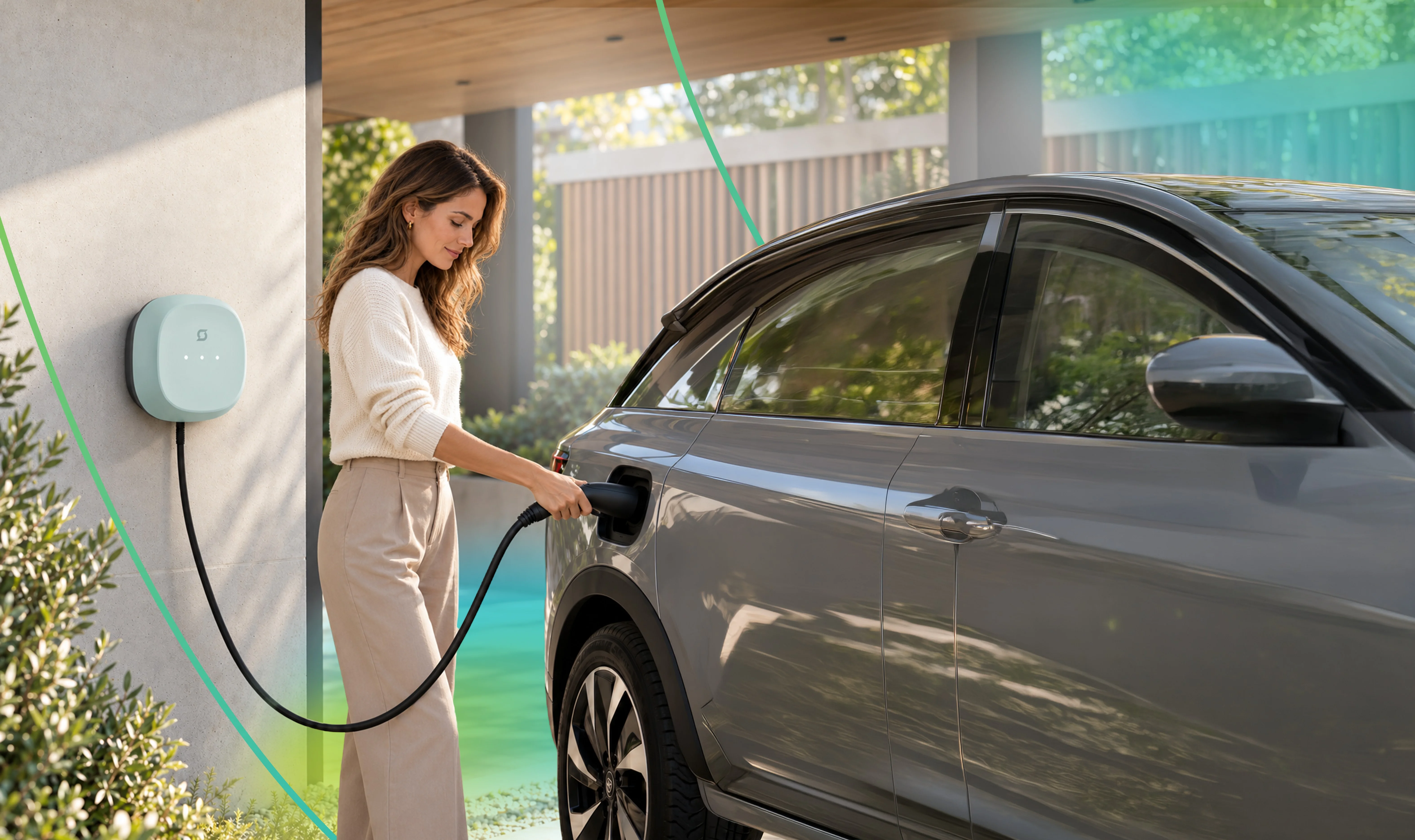
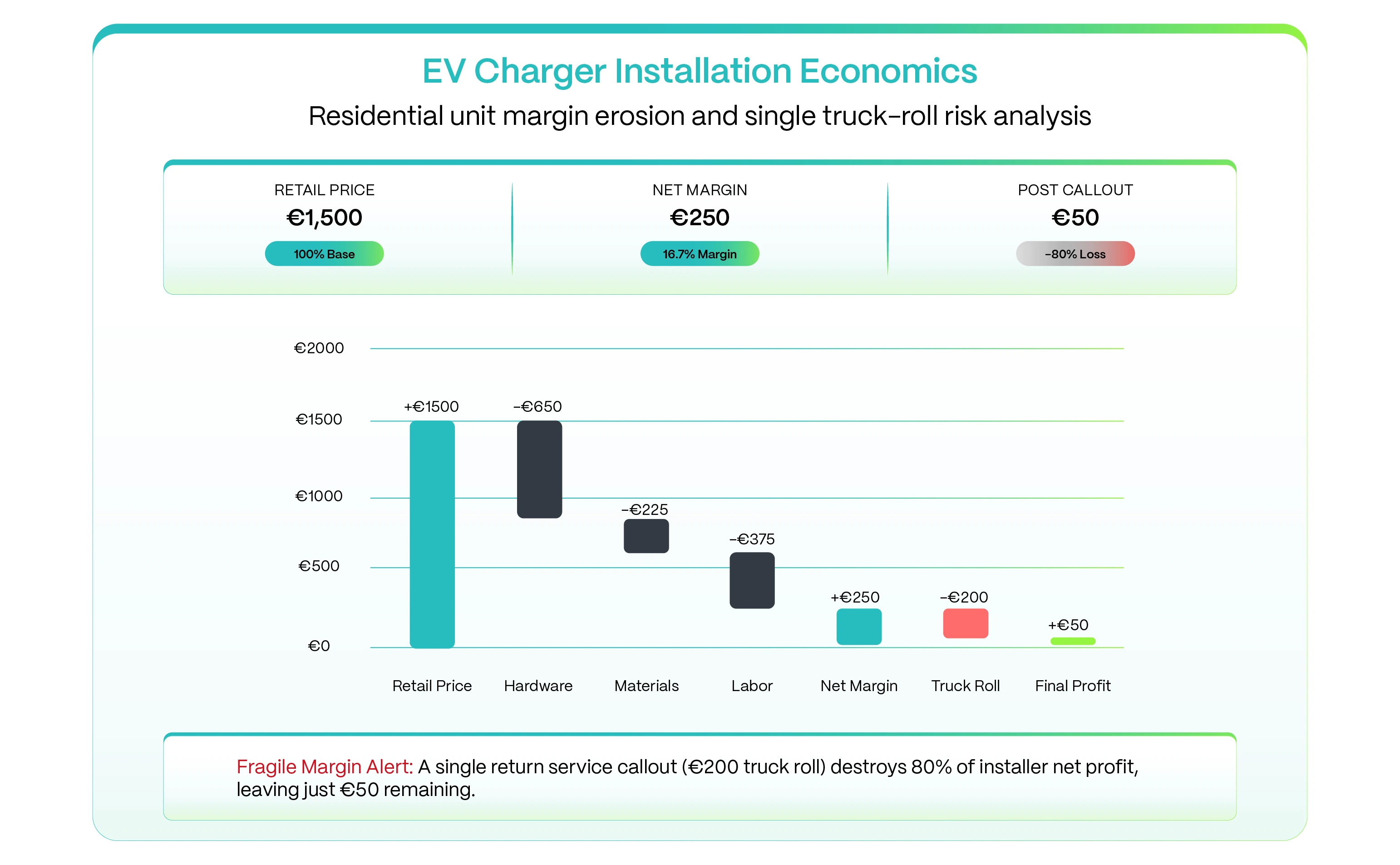
It’s a busy workday in Swansea, Wales, Mr. Smith plugs his EV into his newly installed home charger. It blinks a stubborn amber fault light. Not a pretty sight. Thankfully, he has it under warranty. He immediately called his installer under the SLA (Service Level Agreement). A day later, an electrician navigated heavy traffic, ran diagnostics, and resolved the issue in under a minute with a simple system reboot. The digital handshake timeout was cleared, but the €200 call-out cost completely erased the installer’s net profit margin on the entire installation.
This is not a one-off case. Today, for EV charger installers, scaling a business ends up scaling operational losses. The unnecessary maintenance truck roll wipes out hard-won installation margins. The entire global EV market is seeing the cost of EV maintenance or charger maintenance as an issue that needs to be resolved. Let's have a look.
The Global EV boom increases the number of charging maintenance situations
Physical maintenance visits can fully erode installer margins.
The transition to electric mobility is putting millions of new residential AC chargers in homes. Now that EVs are hitting the broader mass market, everyday drivers treat their home chargers like household appliances. They are not technically savvy themselves and expect seamless functionality.
However, traditional dumb chargers provide zero feedback when a digital protocol fails behind the casing. When an unfamiliar charging status light appears, these everyday drivers assume the unit has suffered a terminal breakdown. They immediately trigger an on-site warranty claim. Given the legacy nature of maintenance contracts, most of them promise physical callouts. They have to comply with more site visits as their installed car charger customer base scales – and this means their operational overhead scales even faster.
Not all failure modes need a physical visit
However, disconnected legacy hardware forces unnecessary escalations.
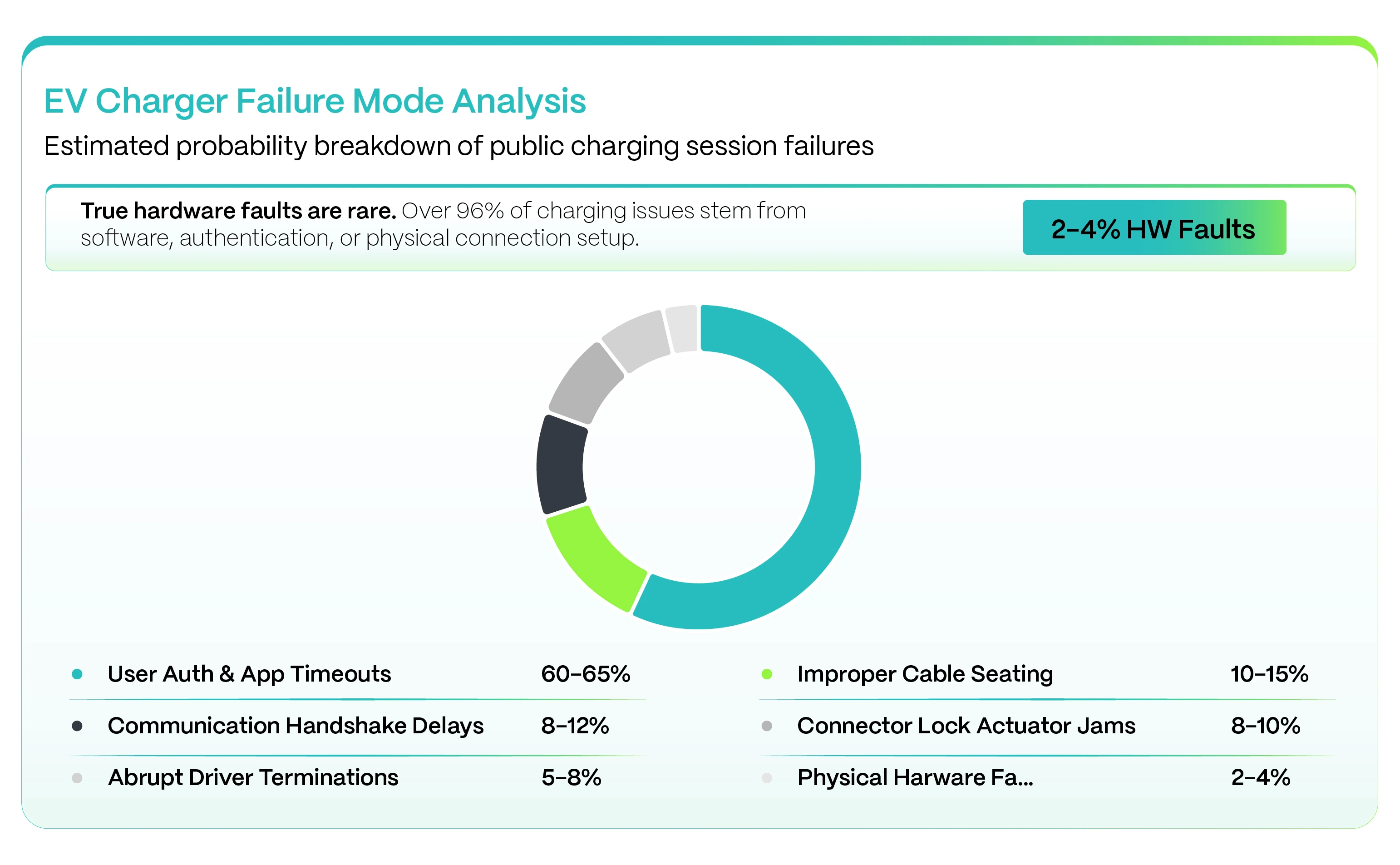
Field telemetry from millions of charging sessions demonstrates that most charger downtime never requires a technical or hardware fix. Most of these are fixable from a remote monitoring method. The share of key issues in maintenance of EV chargers are:
- User and Authentication Errors (60% – 65%): The vast majority of session interruptions stem from app authorization lags, unseated cables, or payment gateway timeouts
- Software and Communication Delays (15% – 25%): Of the remaining technical faults, nearly all are caused by vehicle-charger communication handshake stalls (EVCommunicationError) or locking pin actuator timeouts.
- True Hardware Breakdowns (2% – 4%): Genuine physical damage—such as welded relay contactors, burnt terminal blocks, or severed cables—accounts for only a tiny fraction of reported faults.
Because legacy chargers do not communicate what went wrong, minor handshake stalls and tripped consumer board breakers are routinely escalated into emergency service tickets.
Historically, customer support teams tried to mitigate this by training drivers to run through a manual, frustrating 5-step triage sequence (re-seating cables, inspecting domestic breakers, etc.) before filing a ticket. While the fundamental steps of triage remain the same, relying on frustrated customers to manually diagnose their hardware is a failing strategy. The industry needs an automated bridge between the charger's diagnostic data and the user.
An unnecessary maintenance visit causes installer margin reduction
High call-out labor costs quickly exceed the thin margin on residential wallboxes.
The fundamental challenge in the residential charging sector today is the massive disconnect between technical necessity and operational reality.
While empirical data proves that only 2% to 4% of failures represent true hardware damage, current industry practice sees 60% to 80% of reported charger issues trigger a physical truck roll. Without a Remote Management System (RMS), support desks operate completely blind. Technicians routinely drive hours across regional territories only to discover that the charger is in working order, resolving the ticket by merely resetting a breaker or restarting the charger.
Dispatching a certified technician costs an average of €150 to €250 per visit once travel time, vehicle fleets, and hourly wages are factored in. A single unnecessary truck roll wipes out up to 100% of the net margin earned on the original installation, and a second visit immediately turns the customer account into a net loss.
If a second maintenance visit is needed, the entire installer profitability is wiped out in most cases.
AI-bot SLA, RMS and OCPP compliance can improve experience, retain profitability
Better maintenance resolution gives better customer experience and installer profitability
Plugging this profit leak requires modernizing both service agreements and the underlying hardware infrastructure. Installers can eliminate the unnecessary truck-roll entirely by leaning into the advanced ecosystem provided by manufacturers like Exicom.
1. Change SLAs to ensure self-serve remote triage using AI Chatbots
Installers must restructure their SLAs around a mandatory remote-first protocol, but the burden of diagnosis should no longer fall on the customer. When a homeowner experiences a charging fault, they shouldn't have to guess what went wrong. When a fault occurs, an integrated AI chatbot instantly pops up within the app. Because it is directly linked to the charger's backend, the AI already knows the error code. It conversationally guides the user: "I see the cable isn't locked securely, let's try pushing it in until it clicks" which makes it easy for non-tech savvy users to make small installation corrections. This will avoid unnecessary compliance led service visits.
2. Have a central preventive maintenance schedule via Spin Air RMS
Rather than waiting for a homeowner to report a failure, operators should track fleet health through a centralized Remote Management System (RMS). Exicom’s Harmony Connect platform leverages smart automated monitoring to identify unusual activity and trends across the network. By monitoring grid fluctuations, connector thermal thresholds, and communication logs, the RMS grants support teams predictive insights. This preventative approach enables operators to detect degrading connections and clear software faults over the air before the driver even realizes an issue exists.
3. Ensure that your entire fleet is OCPP compliant
AI chatbots and predictive RMS platforms are only viable if the physical hardware is capable of transmitting rich, standardized diagnostic telemetry. Exicom designs its charging solutions specifically to serve as the foundation for this connected ecosystem
- The Spin Air Advantage: Exicom’s Spin Air is a smart, connected AC charger available in 7.4kW and 22kW variants for homes and fleets. It features an IP66 all-weather rating for extreme temperatures (-25°C to +55°C) and integrates 6mA DC and 30mA AC ground fault detection that continuously monitors for electrical anomalies.
- Direct OCPP Connectivity: Because the Spin Air is natively connected and fully compatible with Open Charge Point Protocol (OCPP) backends, it serves as the ultimate data source for the AI chatbot and the RMS. Support operators can instantly differentiate between a vehicle-initiated pause, a grid brownout, or a charger-side fault without dispatching a van.
- Seamless Remote Resolution: When a handshake hang or actuator timeout does occur, support teams utilizing the Exicom RMS can push background firmware upgrades, execute remote commands, and run rapid diagnostics in seconds, minimizing downtime and costly on-site interventions.
By replacing disconnected legacy hardware with Exicom's Spin Air chargers, intelligent AI chatbot triage, and a robust RMS, installers can resolve 80% of service issues remotely, keeping customer satisfaction high and certified electricians focused on new, profitable installations.
Frequently Asked Questions
Lorem ipsum dolor sit amet, consectetur adipiscing elit, sed do eiusmod tempor incididunt ut labore et dolore magna aliqua. Ut enim ad minim veniam, quis nostrud exercitation ullamco laboris nisi ut aliquip ex ea commodo consequat. Duis aute irure dolor in reprehenderit in voluptate velit esse.
Lorem ipsum dolor sit amet, consectetur adipiscing elit, sed do eiusmod tempor incididunt ut labore et dolore magna aliqua. Ut enim ad minim veniam, quis nostrud exercitation ullamco laboris nisi ut aliquip ex ea commodo consequat. Duis aute irure dolor in reprehenderit in voluptate velit esse.
Lorem ipsum dolor sit amet, consectetur adipiscing elit, sed do eiusmod tempor incididunt ut labore et dolore magna aliqua. Ut enim ad minim veniam, quis nostrud exercitation ullamco laboris nisi ut aliquip ex ea commodo consequat. Duis aute irure dolor in reprehenderit in voluptate velit esse.
Lorem ipsum dolor sit amet, consectetur adipiscing elit, sed do eiusmod tempor incididunt ut labore et dolore magna aliqua. Ut enim ad minim veniam, quis nostrud exercitation ullamco laboris nisi ut aliquip ex ea commodo consequat. Duis aute irure dolor in reprehenderit in voluptate velit esse.
Lorem ipsum dolor sit amet, consectetur adipiscing elit, sed do eiusmod tempor incididunt ut labore et dolore magna aliqua. Ut enim ad minim veniam, quis nostrud exercitation ullamco laboris nisi ut aliquip ex ea commodo consequat. Duis aute irure dolor in reprehenderit in voluptate velit esse.