
Can My Home's Electrical System Handle EV Charging?

Aug 23, 2026
Can My Home's Electrical System Handle EV Charging ?

Yes, in many cases. But it depends on how much power your home is already using and how the home EV charger fits into that demand. A charger with Dynamic Load Management (DLM) can adjust its power draw as your household demand changes.

Read on to find out more on what DLM-enabled EV chargers are and how they make your life easy.

7 PM. The AC is on. The geyser is heating water. Someone is making dinner and using a mixer. The washing machine is still running. That's the evening rush almost every Indian household knows by heart.

You might switch off the iron before the AC goes on. Wait for the geyser before starting the washing machine and so on. You've been doing peak load management by hand, for years.

Now add an EV charger to that evening. For most Indian homes, this is when charging makes sense: plug in after work, charge through the night while the car sits in the porch or basement anyway.  

Did You Know?

The national EV infrastructure framework emphasizes that uncoordinated residential EV charging naturally coincides with domestic evening peak hours, typically between 6:00 PM and 10:00 PM.

Source: NITI Aayog & WRI India – Handbook for Electric Vehicle Charging Infrastructure Implementation

This leads to a very common question in an EV user's mind.

Will An EV Charger Trip My Home MCB?

By far, this is one of the most common threads on Indian EV owner forums: the charger installs fine, then trips the moment the AC or geyser joins in during peak hours. This fear exists due to the limited sanctioned load in Indian homes.  

Indian Homes Have Low Sanctioned Load  

Your sanctioned load is the load your home electricity connection is approved for. A typical urban Indian home may have a sanctioned load of around 3–5 kW, although the actual figure varies by home, location and electricity connection.  

Along with your sanctioned load, your home's wiring, protective devices, actual appliance demand and the charger's power requirement all come into play when you add a high-power appliance such as an EV charger. To understand the practicality of the sanctioned load, let's consider the typical draw of some electrical appliances used in your home.

Here's what an ordinary evening adds up to, before the car is even plugged in:

Appliance Typical Draw
1.5-ton AC (compressor running) 1.5 kW
Storage geyser 2 kW
Refrigerator 0.2 kW
Lights and fans 0.4 kW
Mixer grinder 0.75 kW
Subtotal 4.85 kW

Illustrative values; actual power draw varies by appliance model, capacity and usage.

In this example, those appliances alone add up to about 4.85 kW-almost the entire 5 kW sanctioned load.

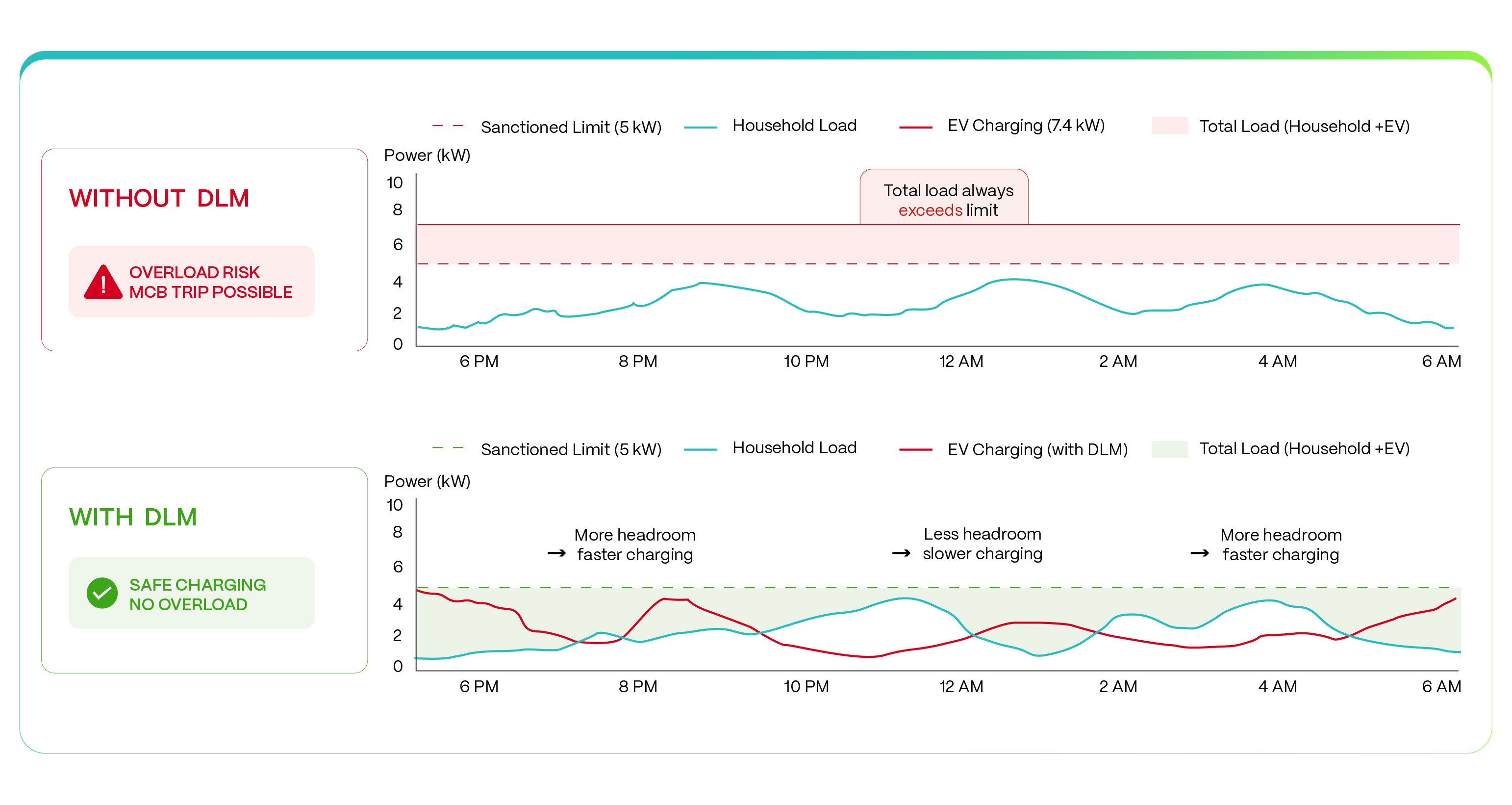
Now add a 7.4 kW charger running at full output, and the theoretical combined demand rises to about 12.25 kW. That doesn't mean the home will continuously draw 12.25 kW-appliances cycle, and their actual consumption varies. But it shows how quickly a high-power charger can consume the headroom available on a modest connection. A feature which completely takes the burden of manual load management, due to the addition of Home EV Charging, off the user is what you need here; and that's Dynamic Load Management.

Related Topic

If you want to know more about DLM, click to read this.

How Dynamic Load Sharing Transforms Charging Site Economics

EV Charger With DLM Adjusts Power Automatically

EV charger's dynamic load management feature solves manual management problem. Instead of pulling a fixed 7.4 kW regardless of what else is running, a DLM-enabled charger reads your home's real-time power draw and adjusts its own output to fit the headroom left over.

How Does DLM Affect Charging Time for an EV?

Let's look at the same 5 kW home with a 7.4. kW Spin Air. DLM continuously monitors household consumption and dynamically adjusts EV charging to use the available headroom within the home's sanctioned load. The table below shows how this works in practice at any given time.

Home Load What Could Be Running Power Left for EV Charging Time for 30 kWh
1 kW Fridge + fans + lights 4 kW ~7.5 hrs
2 kW Fridge + fans + lights + TV 3 kW ~10 hrs
3 kW Fridge + fans + lights + 1 AC 2 kW ~15 hrs
4 kW 1 AC + geyser + regular appliances 1 kW ~30 hrs
Very Low Load Fridge + standby appliances Up to 5 kW ~6 hrs

Without DLM, for a 30 kWh battery, charging continuously at 7.4 kW would take about 4 hours, but it might lead to overloading and your MCB tripping.  

With DLM, you can get the same charge to be completed overnight typically within 6–9 hours, without exceeding the home's available capacity.

This makes overnight charging particularly practical. As household electricity use falls at night, more power becomes available for the EV, allowing it to charge faster without overloading the home.

Key Point

DLM does not increase the cost of electricity.

A 30 kWh charge still uses roughly 30 units of electricity whether DLM is used or not; you pay the same per-unit tariff. DLM simply manages when and how fast those units are delivered.

Spin Air Reads Your Home’s Power Draw In Real Time Through Its DLM Feature

Spin Air’s Dynamic Load Management helps monitor household power usage and can adjust EV charging current accordingly, so charging fits more smoothly within your home’s available electrical capacity. It can help reduce overload risk and may, in some cases, reduce the need for an immediate load upgrade. Actual performance depends on a compatible setup, commissioning, and your site’s available capacity.

So, the next time your evening looks like AC, geyser, mixer, and now a car: you don't manually manage all four. The charger handles that part. You just plug in your DLM-enabled EV Home Charger.

Customer Voices

What EV Owners Say

EV Owner Review
I will be more than happy buying a third-party EV charger from a reputed brand like Exicom…
SJ

Shreyans_Jain

Team-BHP

EV Owner Review
Charging my EV with an Exicom charger has been a great experience — I’d definitely recommend it.
NA

Nandini Aggarwal

Gurugram · Hyundai

Want to know what actually happens behind the scenes when DLM manages your EV charging? Check out our next blog

EV Charging Glossary

  • Sanctioned Load

    The maximum electrical load, measured in kW, that your utility provider permits your home connection to draw at one time.

    Related Exicom Wiki: Dynamic Load Balancing
  • Dynamic Load Management (DLM)

    A smart charging feature that monitors available electrical capacity in real time and adjusts EV charging power accordingly to help prevent electrical overload.

    Explore Dynamic Load Management on Exicom Wiki
  • MCB (Miniature Circuit Breaker)

    A protective device in an electrical distribution system that interrupts power when the circuit experiences excessive current or certain electrical faults.

    Related Exicom Wiki: Level 2 Charging
  • Headroom

    The electrical capacity still available for the EV charger after the power being consumed by active household appliances is taken into account.

    Related Exicom Wiki: Dynamic Load Balancing
  • Peak Load

    The highest level of electrical demand placed on a home, building or electrical network during a particular period.

    Related Exicom Wiki: Demand & Peak Power
  • Kilowatt (kW)

    A unit of power that measures the rate at which energy is being supplied or consumed at a particular moment. A 7.4 kW charger can deliver power faster than a 3.3 kW charger when the vehicle and electrical supply support that rate.

    Understand kW vs kWh on Exicom Wiki
  • Kilowatt-hour (kWh)

    A unit of energy representing the amount of electricity consumed or stored over time. EV battery capacity and electricity consumption are commonly expressed in kWh.

    Explore Kilowatt-hour (kWh) on Exicom Wiki

Sources & Further Reading

  • NITI Aayog & WRI India

    Handbook for Electric Vehicle Charging Infrastructure Implementation

    View Official Handbook
  • Ministry of Power, Government of India / Bureau of Energy Efficiency

    Guidelines for Installation and Operation of Electric Vehicle Charging Infrastructure – 2024

    View Official Guidelines
  • Team-BHP & EV Owner Community

    Aftermarket wallbox chargers for EVs — owner experiences and discussion around home EV charging solutions.

    View Team-BHP Discussion
Author -  
Amrita Parashar
Share

Frequently Asked Questions

Will an EV charger trip my home's MCB?

Lorem ipsum dolor sit amet, consectetur adipiscing elit, sed do eiusmod tempor incididunt ut labore et dolore magna aliqua. Ut enim ad minim veniam, quis nostrud exercitation ullamco laboris nisi ut aliquip ex ea commodo consequat. Duis aute irure dolor in reprehenderit in voluptate velit esse.


It can, if your charger and heavy appliances run at the same time. Most Indian homes have a sanctioned load of 3 to 5 kW. If you plug in a 7.4 kW charger while your AC and geyser are on, you will overload the system and trip the MCB. A charger with Dynamic Load Management (DLM) fixes this by reading your home's live power draw and only using the leftover capacity.
Do I need to upgrade my sanctioned load for home EV charging?

Lorem ipsum dolor sit amet, consectetur adipiscing elit, sed do eiusmod tempor incididunt ut labore et dolore magna aliqua. Ut enim ad minim veniam, quis nostrud exercitation ullamco laboris nisi ut aliquip ex ea commodo consequat. Duis aute irure dolor in reprehenderit in voluptate velit esse.

Not necessarily. If you install a smart charger with a DLM feature, it automatically adjusts its power draw to fit within your existing sanctioned load. It lowers the charging speed during peak evening hours when other appliances are running. It then speeds up overnight when household demand drops.
How long does it take to charge an EV with Dynamic Load Management?

Lorem ipsum dolor sit amet, consectetur adipiscing elit, sed do eiusmod tempor incididunt ut labore et dolore magna aliqua. Ut enim ad minim veniam, quis nostrud exercitation ullamco laboris nisi ut aliquip ex ea commodo consequat. Duis aute irure dolor in reprehenderit in voluptate velit esse.

Charging time shifts based on your home's real-time electricity use. If you have a 30 kWh battery and high household load (like running an AC and geyser), charging might take over 15 hours. Overnight, when most appliances are off, a DLM-enabled charger can deliver the maximum available power and complete the charge in 6 to 9 hours.
Does a DLM charger increase my electricity bill?

Lorem ipsum dolor sit amet, consectetur adipiscing elit, sed do eiusmod tempor incididunt ut labore et dolore magna aliqua. Ut enim ad minim veniam, quis nostrud exercitation ullamco laboris nisi ut aliquip ex ea commodo consequat. Duis aute irure dolor in reprehenderit in voluptate velit esse.

No. A 30 kWh battery requires 30 units of electricity to charge, whether you use DLM or not. The feature just controls how fast those units are delivered to prevent system overloads. You pay the exact same per-unit tariff.

Lorem ipsum dolor sit amet, consectetur adipiscing elit, sed do eiusmod tempor incididunt ut labore et dolore magna aliqua. Ut enim ad minim veniam, quis nostrud exercitation ullamco laboris nisi ut aliquip ex ea commodo consequat. Duis aute irure dolor in reprehenderit in voluptate velit esse.

Recent Blogs

View all

Delhi's New EV Policy 2026 - Decoded for Everyone Charging EV at Home

12 August 2026
12 August 2026
EV charging

EV Home Charging Cost: A State-Wise Breakdown

5 August 2026
5 August 2026
EV charging

From Fuel Volatility to Predictable Operations: Why EV Fleets Make Sense

1 August 2026
1 August 2026
EV charging
We use cookies to make your experience on our website better. By clicking on “Accept All”, you are agreeing for cookies to be used. More information.