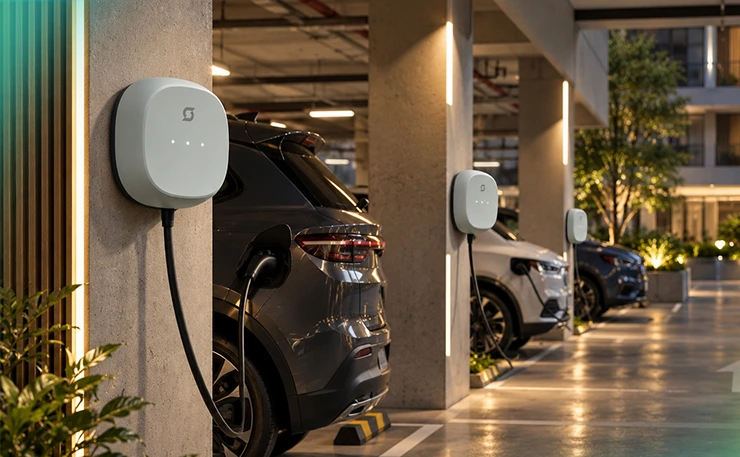



Living on rent in a society: How do I install a charger for my EV?
.avif)
We thought, you thought, we all thought. With fuel prices now crossing INR 100 per liter in many places, there hasn’t ever been a greater incentive to switch to EVs, especially for people living in metro cities.
You mainly need reliable overnight power, so a standard residential AC charger can easily suffice. Your main decision comes down to capacity. There are charges in the ranges of 3.3kW, 7.4 kW, 11 kW, or 22 kW limits, but the right choice depends entirely on your car's onboard converter. You also have to balance your new hardware against your apartment's electrical reality. Your home gets a strict, sanctioned load from the utility, and an EV charger will add to it. Hence, it is a good idea to get an EV charger that works in a wide range of capacities.
Once your product choice is sorted, you just have to navigate the approval process with your RWA and facility management. To be honest, most of us here are living on rent, in gated societies with common facilities. The decision to create an EV charging provision in a shared parking space is not solely ours to make. And society management is far from predictable, which leads us to the elephant in the room.
Can my society deny permission for installing an EV charger?
No, they cannot. The Ministry of Power’s 2024 guidelines clearly classify EV charging infrastructure as a de-licensed activity, which means anyone can opt for it. Your Resident Welfare Association (RWA) must follow these rules as they operate under a regulated permission structure. Recent discussions in the Bombay High Court have echoed that apartment charging as essential residential infrastructure.
Your RWA, however, definitely has a say in EV charging safety. The managing committee will ask for technical drawings, safe routing, load checks, and fire-safety compliance. You have to fit the charger into the building's existing electrical capacity.
There is also a cost aspect to the installation, which can sometimes create unnecessary friction. The cleanest approach is to separate private equipment from common infrastructure. You pay for your specific EV charger, the dedicated cable run, and protection devices pertaining to it. The society manages shared conduits and structured trunking as collective assets.
If you are a group of multiple people considering home charging your EVs, then you can also try convincing the RWA to consider common cable management from the start. Then, as and when other residents also adopt EVs, the charging infrastructure will be easier to scale.
Pick your EV charger carefully before you schedule that committee meeting though. Make a full proof investment by buying a smart charger, instead of buying the cheapest one in the market and then taking the headache of fixing trips. Smart Chargers can intelligently manage load on the basis of car batteries and automatically drop their power draw when your apartment's energy use spikes. You get advanced protections like built-in 6mA DC and 30mA AC ground fault detection to catch electrical issues instantly. You can optimize them to pull power from rooftop solar. They also auto-adjust to the grid, so you skip the hassle of manually restarting your session after a power cut. Handing this kind of concrete evidence to your RWA proves you respect the building's norms.
How to file an EV charger installation request?
A society has a limited time window to accept or reject the request, typically 7 days
(as per a 2022 circular also upheld in Amit Dholakia v. The State of Maharashtra, Bombay High Court, 2025). Submit a documented plan to keep the discussion anchored in evidence.
An application should be directed to the RWA
Write a formal request letter to the managing committee. A professional proposal immediately improves your chances of getting approval and a No Objection Certificate (NOC).
4 things are needed for NOC
Your building management needs precise details to approve the work. Your application must take care of the following elements:
- The exact electrical load you plan to draw
- The proposed cable route from the meter room to your parking slot
- Your EV charger model
- Declaration about following all electrical and fire-safety rules
Here is a sample letter you can download and use:
Follow this process to build your application
.avif)
- Review your society's specific bylaws.
- Obtain a written load estimate from a licensed electrician confirming your infrastructure can handle it. If your current sanctioned load falls short, apply for a load enhancement through DISCOM.
- Secure a wiring diagram mapped by your electrician.
- Verify your installer's professional credentials.
- Outline a clear metering and billing plan. You can choose to draw a line from your existing household meter, or even install a separate meter to completely seperate EV charging from your domestic bills
- List your specific safety measures like dedicated MCBs, RCCBs, and proper earthing.
After filing your application, schedule a personal meeting to walk stakeholders through your plan. If you are using a smart charger, be sure to mention features like RFID access and dynamic load balancing to address fears about unauthorized usage or grid strain. Most objections disappear once people understand technical details.
Efficient Charging. Everyday.
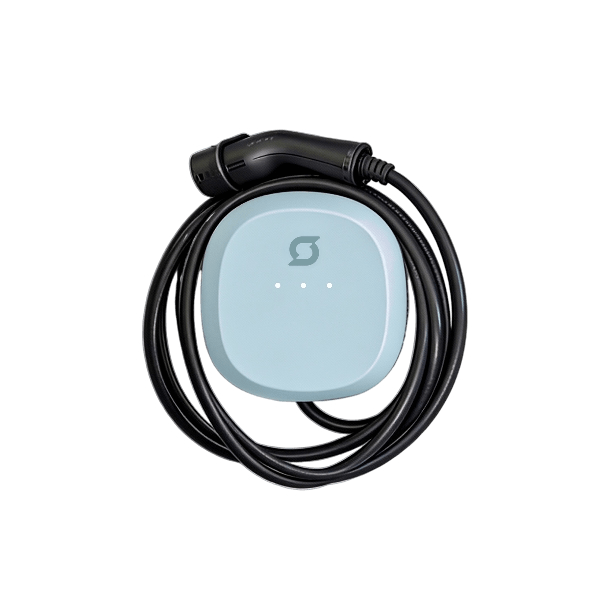
Spin Air 2 AC Charger
Compact. Smart. Reliable. 7.4kW charging solution for homes, offices and more.
Explore Product →- ✓7.4kW Power Output
- ✓Smart & Connected
- ✓Safe & Reliable
- ✓Compact Wallbox Design
Once the installation finishes, ask your electrician for a signed completion note. That document proves your circuit route meets safety standards and gives you a clean operational start.
Frequently Asked Questions
Lorem ipsum dolor sit amet, consectetur adipiscing elit, sed do eiusmod tempor incididunt ut labore et dolore magna aliqua. Ut enim ad minim veniam, quis nostrud exercitation ullamco laboris nisi ut aliquip ex ea commodo consequat. Duis aute irure dolor in reprehenderit in voluptate velit esse.
Lorem ipsum dolor sit amet, consectetur adipiscing elit, sed do eiusmod tempor incididunt ut labore et dolore magna aliqua. Ut enim ad minim veniam, quis nostrud exercitation ullamco laboris nisi ut aliquip ex ea commodo consequat. Duis aute irure dolor in reprehenderit in voluptate velit esse.
Lorem ipsum dolor sit amet, consectetur adipiscing elit, sed do eiusmod tempor incididunt ut labore et dolore magna aliqua. Ut enim ad minim veniam, quis nostrud exercitation ullamco laboris nisi ut aliquip ex ea commodo consequat. Duis aute irure dolor in reprehenderit in voluptate velit esse.
Lorem ipsum dolor sit amet, consectetur adipiscing elit, sed do eiusmod tempor incididunt ut labore et dolore magna aliqua. Ut enim ad minim veniam, quis nostrud exercitation ullamco laboris nisi ut aliquip ex ea commodo consequat. Duis aute irure dolor in reprehenderit in voluptate velit esse.
Lorem ipsum dolor sit amet, consectetur adipiscing elit, sed do eiusmod tempor incididunt ut labore et dolore magna aliqua. Ut enim ad minim veniam, quis nostrud exercitation ullamco laboris nisi ut aliquip ex ea commodo consequat. Duis aute irure dolor in reprehenderit in voluptate velit esse.
%20(1).webp)