


Why did my EV charger stop suddenly?
Summary
EV chargers can sometimes stop mid-session due to voltage drops, communication faults between the vehicle and charger, or a locked charging connector.
This can be more common when multiple high-load appliances are running at the same time or when the local power supply experiences fluctuations.
A smart EV charger can often identify the fault and guide troubleshooting without requiring immediate electrician intervention.
It's frustrating when you plug your EV in at home, go inside for the night, and wake up 8 hours later to find it stopped charging 40 minutes after you walked away. You immediately pull out your smartphone and ask ChatGPT or Google about what happened to your EV charger. You type in your car model, the charger brand, and how many red lights are blinking on the wall unit.
The search results reply with a list of basic fixes. They ask you to try and flip the garage breaker, clean the connector pins, and soft-reboot the vehicle screen. You keep doing hit and trial until your charger starts again, or doesn't, in which case, the internet gives you 10 different listings with 50 different electricians to call.
But what if you didn't have to do all of this? What if there was a simpler way to understand why your EV charger stopped, and a simpler way to have it fixed?
EV Charging May Stop Mid-Session Due To 3 Main Reasons
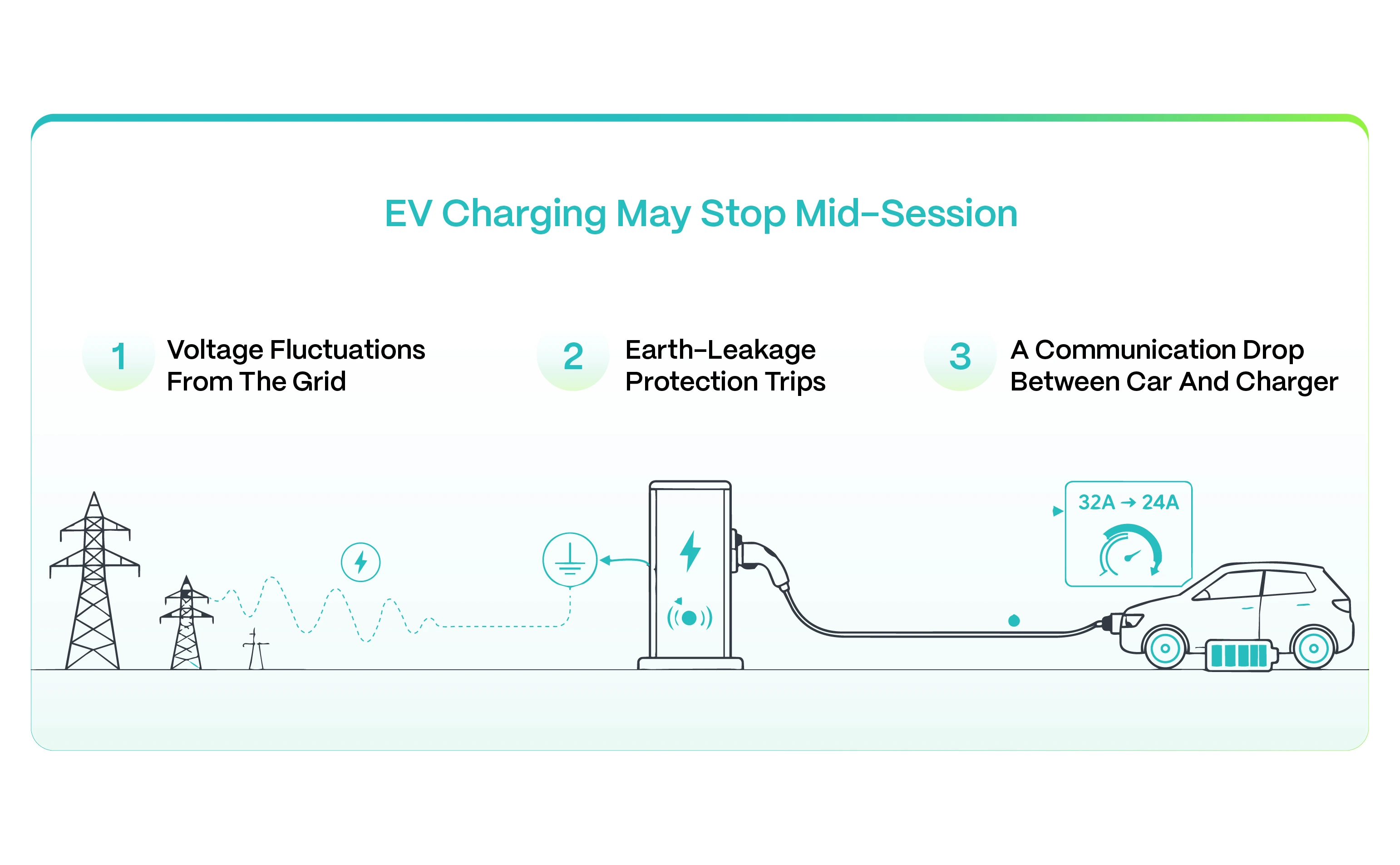
Home AC chargers run continuous safety checks in the background. If internal sensors detect electrical conditions outside normal operating limits, the charger cuts power immediately to protect both your vehicle and your home electrical wiring. Here are the three main reasons that may cause a interrupted EV Charging:
Voltage Fluctuations From The Grid
Home power supply in India isn't always steady. A sudden dip or spike in voltage, especially with older wiring or frequent load changes, can be enough to make a charger pause or stop as a protective measure.
This doesn't mean every fluctuation interrupts a session; small variations happen all the time and most chargers handle them fine. But a significant one, the kind you might also notice as lights flickering elsewhere in the house, can be one reason charging stops without warning.
Earth-Leakage Protection Trips The Charger For Safety
Earth-leakage circuits monitor the balance between active phase and neutral lines. If electrical current leaks into the protective earth conductor, the charger shuts down power within milliseconds. Rain moisture inside the charging coupler, wear along the charging cable, or stray current returning through the vehicle can trigger this protective disconnect.
Chargers like the Exicom Spin Air carry internal safety sensors that detect 30 mA AC and 6 mA DC leakage. This cutoff reflects an active safety safeguard designed to isolate electrical hazards, rather than a defect in the charging unit.
A Communication Drop Between Car And Charger
Electricity never flows through a Type 2 connector without continuous coordination. The vehicle and charger communicate constantly through an analog signal line called the Control Pilot pin.
If that link is interrupted, even briefly, the session can pause or stop entirely. It might be a loose connector, a software hiccup on either side, or something as ordinary as the cable shifting.
Any of these 3 conditions can stop charging in seconds. The challenge for any driver is figuring out which one took place.
Troubleshooting Most Ev Chargers Is Not Intuitive or Quick
Standard wallbox units offer minimal diagnostic feedback, turning an interrupted charge into time consuming guess work.
Blinking LED Codes Are Hard To Read Without A Manual
Most home chargers communicate faults through LED patterns: a certain colour, a certain number of blinks.
A red light could signal an earth fault with two quick pulses, or an under-voltage condition with three pulses. Unless you keep the printed user manual in your glove compartment, deciphering these blinking patterns takes time. Flashing lights help trained field technicians, but everyday car owners need plain, readable answers.
A Support Call Can Take Days To Resolve A Fault
Calling customer support often brings unexpected delays. You have to describe flashing lights over the phone, while support agents work without any direct visibility into an offline charger.
If phone instructions fail to resolve the problem, the company must dispatch a service technician to inspect your home wiring in person. That leaves you without a working home charger while you wait for a technician to visit.
The worst - A Locked Cable Leaves You Stuck Until Someone Arrives
Type 2 charging cables use an internal motorized pin inside the car's inlet to lock the connector during power transfer.
When power cuts abruptly during an electrical fault, the car's locking mechanism often stays latched. Releasing the plug requires using your car's manual override procedure, which usually involves locating an emergency pull cord hidden behind the trunk liner or wheel arch. Drivers who do not know where this release cord is stored can find themselves stuck waiting for roadside help.
A connected EV charger changes this experience by sending diagnostic information directly to your phone.
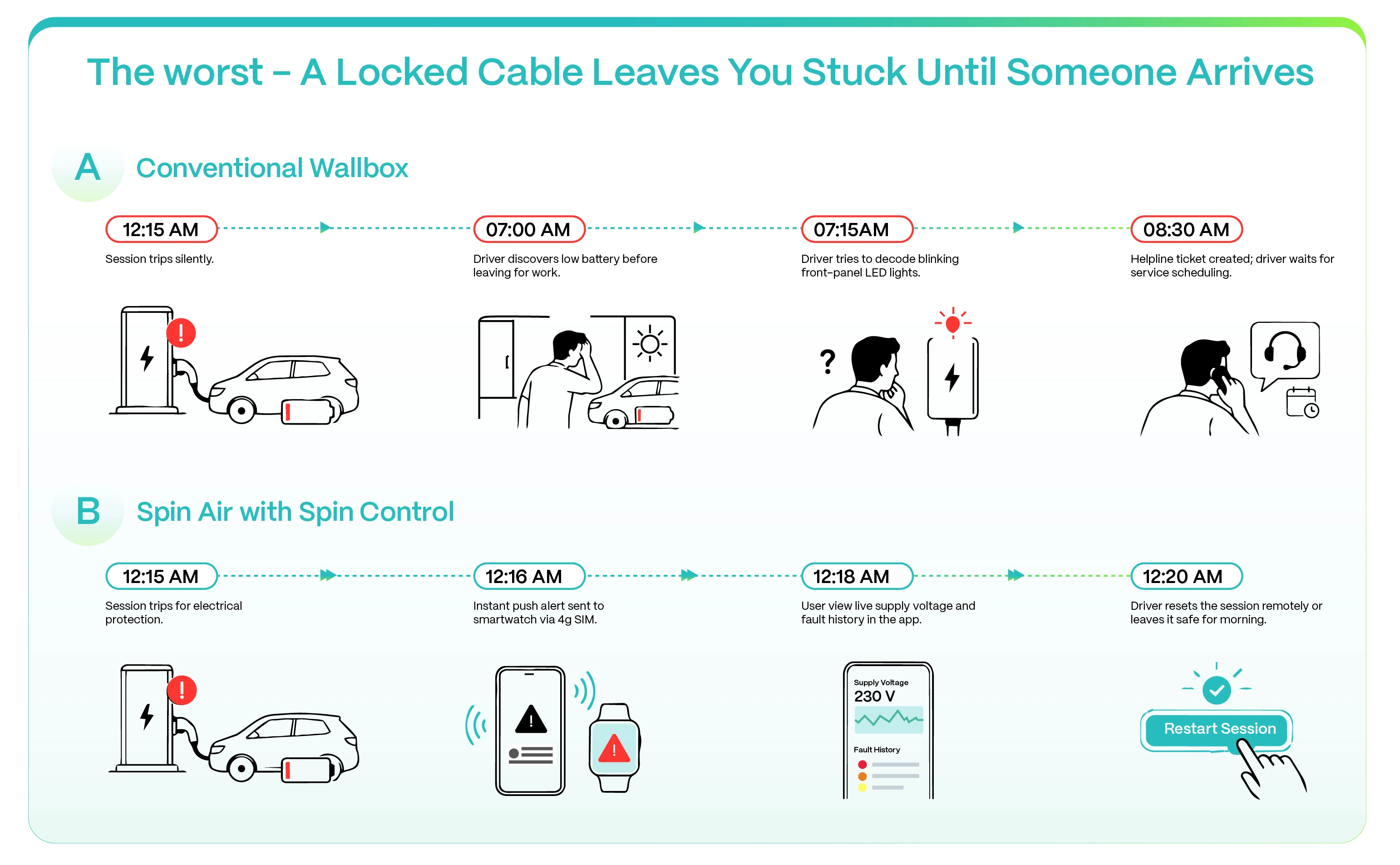
A Smart Connected Charger Doesn't Make You Wait For Customer Support
Connected equipment replaces manual guesswork with clear status updates you can read on your screen.
The Spin Control App Shows Live Status The Moment A Session Stops
Exicom Spin Air works with the Spin Control app,instead of walking down to check the unit in person, you can open the app and see the charging status and session details it has. When charging stops mid-session, you can check live operational status, line voltage, current draw, and exact stoppage times inside the app. This information makes it easy to see whether power cut out due to a local blackout or an active safety trip. The app displays charger-side operating data rather than diagnosing internal car battery sub-assemblies, providing clear visibility over your home charging setup.
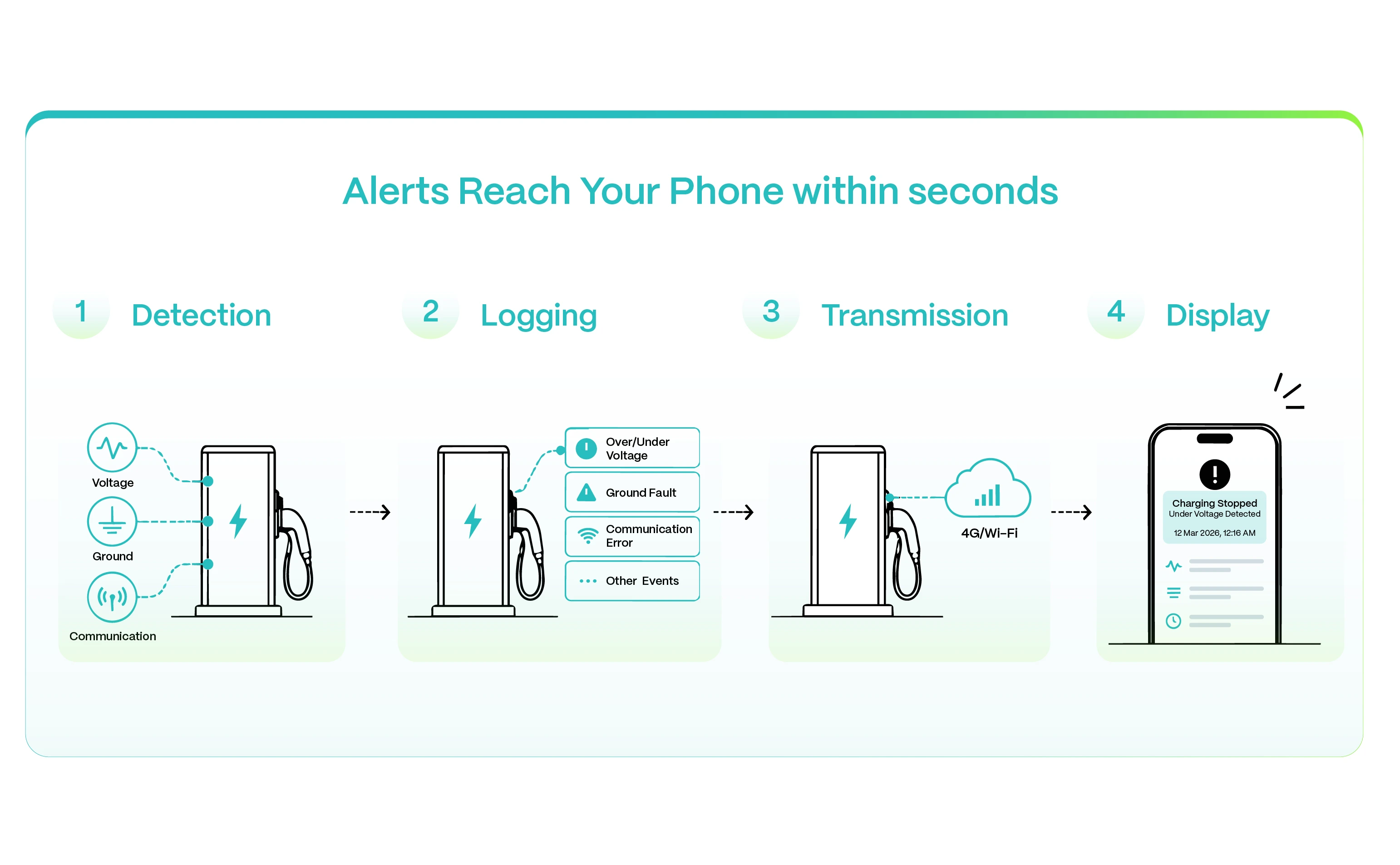
Alerts Reach Your Phone Within Seconds.
Instead of discovering hours later that charging stopped, the app can send you a status alert closer to when it happened. Spin Air includes two years of SIM connectivity, which allows this kind of remote access from outside the home, subject to mobile network availability and successful commissioning. That notice gives you time to reset the charger or plug the car back in before your morning routine begins.
Self-Diagnostics Flag The Part Causing The Fault
Spin Air logs up to 64 distinct alarm states and operational events in its internal memory.
The charger records whether the stoppage stemmed from grid swings, earthing trips, or broken pilot communication. If you contact customer support, the app provides exact event logs. Support technicians can review the data remotely and dispatch an engineer with the correct parts on the first visit.
When an EV charger stops charging at night, having immediate information is what matters most.
A connected charger shows you what happened right away, eliminating the need to decode blinking lights or hunt for emergency release cords. Having clear visibility over every session gives you full control over your daily charging routine, ensuring your car is always ready when you need to drive.
Frequently Asked Questions
Lorem ipsum dolor sit amet, consectetur adipiscing elit, sed do eiusmod tempor incididunt ut labore et dolore magna aliqua. Ut enim ad minim veniam, quis nostrud exercitation ullamco laboris nisi ut aliquip ex ea commodo consequat. Duis aute irure dolor in reprehenderit in voluptate velit esse.
Lorem ipsum dolor sit amet, consectetur adipiscing elit, sed do eiusmod tempor incididunt ut labore et dolore magna aliqua. Ut enim ad minim veniam, quis nostrud exercitation ullamco laboris nisi ut aliquip ex ea commodo consequat. Duis aute irure dolor in reprehenderit in voluptate velit esse.
Lorem ipsum dolor sit amet, consectetur adipiscing elit, sed do eiusmod tempor incididunt ut labore et dolore magna aliqua. Ut enim ad minim veniam, quis nostrud exercitation ullamco laboris nisi ut aliquip ex ea commodo consequat. Duis aute irure dolor in reprehenderit in voluptate velit esse.
Lorem ipsum dolor sit amet, consectetur adipiscing elit, sed do eiusmod tempor incididunt ut labore et dolore magna aliqua. Ut enim ad minim veniam, quis nostrud exercitation ullamco laboris nisi ut aliquip ex ea commodo consequat. Duis aute irure dolor in reprehenderit in voluptate velit esse.
Lorem ipsum dolor sit amet, consectetur adipiscing elit, sed do eiusmod tempor incididunt ut labore et dolore magna aliqua. Ut enim ad minim veniam, quis nostrud exercitation ullamco laboris nisi ut aliquip ex ea commodo consequat. Duis aute irure dolor in reprehenderit in voluptate velit esse.