


Why Uptime Is Not just a “Nice-to-Have” - The Real cost of Downtime

Across charging networks, two stations with the same capacity can deliver very different revenues. Multiple factors like location, demand patterns, and network quality influence performance. However, one of the most critical differentiators is uptime.
As EV charging in India shifts from an installation-led model to a utilization-driven one, the distinction between a charger being installed and actually being available becomes critical. EV charger uptime is no longer a background metric; a charger generates value only when it is available, functional, and dispensing power.
The economics of uptime
Research shows that 72% of EV users face uptime or connectivity issues at charging stations, which erodes trust and reduces repeat footfall. Stations with high uptime can reverse this by delivering consistent experiences and retaining users. This is why uptime is identified as a core lever of operational excellence for CPOs. Uptime directly determines how much of your installed capacity actually converts into revenue. The relationship is simple:
Revenue Loss = (Total Hours × Downtime %) × Sessions per Hour × Revenue per Session
As uptime improves, available hours increase. This directly influences the charging network's profitability.
- Downtime compounding: At scale, uptime gaps multiply. For 100 chargers, 98% uptime results in 17,500 downtime hours annually, while 95% leads to 43,800 hours. Improving uptime recovers these lost hours and stabilizes utilization across the network. Also, with demand concentrated in peak windows, downtime during these periods results in missed sessions that cannot be recovered, directly increasing revenue impact.
- LTV impact: EV downtime impact builds over time through user behavior. If one in five users does not return after a failed session:
Higher uptime protects long-term revenue, not just immediate sessions.
- Fleet stability: Fleet charging reliability depends on predictable availability. Better uptime supports consistent utilization, reduces idle time, and lowers service overhead.
At a system level, the impact becomes more apparent. At 2% utilization, CPOs face negative 69% EBITDA margins. Break-even requires 5% utilization, while viable economics require 12% or higher. Revenue ceilings further constrain the system. Regulatory limits cap service fees at INR 3 to 4 for AC chargers and INR 11 to 13 for DC chargers. This leaves little room to absorb inefficiencies. When uptime drops, revenue cannot be easily offset through pricing.
This is why the downtime cost EV charging networks experience is not limited to missed sessions. It directly affects profitability.
Why uptime gap persist
CPOs already understand the importance of uptime. However, there are certain gaps in infrastructure uptime engineering, especially at the design stage. Thermal stress, grid instability, and component fatigue aren’t always random or standalone events. They are outcomes of how the system is designed, validated, and deployed.
If uptime is treated as a maintenance outcome, failures will continue to surface in the field. If it is treated as a design objective, many of these failures can be reduced before deployment.
How to improve uptime in EV charging networks
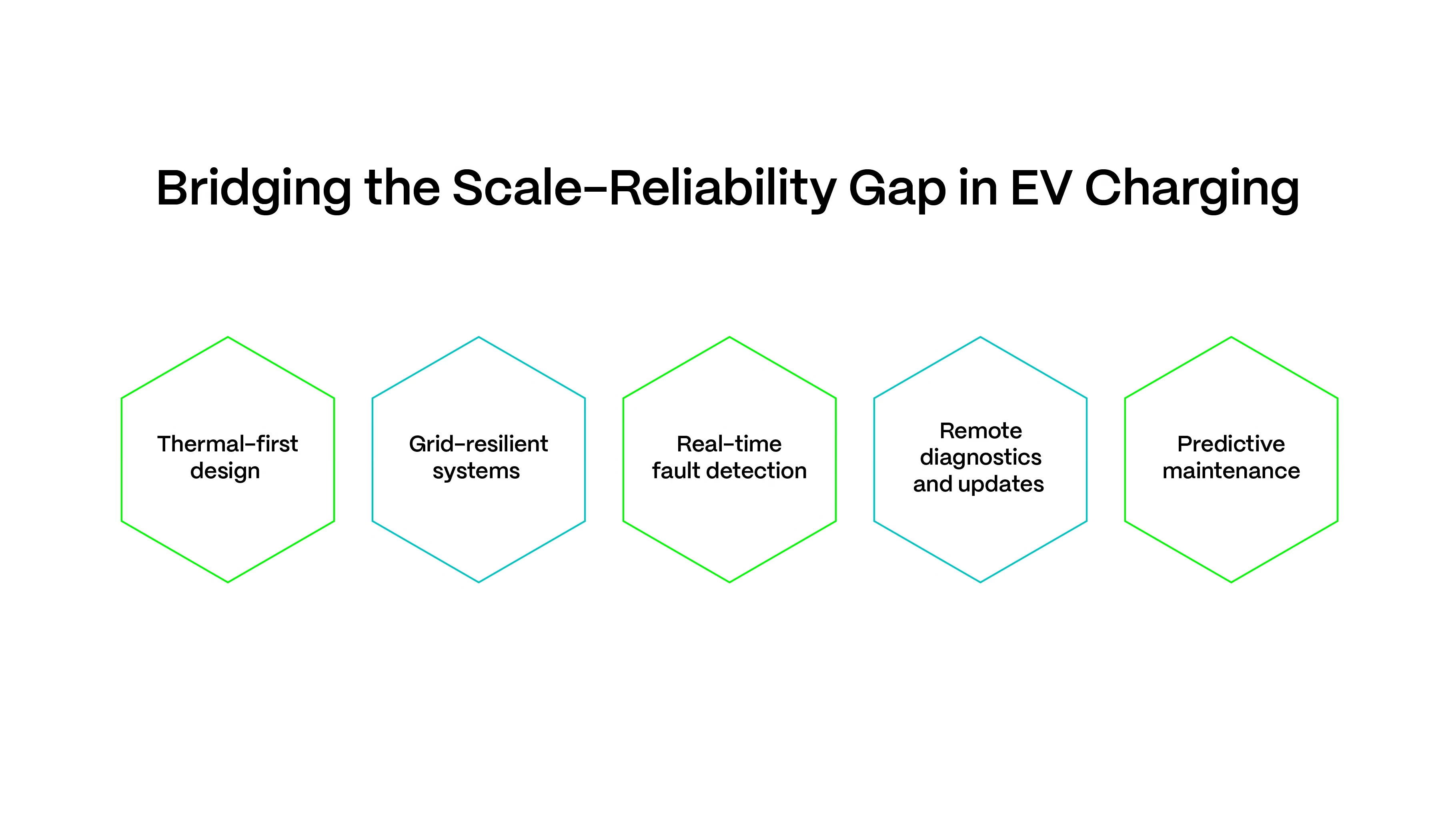
Improving uptime starts at the design stage. The focus shifts from reacting to failures to preventing them.
- Hardware and design: Failures often begin at the hardware level. High-power chargers operate under continuous thermal stress, and without effective thermal management, their components degrade more quickly, leading to instability and downtime. Even simple design interventions, like incorporating shade and passive cooling into station design, have improved performance. One test indicated that with these design changes, EVs charged 15 minutes faster and used 2 kWh less energy per session. Better thermal conditions reduce stress on both the charger and the vehicle, directly improving uptime consistency.
- Grid resilience: Grid-resilient charging systems or even grid-independent solutions can ensure consistent performance even when external conditions fluctuate. Solutions like dynamic power sharing, where available power is distributed across chargers based on real-time demand, help maintain performance without requiring constant infrastructure upgrades. Architectures such as ring topology further support charging network uptime by enabling interconnected chargers to share load and redistribute power based on site demand. In parallel, harmonic filtering and power conditioning help reduce distortion in the supply, protecting power electronics from stress.
- Testing and validation under real conditions: Chargers need to be tested beyond standard compliance. This includes performance under extreme temperatures, voltage fluctuations, and sustained high-load operation. Systems that are only validated under controlled lab conditions may not show consistent, reliable performance in the field.
- Diagnostics and repair: When failures do occur, the speed of recovery becomes critical. This is where charger MTTR reduction (Mean Time to Repair) comes into play. Real-time fault alerts and insights allow issues to be identified immediately. Remote diagnosis and repair capabilities reduce the need for on-site intervention, while remote firmware upgrades ensure systems remain updated without downtime-heavy service cycles. Together, these reduce the time a charger remains unavailable and restore service faster.
- Predictive maintenance: Predictive maintenance EV systems use performance data to detect early signs of failure. Operators can intervene before breakdowns occur, reducing unplanned downtime. Over time, this stabilizes performance across the network. Maintenance can also be further strengthened through (OTA) over-the-air monitoring and updates, improving both uptime and service efficiency.
Factoring uptime into procurement decisions
While we’ve established that the design stage is where uptime is engineered, for CPOs and fleet operators, procurement is where these design decisions are effectively selected. Vendor evaluation often focuses on upfront cost, power ratings, and deployment timelines, but uptime-led factors need to be assessed to ensure long-term performance.
- Prioritize vendors with demonstrated performance at scale. Deployment footprint and uptime track record indicate how systems perform beyond controlled environments.
Uptime depends on how quickly issues are identified and resolved. Systems with continuous monitoring of parameters like temperature, voltage, and fault states enable faster diagnosis and reduce downtime. Remote visibility also supports proactive intervention before failures escalate. - Assess how power is distributed across chargers at a site. Systems that dynamically allocate power based on demand improve utilization and maintain performance under constrained supply conditions.
- Look for evidence of testing under real-world stress. This includes sustained high-load operation, temperature variability, and unstable grid conditions.
- Evaluate how the system is designed to be serviced. Modular components, fault isolation, and field-replaceable parts reduce downtime during repairs. Strong diagnostics, remote monitoring, and OTA updates improve response time and keep systems operational with minimal disruption.
Lifecycle reliability and total cost of ownership of EV charging
Procurement assessment should extend beyond initial capex to include uptime consistency, service frequency, and operational continuity over time.
Lower-cost hardware can result in higher failure rates, increased maintenance needs, and greater downtime. In surveys, hardware issues are among the most cited reasons for unsuccessful charging experiences, and these failures often translate directly into charger downtime. These factors reduce revenue realization and negatively impact EV charger ROI.
When uptime is not factored into procurement decisions, these costs accumulate across the network. What appears as a lower upfront investment often results in higher lifecycle costs, reduced utilization, and weaker overall returns.
Final Takeaway
Uptime directly decides how much your network actually earns. Every drop in uptime reduces utilization, weakens trust, and limits revenue potential. For CPOs, this means that charging network uptime needs to be factored in as an infrastructure decision.
Frequently Asked Questions
Lorem ipsum dolor sit amet, consectetur adipiscing elit, sed do eiusmod tempor incididunt ut labore et dolore magna aliqua. Ut enim ad minim veniam, quis nostrud exercitation ullamco laboris nisi ut aliquip ex ea commodo consequat. Duis aute irure dolor in reprehenderit in voluptate velit esse.
Lorem ipsum dolor sit amet, consectetur adipiscing elit, sed do eiusmod tempor incididunt ut labore et dolore magna aliqua. Ut enim ad minim veniam, quis nostrud exercitation ullamco laboris nisi ut aliquip ex ea commodo consequat. Duis aute irure dolor in reprehenderit in voluptate velit esse.
Lorem ipsum dolor sit amet, consectetur adipiscing elit, sed do eiusmod tempor incididunt ut labore et dolore magna aliqua. Ut enim ad minim veniam, quis nostrud exercitation ullamco laboris nisi ut aliquip ex ea commodo consequat. Duis aute irure dolor in reprehenderit in voluptate velit esse.
Lorem ipsum dolor sit amet, consectetur adipiscing elit, sed do eiusmod tempor incididunt ut labore et dolore magna aliqua. Ut enim ad minim veniam, quis nostrud exercitation ullamco laboris nisi ut aliquip ex ea commodo consequat. Duis aute irure dolor in reprehenderit in voluptate velit esse.
Lorem ipsum dolor sit amet, consectetur adipiscing elit, sed do eiusmod tempor incididunt ut labore et dolore magna aliqua. Ut enim ad minim veniam, quis nostrud exercitation ullamco laboris nisi ut aliquip ex ea commodo consequat. Duis aute irure dolor in reprehenderit in voluptate velit esse.