


Which EV chargers will perform in the EU? Guide for Distributors and Installers
Remember walking into a mobile phone shop back in 2006?
Dozens of handsets lined up the walls, each sporting a slide-out keyboard, a dedicated music dial, or a quirky swivel screen. Pretty quickly, buyers quietly settled on the two or three sensible designs that just worked every single day for years to come.
Across Europe, EV charger distributors and installers are currently working through a similar sorting process.
Smart EV chargers are now non-negotiable In Europe
The European residential charging market transformed permanently when the UK enacted the Electric Vehicles (Smart Charge Points) Regulations in June 2022[1], legally requiring every home EV charger to include data connectivity, off-peak default hours, and randomised delay functions[2]. This meant that every new EV charger had to now be a smart charger, which was unavoidable, given how EV adoption was going across Europe.
Passenger EVs have pushed past 10 million units. Power grids across Europe can't realistically sustain these millions of vehicles pulling 32A loads simultaneously at peak evening hours, which is why smart charging became the logical next step.
Naturally, installation and distribution businesses adapted. Smart charger SKUs became the baseline for legal compliance, grid connection permits, and local subsidy schemes.
Smart EV chargers come with a number of features
Modern home chargers pack plenty of clever tech onto the wall box unit: live tariff tracking, automatic phase switching, RFID locks, and slick mobile apps. Manufacturers love stuffing spec sheets with flashy gadgets to tempt tech-savvy homeowners. It’s almost as if we are spoilt for choice as every EV charger claims a variety of things, some common, some rather unique.
But as an installer or distributor of EV chargers, your business does not live on novelties. It runs on installation speed, zero callbacks, and solid gross margins. The right hardware needs to satisfy the homeowner while actively protecting your bottom line.
5 features are most crucial when it comes to ROI for installers
Smart EV chargers shall continue to increasingly diversify their features to serve end-user needs, but how does an installer triangulate which features to prioritize? We made a list from an ROI standpoint.
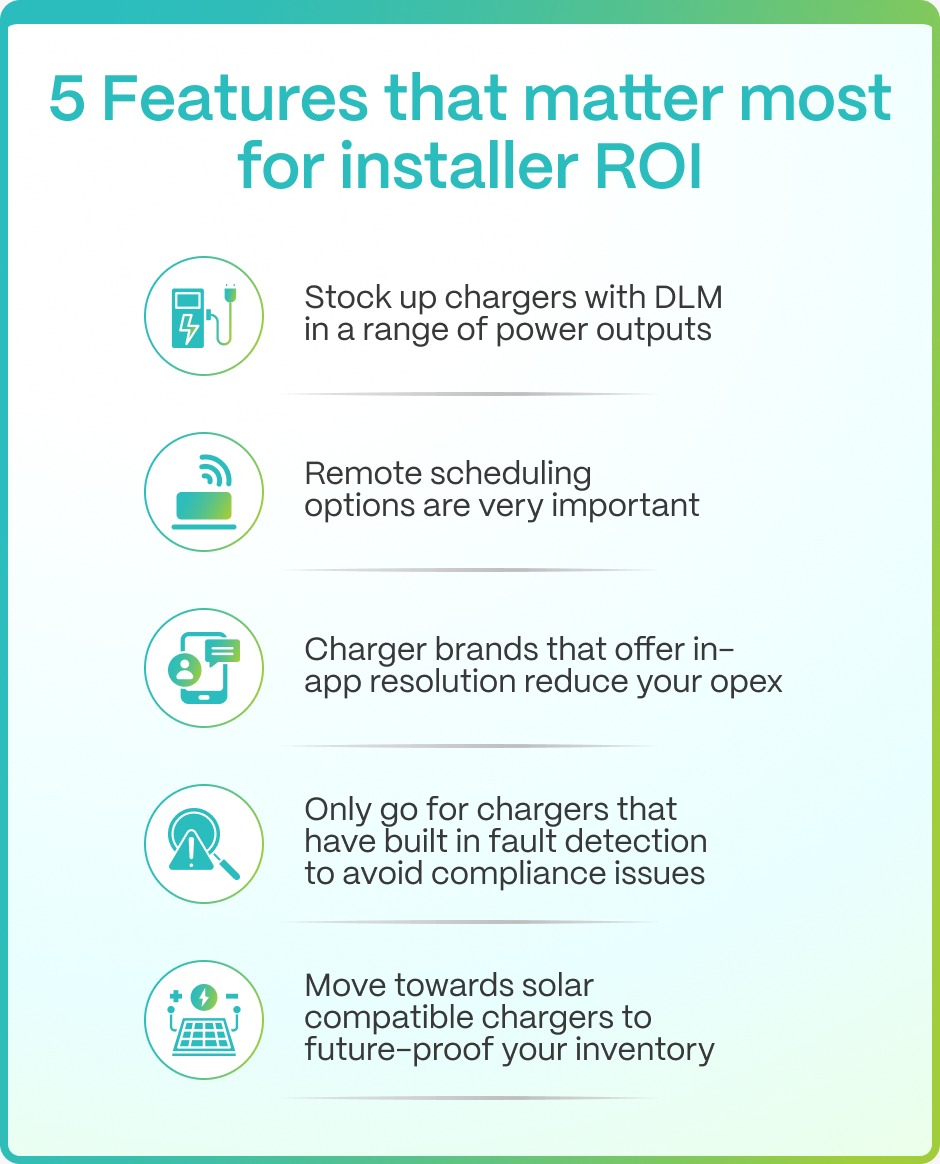
1. Stock up chargers with DLM in a range of power outputs
European domestic electrical supplies vary wildly between territories and individual streets. British homes typically operate on single-phase 60A or 80A main fuses. German, Dutch, and Nordic homes frequently supply 3-phase power capable of supporting 11kW or 22kW charging speeds.
Carrying separate hardware models for single-phase and 3-phase jobs ties up substantial working capital in warehouse stock. Distributors and electrical contractors need EV chargers that covers 7.4kW single-phase - 22kW 3-phase across the same base unit.
But, power demands keep fluctuating throughout the day, and even a 7.4kW EV charger configuration can cause MCB trips if total load is exceeded. This is why even home chargers these days have Dynamic Load Management (DLM). The DLM protects the home from exceeding the sanctioned load. A hardwired current transformer (CT) clamp monitors the real-time amperage of the main incoming cable. When an electric shower, heat pump, or induction hob draws peak current, the EV charger automatically throttles the EV charge rate. The vehicle's charging speed recovers automatically once household consumption drops.
This capability lets your team complete installations in older properties with restricted incoming supplies. You avoid bureaucratic grid upgrade applications with local distribution network operators. Jobs get commissioned on the day, invoices get paid immediately, and your cash flow stays healthy.
2. Remote scheduling options are very important
Energy tariffs dictate consumer charging habits across Europe. Variable tariffs in the UK, Germany, and the Netherlands offer night rates at a quarter of the peak daytime cost. Homeowners want their EV charger to handle these price windows automatically.
Hardware with built-in remote scheduling gives customers direct control over charging schedules through their smartphone. The user inputs their electricity tariff hours once, plugs in their car when arriving home, and walks inside. The system holds the charge until the off-peak tariff window opens.
Electric car onboard software frequently goes to sleep during delayed charging sessions, causing skipped charges and early-morning customer complaints. Reliable scheduling software inside the charger delivers dependable overnight charging cycles. Your technicians focus entirely on fitting new domestic units, avoiding call-outs from drivers with empty batteries. Apps with remote overrides give users immediate flexibility if they need an unexpected midday top-up, switching into full-power mode without altering the stored weekly economy schedule.
3. Charger brands that offer in-app resolution reduce your opex
A second van visit to a completed job destroys your profit margin. Fuel costs, technician wages, and lost installation revenue add up to over <£180> every time a van rolls back to investigate a nuisance fault.
Most domestic support tickets stem from simple operational snags. Homeowners change their home Wi-Fi password, experience a temporary broadband drop, or misread a flashing status LED.
Charger manufacturers with comprehensive in-app self-resolution tools shift simple troubleshooting directly to the homeowner. The mobile application walks the customer through Wi-Fi reconnection, network resets, and Bluetooth pairing via step-by-step prompts.
Clear diagnostic feedback translates technical fault codes into practical user advice. The customer resolves minor connection drops in 2 minutes without logging a support ticket.
Built-in network diagnostic tools within the mobile app test local Wi-Fi signal strength at the EV charger’s location. This lets customers identify dead zones and reposition their domestic mesh extenders before blaming the EV charger’s hardware. Keeping your qualified electricians focused on billable installation work protects your operational margins across the fiscal year.
4. Only go for chargers that have built in fault detection to avoid compliance issues
Safety regulations create significant physical labour and hardware expenses if your equipment lacks integrated protection. For eg, British Standard BS 7671 requires dedicated protective multiple earthing (PME) fault detection for outdoor charging points connected to standard TN-C-S[3] electrical networks.
External open-PEN detection devices require extra wall enclosures, additional cabling, and extended labour time. Sinking a physical copper earth electrode[4] into a finished paved driveway requires extra installation steps and carries the risk of puncturing hidden underground utilities. Wall box units with integrated open-PEN fault protection disconnect all live conductors and the protective earth conductor within milliseconds of detecting a voltage anomaly. The entire safety mechanism sits inside the casing.
EV chargers with internal 6mA DC leakage detection provides an equal financial advantage. It prevents DC fault currents from blinding the home's main upstream electrical protection. Installers can fit a standard, economical Type A residual current device (RCD)[5] in the distribution board. You save £80 to £120 on switchgear materials on every single job while guaranteeing full regulatory compliance.
5. Move towards solar-first chargers to future-proof your inventory
Domestic solar panel adoption continues to climb steadily across Western and Northern Europe. Installing a solar-ready EV charger gives homeowners the ability to charge using 100% self-generated green electricity during peak daylight hours. While most smart chargers are solar-compatible, they do not necessarily prioritize solar, and draw from whichever power source is available.
A solar first charger actively tracks the home's real-time energy production using a CT clamp or direct inverter integration. It monitors the exact amount of surplus electricity destined for grid export and adjusts the vehicle's charging speed to match that specific kilowatt figure. EV drivers are actively seeking chargers that allow them to maximize their savings. By going for not just solar-first, and not just solar-compatible EV chargers, an installers enables the most economic option for customers, which translates to long term business gains.
This brings us to the ideal hardware choice for forward-thinking European installers: the Exicom Spin Air.

Home EV charging
Where the Exicom Spin Air fits
The Exicom Spin Air covers most of this checklist on one platform.
Download the Spin Air datasheet (PDF)Explore Exicom Features
- Power range 7.4 kW single-phase, and 11 kW or 22 kW three-phase. The 22 kW model can also run on a single-phase supply, derated to 7.4 kW.
- Load management Dynamic load curtailment, plus a manual maximum load limit you can set in 1 A steps through the Spin Control app. The SpinNet option adds load sharing across up to 31 chargers.
- DC fault protection Integrated 6 mA DC detection (to IEC 62955) and 30 mA AC residual current detection, with a Type A RCD recommended upstream.
- Metering and connectivity Integrated MID-compliant energy metering (option), OCPP 1.6J, Wi-Fi, Bluetooth or 4G, and over-the-air software updates.
- Built for outdoor driveways IP66 and IK10 rated, full power from -25°C to 55°C, Type 2 tethered 5 m cable.
- Standards CE; IEC 61851-1, IEC 61851-21-2, IEC 62196-1 and IEC 62196-2.
The Spin Control app lets homeowners manage the charger, set charging schedules for lower-rate electricity, and share access with family.
The Spin Air brings these commercial requirements together into a single hardware SKU. It supports 7.4kW single-phase through to 22kW 3-phase connections, giving you a universal platform for any domestic driveway.
Integrated open-PEN fault protection and 6mA DC[6] detection eliminate the need for earth rods and expensive switchgear, cutting your installation time significantly. The unit includes dynamic load management via CT measurement, native solar diversion capabilities, and precise remote tariff scheduling.
Its companion app, the Spin Control, delivers comprehensive in-app troubleshooting so customers resolve their own network hitches. Stocking the Exicom Spin Air lets you simplify your inventory down to one dependable product line that satisfies current European regulations and future residential energy demands.
Frequently Asked Questions
Lorem ipsum dolor sit amet, consectetur adipiscing elit, sed do eiusmod tempor incididunt ut labore et dolore magna aliqua. Ut enim ad minim veniam, quis nostrud exercitation ullamco laboris nisi ut aliquip ex ea commodo consequat. Duis aute irure dolor in reprehenderit in voluptate velit esse.
Lorem ipsum dolor sit amet, consectetur adipiscing elit, sed do eiusmod tempor incididunt ut labore et dolore magna aliqua. Ut enim ad minim veniam, quis nostrud exercitation ullamco laboris nisi ut aliquip ex ea commodo consequat. Duis aute irure dolor in reprehenderit in voluptate velit esse.
Lorem ipsum dolor sit amet, consectetur adipiscing elit, sed do eiusmod tempor incididunt ut labore et dolore magna aliqua. Ut enim ad minim veniam, quis nostrud exercitation ullamco laboris nisi ut aliquip ex ea commodo consequat. Duis aute irure dolor in reprehenderit in voluptate velit esse.
Lorem ipsum dolor sit amet, consectetur adipiscing elit, sed do eiusmod tempor incididunt ut labore et dolore magna aliqua. Ut enim ad minim veniam, quis nostrud exercitation ullamco laboris nisi ut aliquip ex ea commodo consequat. Duis aute irure dolor in reprehenderit in voluptate velit esse.
Lorem ipsum dolor sit amet, consectetur adipiscing elit, sed do eiusmod tempor incididunt ut labore et dolore magna aliqua. Ut enim ad minim veniam, quis nostrud exercitation ullamco laboris nisi ut aliquip ex ea commodo consequat. Duis aute irure dolor in reprehenderit in voluptate velit esse.
.webp)