



A hardware module that detects smooth residual DC of 6 mA or above on an AC charging circuit and initiates removal of supply, helping prevent DC current from impairing upstream residual-current protection.
Connected EV Chargers Are Redefining the EV Ownership Experience
Sep 2, 2026
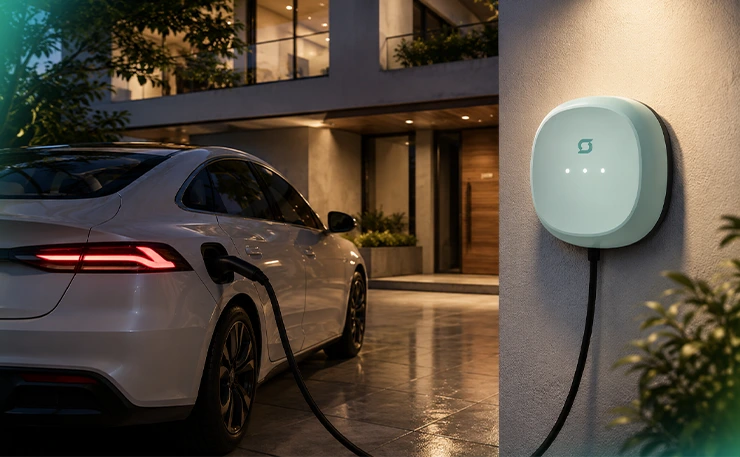
For network operators, reported uptime is often an illusion that hides real session failures. With hardware performance converging across suppliers, long-term customer trust is built behind the scenes through automated safety circuits, live telemetry, and predictive software.
In this blog, we look at how live telemetry, internal safety circuits, and connected management software turn standard charger hardware into reliable infrastructure for EVs.
The EV Charger Software Is Becoming The Real Differentiator
Alternating current charging hardware operates on established electrical principles. Silicon carbide switches, copper contactors, and standard Type 2 plug outputs deliver similar energy conversion efficiency across equipment suppliers.
A standard 22 kW AC charger draws 32 amperes per phase across a 400 V three-phase supply line. The physical power output follows basic AC circuit math:
Because AC chargers route grid power directly into the vehicle's onboard charger, physical contactors set the hardware baseline.
Real differences in station performance come down to how central software handles messaging over Open Charge Point Protocol (OCPP 1.6J).

Standard network uptime measures whether a charger's cellular modem answers a basic server ping. That simple modem check ignores broken plug latches, internal ground leakage trips, and high internal cabinet temperatures. Operational software controls actual network revenue, equipment lifespan, and driver retention.
Data Moves From Backend Metrics To Front-Facing Customer Trust
Driver trust depends directly on charger availability. The J.D. Power 2026 Public Charging Study recorded a 12% failed visit rate across locations, with physical equipment breakdowns causing 60% of those non-charging visits. When drivers run into broken stations, they post low ratings on navigation apps and avoid those locations on future trips.
Live telemetry streams collected by our Remote Management System turn hardware logs into visible site reliability. Reading equipment metrics every 10 seconds allows our software engines to catch electrical drift before a charger shuts down.
Our Remote Management System tracks core operational parameters across every deployed plug:
- Line voltages operating within nominal 90 Vac to 265 Vac bounds.
- Internal cabinet temperatures nearing the 55°C operating limit.
- Earth leakage current reaching 30mA AC or 6mA DC limits.
- Packet latency across TLS 1.2 encrypted connections.
Integrated Hardware Protection (RDC-DD) Generates Critical Telemetry
Direct current ground faults need active protection. When direct current leaks into the earth line from vehicle power electronics, continuous DC current blinds standard AC circuit breakers by saturating their magnetic coils.
We build Residual Direct Current Detecting Devices (RDC-DD) directly into our charging hardware. This internal safety module continuously monitors DC ground leakage by checking current vector sums:
When DC leakage hits 6mA, the internal RDC-DD trips the circuit within milliseconds. This isolates the fault locally, stopping upstream house or site breakers from tripping and keeping the rest of your facility powered.
Capturing hardware safety events in real time bridges the gap between electrical protection and user experience. Instead of waiting for a driver to plug in and face an unexplained error, the central platform already knows the unit’s operational state, allowing automated algorithms and support tools to step in instantly.
AI Chatbots And Predictive Support Convert Telemetry Into Driver Trust
Predictive RMS software continuously analyzes incoming hardware telemetry to identify patterns before failures occur. When an internal temperature sensor detects elevated cabinet heat or line voltage instability, predictive algorithms trigger an automated soft reset or throttle output power to maintain uptime.
AI chatbots and public discovery apps connect directly to these live telemetry feeds. If a connector requires remote servicing, the central management platform updates mapping databases in real time, preventing drivers from navigating an unavailable plug.
When a driver interacts with an automated customer service chatbot during a charging session, the assistant reads real-time diagnostic codes instantly. The AI chatbot can initiate remote cable unlocking, run quick diagnostic checks, or direct the driver to an adjacent operational charger without putting them on hold.
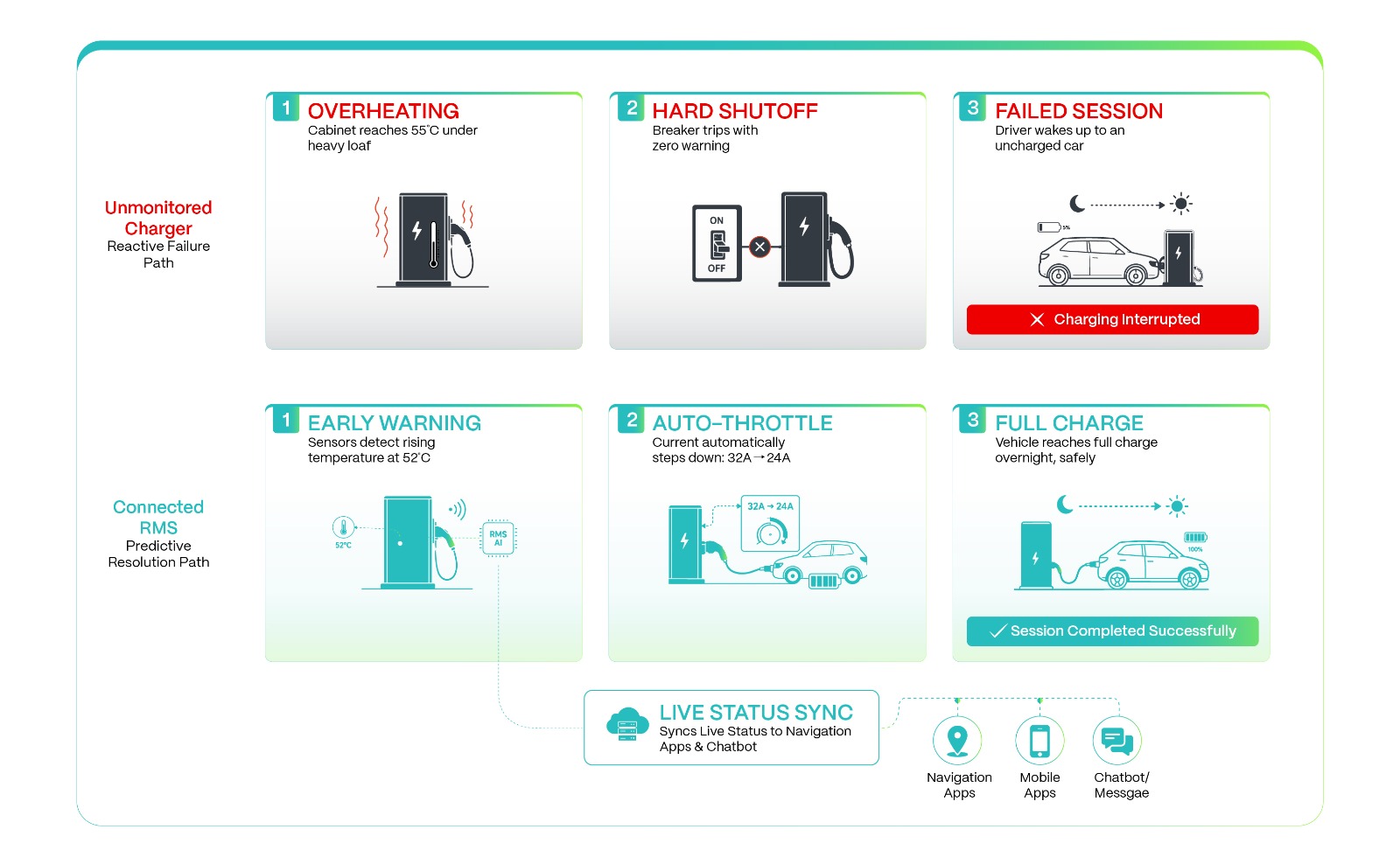
Catching phase voltage shifts and ground leakage trends on a central dashboard gives service crews time to reset units remotely or schedule maintenance before drivers plug in.
The Exicom Spin Air is engineered to bring this exact enterprise-grade telemetry, predictive health monitoring, and grid safety from commercial charging networks directly into private driveways and multi-unit residential complexes.
Spin Air combines intelligent software with intelligent charging
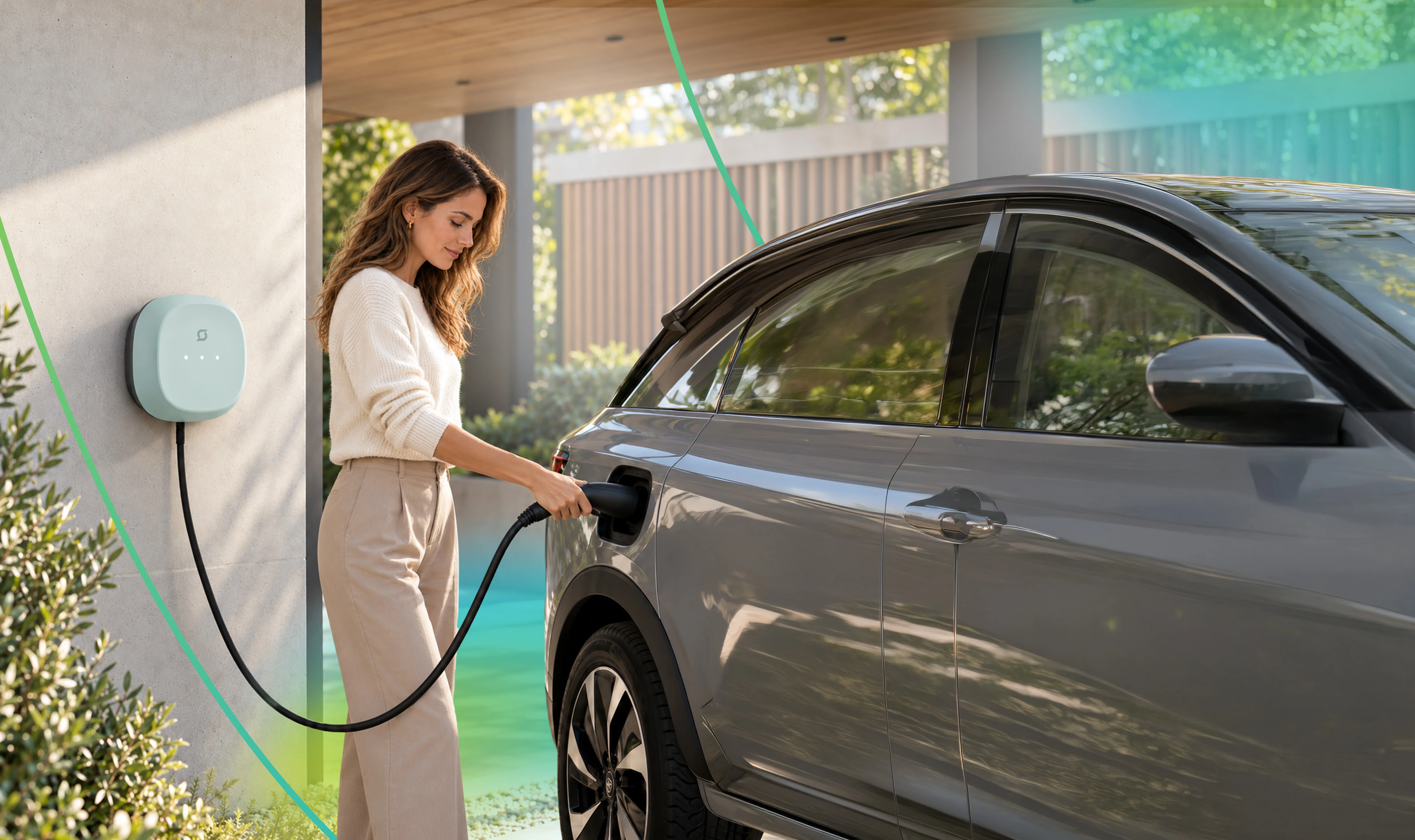
The Exicom Spin Air home EV charger is built to connect sturdy hardware design with live telemetry software. Available in 7.4 kW single-phase, 11 kW three-phase, and 22 kW three-phase options, Spin Air serves residential garages, multi-unit housing, and commercial fleet sites.
The outer shell uses fire-retardant Polycarbonate and ABS composite rated to UL94-V0 safety standards. Built to IP66 weatherproof standards and IK10 impact protection, the casing shields internal electronics across operating temperatures from -25°C to 55°C.
Alongside its rugged casing, Spin Air runs edge-level Dynamic Load Management (DLM) to balance charging output against real-time household appliance demand, ensuring circuits never overload. Inside the casing, the main controller runs OCPP 1.6J over Wi-Fi, Bluetooth, 4G LTE, or Ethernet connections. Integrated safety features include built-in RDC-DD modules sensing 6mA DC and 30mA AC ground faults to meet IEC 62955 standards directly.
One Charger. Smarter Everyday EV Charging.
Explore Spin Air →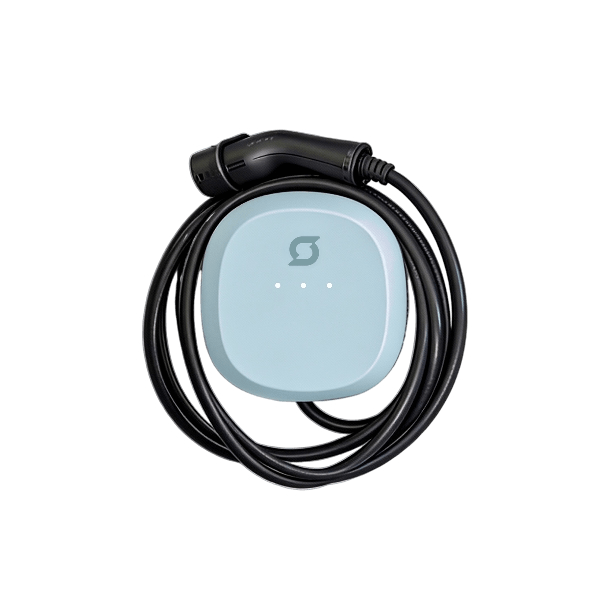
Electric mobility succeeds when drivers plug in at night and know their car will be ready for the morning commute without a second thought.
With over 150,000 installations running across extreme climates, we build infrastructure that handles rain, dust, heat, and grid spikes quietly in the background. Smart telemetry control and hardware protection work together so you wake up to a full battery every single day.
Talk to our team today to see how the Exicom Spin Air brings connected charging home.
Author -
Amrita ParasharShare
Frequently Asked Questions
What does "uptime" actually mean for an EV charger?
Lorem ipsum dolor sit amet, consectetur adipiscing elit, sed do eiusmod tempor incididunt ut labore et dolore magna aliqua. Ut enim ad minim veniam, quis nostrud exercitation ullamco laboris nisi ut aliquip ex ea commodo consequat. Duis aute irure dolor in reprehenderit in voluptate velit esse.
Standard network uptime only measures whether a charger's cellular modem answers a server ping. That check ignores broken plug latches, internal ground leakage trips and high cabinet temperatures. A charger can report 99% uptime while drivers still fail to start a session, which is why reported uptime often hides real session failures.
How does a connected EV charger prevent failed charging sessions?
Lorem ipsum dolor sit amet, consectetur adipiscing elit, sed do eiusmod tempor incididunt ut labore et dolore magna aliqua. Ut enim ad minim veniam, quis nostrud exercitation ullamco laboris nisi ut aliquip ex ea commodo consequat. Duis aute irure dolor in reprehenderit in voluptate velit esse.
A connected charger streams live telemetry to a Remote Management System, which reads equipment metrics every 10 seconds. Predictive algorithms catch electrical drift — line-voltage instability, cabinet heat, earth leakage trends — before a shutdown, then trigger an automated soft reset or throttle output power to keep the unit available.
What is RDC-DD and why does 6mA DC detection matter at home?
Lorem ipsum dolor sit amet, consectetur adipiscing elit, sed do eiusmod tempor incididunt ut labore et dolore magna aliqua. Ut enim ad minim veniam, quis nostrud exercitation ullamco laboris nisi ut aliquip ex ea commodo consequat. Duis aute irure dolor in reprehenderit in voluptate velit esse.
RDC-DD stands for Residual Direct Current Detecting Device. When DC leaks into the earth line from vehicle power electronics, continuous DC current saturates the magnetic coils in standard AC breakers and blinds them. An integrated RDC-DD trips within milliseconds at 6mA DC, isolating the fault locally so the rest of your home stays powered.
How do EV charging apps and AI chatbots know a charger is broken?
Lorem ipsum dolor sit amet, consectetur adipiscing elit, sed do eiusmod tempor incididunt ut labore et dolore magna aliqua. Ut enim ad minim veniam, quis nostrud exercitation ullamco laboris nisi ut aliquip ex ea commodo consequat. Duis aute irure dolor in reprehenderit in voluptate velit esse.
They connect directly to live telemetry feeds from the charger management platform. If a connector needs remote servicing, mapping databases update in real time so drivers aren't routed to an unavailable plug. During a session, an AI chatbot reads real-time diagnostic codes and can remotely unlock a cable or redirect the driver to a working charger.
Lorem ipsum dolor sit amet, consectetur adipiscing elit, sed do eiusmod tempor incididunt ut labore et dolore magna aliqua. Ut enim ad minim veniam, quis nostrud exercitation ullamco laboris nisi ut aliquip ex ea commodo consequat. Duis aute irure dolor in reprehenderit in voluptate velit esse.
.webp)

