


Why Businesses Need Battery Energy Storage for Rooftop Solar?

India's renewable energy transition is entering a new phase. As solar and wind capacity expand, the focus is shifting from generating more clean electricity to ensuring that it is available when required. According to the International Energy Agency (IEA), variable renewable energy sources, primarily solar and wind, are expected to account for approximately 26% of India's electricity supply by 2030, compared with around 14% in 2025.
However, renewable electricity generation does not always coincide with the hours when businesses need power. This creates a growing need for solutions that can store surplus electricity and make it available when generation declines- making battery energy storage for rooftop solar an increasingly vital solution to address this challenge.
India's solar expansion is changing how businesses approach energy
India's installed solar capacity reached 171.05 GW as of 30 September 2026, including 33.41 GW of grid-connected rooftop solar, according to the Ministry of New and Renewable Energy (MNRE). The International Energy Agency (IEA) forecasts that India's solar PV capacity will exceed 350 GW by 2030, representing more than a twofold increase from the current level. Solar photovoltaic (PV) power also overtook hydropower as India's largest source of renewable electricity in 2025.

For commercial and industrial (C&I) battery storage facilities, this expansion creates opportunities to generate electricity closer to where it is consumed. Businesses can use rooftop solar installations to manage electricity expenses, reduce dependence on conventional power sources and increase renewable energy use in their operations. However, the benefits of solar also depend on how well its generation aligns with a facility's electricity consumption. A manufacturing plant operating throughout the day may consume much of its solar generation immediately, while an office or warehouse with different operating hours may have a different consumption pattern.
This raises an important question: how can businesses make the most of their solar electricity when generation and consumption do not always coincide? Increasingly, the answer lies in adopting battery energy storage for rooftop solar in India to capture surplus daytime power for evening and peak-demand hours.
More solar generation does not automatically mean more usable electricity
Solar panels generate electricity during daylight hours, with output generally peaking around midday before declining towards sunset. Business electricity demand, however, does not necessarily follow the same pattern. While a manufacturing facility may consume substantial electricity during the day, warehouses, offices and other commercial facilities may continue operating into the evening.
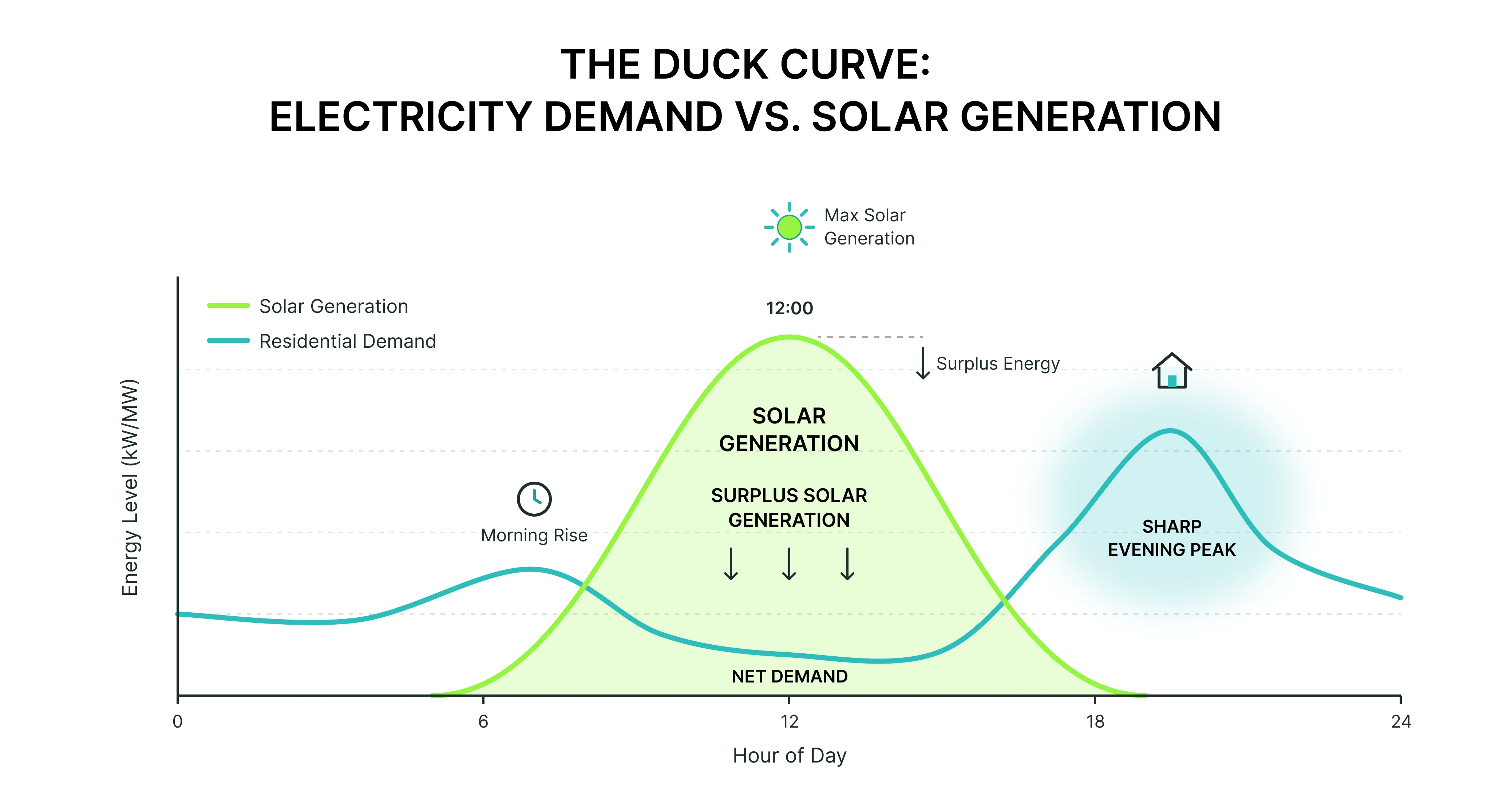
When solar generation declines but electricity demand remains high, businesses may need to draw more power from the grid. This mismatch between electricity generation and consumption is also visible at the grid level, where increasing solar output changes the amount of electricity that conventional power sources must supply throughout the day.
One way to understand this challenge is through the duck curve. It illustrates how strong solar generation can reduce the amount of electricity conventional power sources need to supply during the middle of the day. As solar output falls in the evening, the demand that other sources must meet rises sharply.
For businesses operating during these evening hours, this can mean greater reliance on grid electricity when their solar installations are no longer generating enough power to meet demand.
The timing of electricity consumption can also influence expenses. Under applicable Time-of-Day (ToD) tariff structures, businesses may pay different electricity rates depending on when they consume power. If higher tariffs coincide with periods of low solar generation, the facility may face higher electricity expenses.
Battery storage can help businesses make solar power more flexible like beyond daylight hours
Battery Energy Storage Systems (BESS) offer one way to address the gap between electricity generation and consumption.
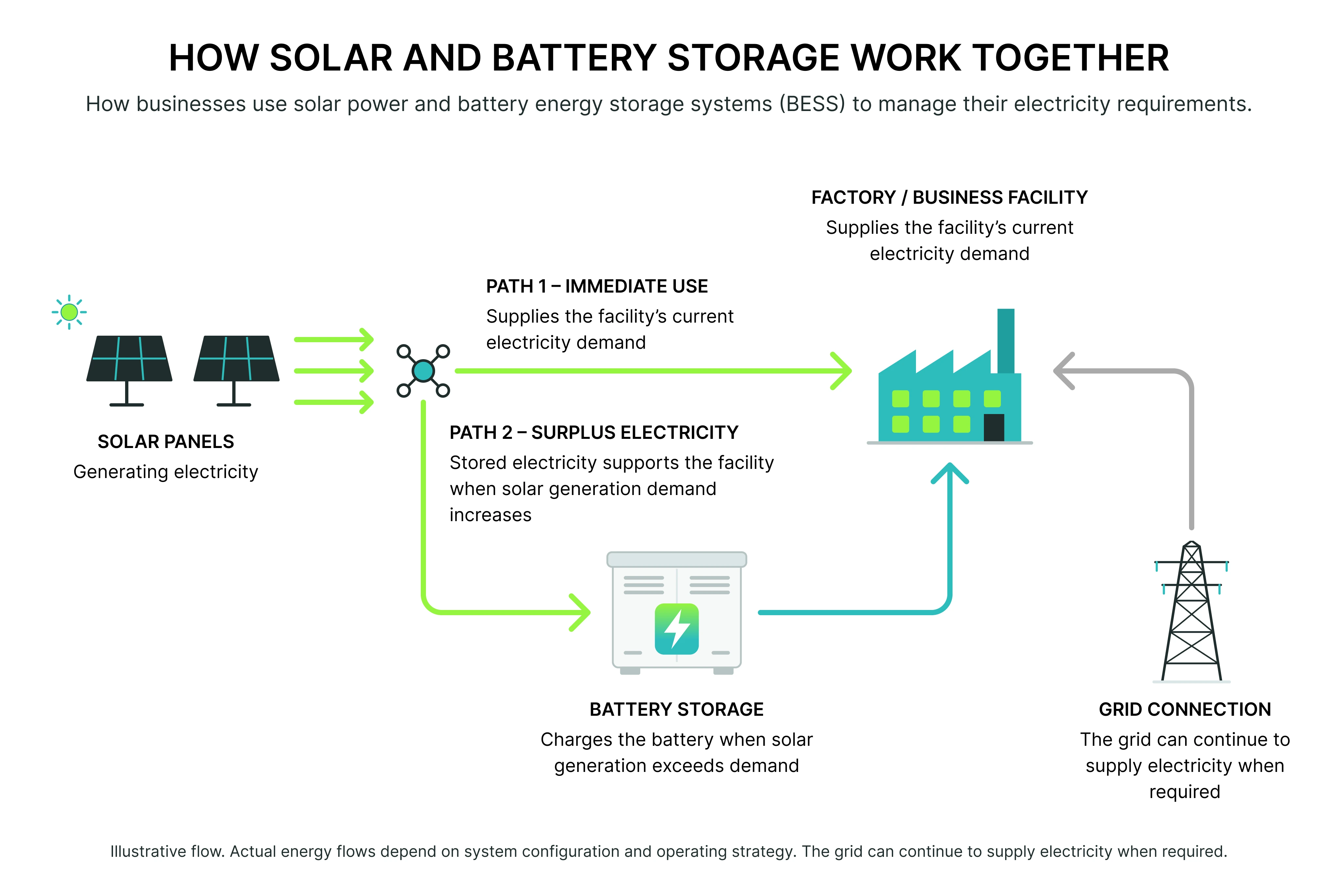
Instead of relying entirely on immediate consumption or exporting surplus electricity to the grid, businesses can store a portion of the excess energy in batteries and use it later.
During the day, solar panels first supply the facility's immediate electricity requirements. When generation exceeds consumption, the surplus can be used to charge the battery. Later, when solar output declines or electricity demand increases, the stored energy can be discharged to support the facility.
This allows businesses to shift some of their solar energy use from one part of the day to another.
By storing electricity for later use, BESS can improve a facility's solar self-consumption - the share of solar electricity generated on-site that the facility uses. It can also reduce the need to draw electricity from the grid during selected periods.
However, battery storage does not return every unit of electricity put into it. Some energy is lost during charging and discharging. The amount of electricity that can be stored and supplied later depends on battery capacity, system efficiency, operating conditions, and the facility's consumption pattern.
A BESS installation must therefore be designed around the business's actual energy requirements, rather than simply choosing a battery with a larger capacity.
Storage can support more than solar self-consumption
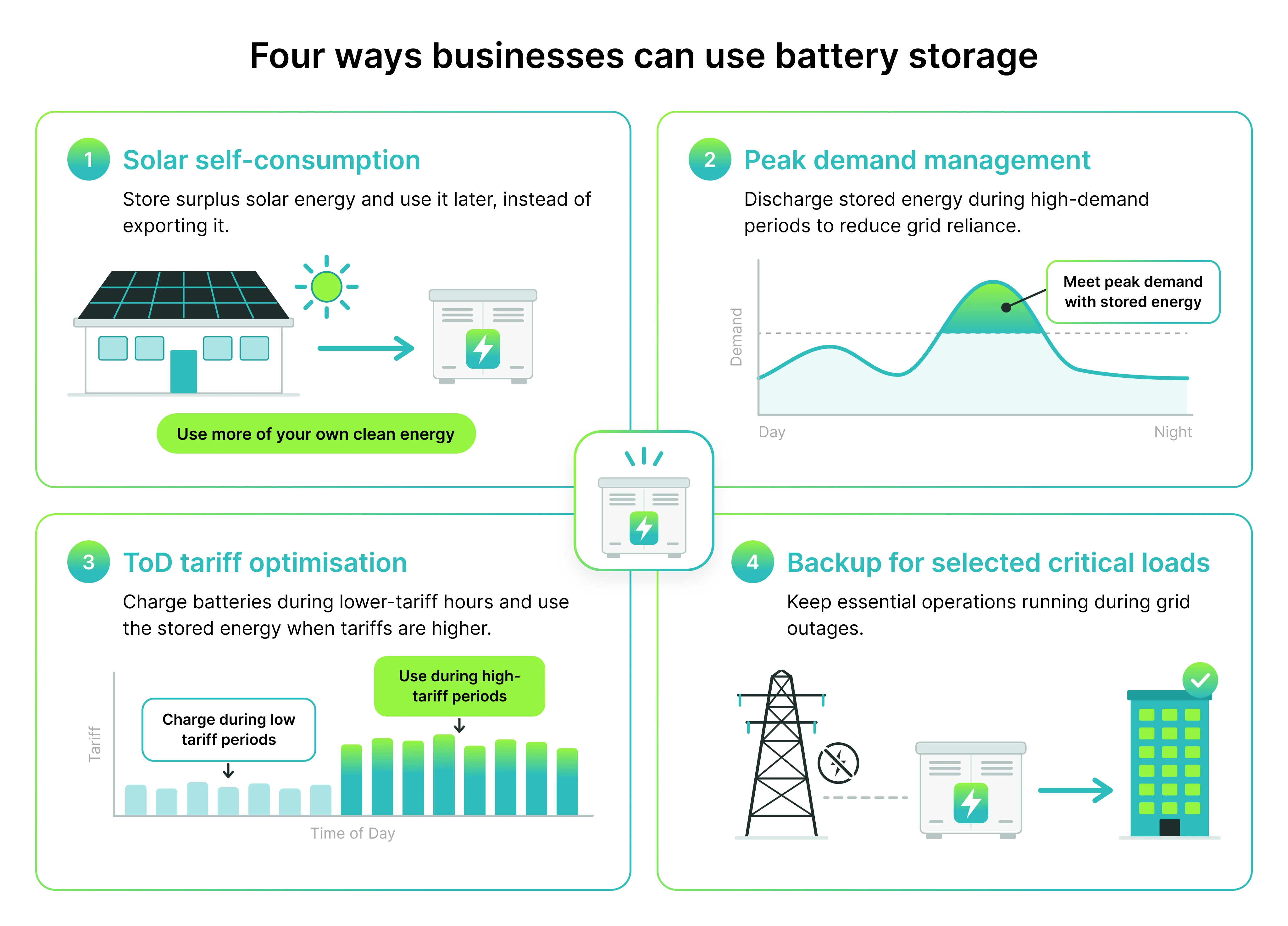
Beyond storing surplus solar electricity, BESS can support several business requirements, from managing peak demand and optimizing electricity costs to maintaining power supply for selected critical operations.
India's growing storage requirements point to a larger shift in energy planning
The need for storage is not limited to individual commercial and industrial facilities. It is also becoming an important part of India's wider electricity planning.
The Central Electricity Authority (CEA) projects a requirement of 47.24 GW of battery energy storage capacity, equivalent to 236.22 GWh, by 2031-32.
These figures represent a projected national requirement, not India's currently installed BESS capacity. They indicate the scale of storage expected to support the country's evolving electricity system.
For businesses, this shift raises practical consideration: as renewable generation expands, energy storage and management will become increasingly relevant to how electricity is supplied, consumed, and balanced.
Investment
However, the growing need for storage does not mean every business requires the same solution. The right system must account for the facility's load profile, solar generation, backup requirements, available space, and financial objectives.
Integrated storage systems bring battery, power conversion and energy management together
Traditional power solutions such as diesel generators and Uninterruptible Power Supply (UPS) systems have long helped businesses address electricity interruptions and maintain operational continuity. However, these solutions generally serve specific requirements, such as supplying backup power or maintaining power to connected equipment during an interruption.
A Battery Energy Storage System can perform a broader energy management role. Rather than functioning only as a backup source, it can store electricity when generation is high or demand is low, supply it when required and coordinate power flows between solar installations, the grid and connected loads. Depending on its configuration, it can also support peak demand management and renewable energy integration.
The difference lies in how the system manages electricity. A BESS is not simply a battery connected to a facility. It combines energy storage, power conversion and control systems that coordinate how electricity is stored, distributed and consumed.
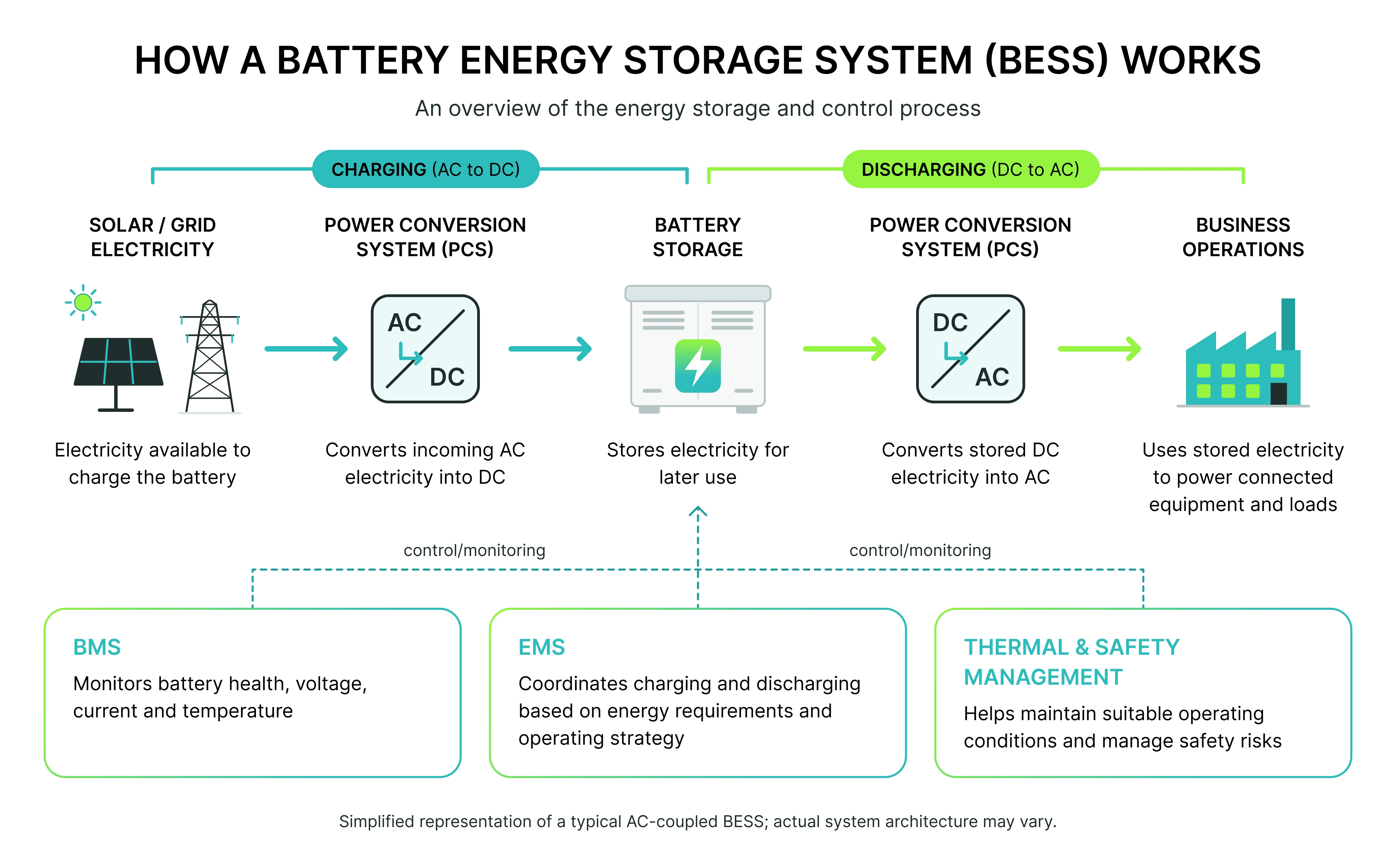
This integration matters because storage performance depends on how these components work together within the facility's electrical infrastructure.
Exicom offers integrated Battery Energy Storage Solutions that combine battery modules, BMS, PCS, EMS, and supporting safety and thermal management systems.
For commercial and industrial applications, its Energy Cube is designed to support requirements such as peak demand management, backup power and solar energy storage. Its Energy Cube All-in-One brings energy storage and power conversion together in an integrated solution.
India's next energy hurdle is getting clean power to the places that need it.
The opportunity, however, is not simply to install more batteries. It is to understand when electricity is generated, when it is consumed, and how storage can make the two works together.
As India's energy mix continues to evolve, businesses will need to look beyond how much electricity they generate and consider how effectively they can manage and use it.
Explore Exicom's integrated Battery Energy Storage Solutions to understand how your business can store, manage and use electricity more effectively.
Frequently Asked Questions
Lorem ipsum dolor sit amet, consectetur adipiscing elit, sed do eiusmod tempor incididunt ut labore et dolore magna aliqua. Ut enim ad minim veniam, quis nostrud exercitation ullamco laboris nisi ut aliquip ex ea commodo consequat. Duis aute irure dolor in reprehenderit in voluptate velit esse.
Lorem ipsum dolor sit amet, consectetur adipiscing elit, sed do eiusmod tempor incididunt ut labore et dolore magna aliqua. Ut enim ad minim veniam, quis nostrud exercitation ullamco laboris nisi ut aliquip ex ea commodo consequat. Duis aute irure dolor in reprehenderit in voluptate velit esse.
Lorem ipsum dolor sit amet, consectetur adipiscing elit, sed do eiusmod tempor incididunt ut labore et dolore magna aliqua. Ut enim ad minim veniam, quis nostrud exercitation ullamco laboris nisi ut aliquip ex ea commodo consequat. Duis aute irure dolor in reprehenderit in voluptate velit esse.
Lorem ipsum dolor sit amet, consectetur adipiscing elit, sed do eiusmod tempor incididunt ut labore et dolore magna aliqua. Ut enim ad minim veniam, quis nostrud exercitation ullamco laboris nisi ut aliquip ex ea commodo consequat. Duis aute irure dolor in reprehenderit in voluptate velit esse.
Lorem ipsum dolor sit amet, consectetur adipiscing elit, sed do eiusmod tempor incididunt ut labore et dolore magna aliqua. Ut enim ad minim veniam, quis nostrud exercitation ullamco laboris nisi ut aliquip ex ea commodo consequat. Duis aute irure dolor in reprehenderit in voluptate velit esse.