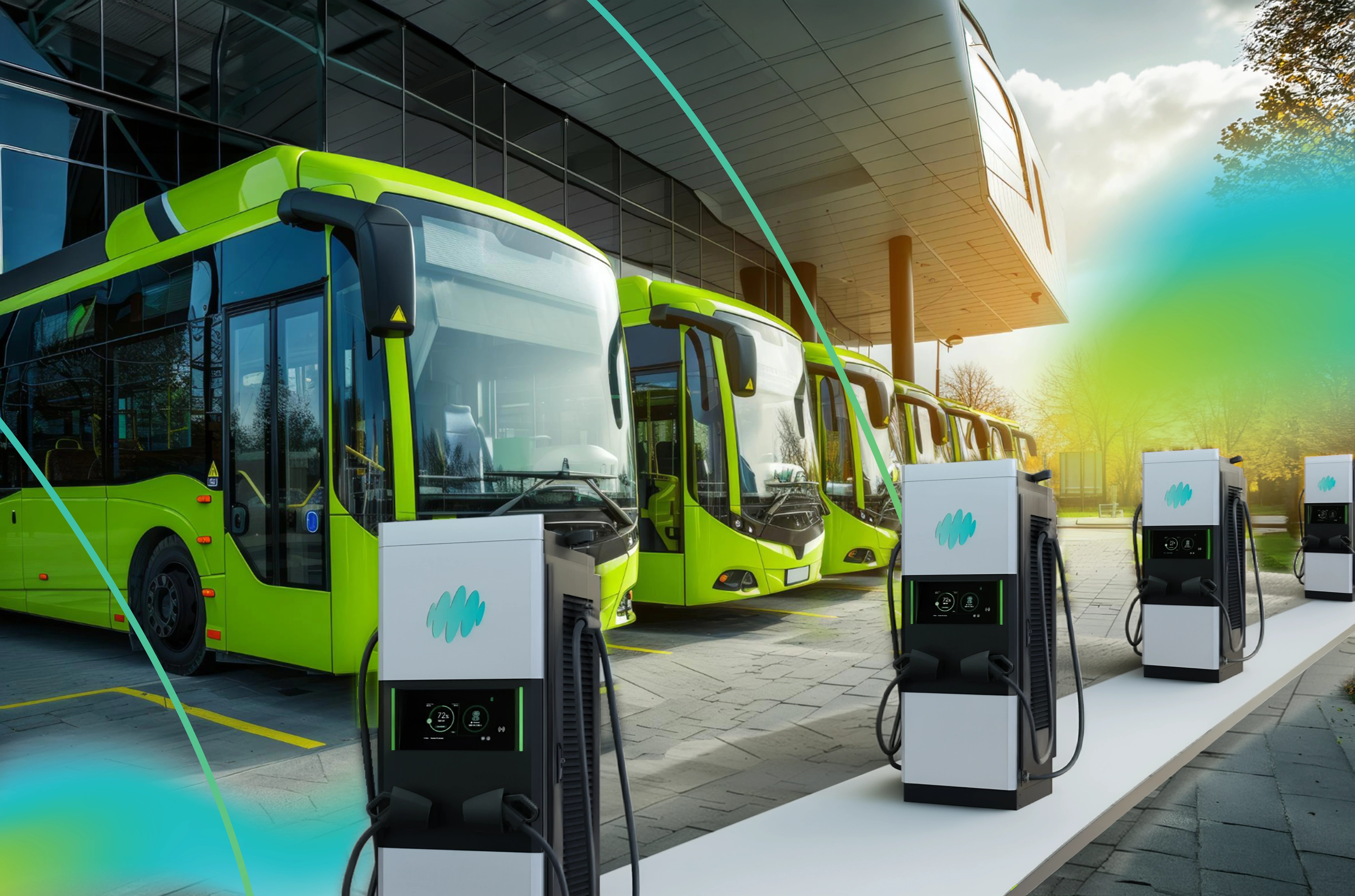



Intelligent Load Management Will Shape the Next Phase of Home EV Charging
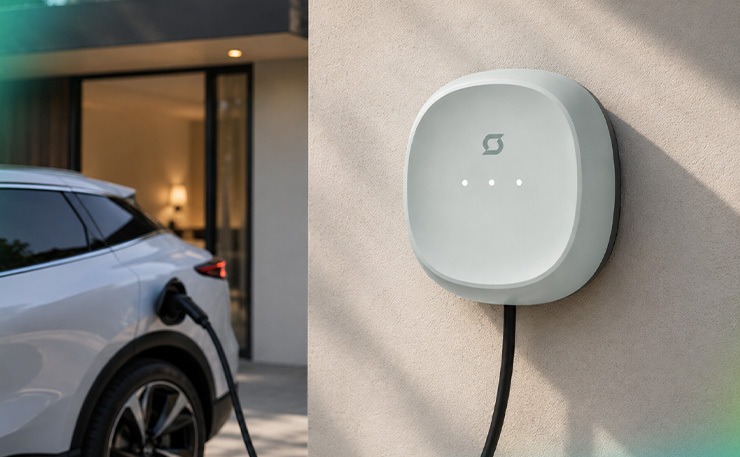
In this blog, we break down why Dynamic Load Management (DLM) is the need of the hour for Indian homes and explore exactly how DLM works behind the scenes to ensure seamless charging
India's Power Demand Keeps Setting New Records
India's power grid operates under heavy pressure every summer. National peak electricity demand reached 270.82 GW in May 2026. Ministry projections show peak demand heading toward 300 GW by next year. Per capita annual electricity consumption jumped 52.6% over the last decade, reaching 1,460 kWh. Rapid urban expansion, heavy manufacturing, and millions of air conditioners running at once drive these surges.
.jpg.jpeg)
India's EV Numbers Are Growing Faster Than Residential Grid Upgrades
EVs add a completely new consumption pattern to residential power lines. Household appliances like washing machines or pumps run intermittently. EVs draw heavy current for six to eight hours straight. In Delhi, total power drawn by charging infrastructure climbed from 24 MW in FY 2018-19 to over 227 MW.
When a driver plugs in a standard 7.4 kW AC home EV charger, it draws between 31.3 A and 32 A of continuous current at 230 V. Multiply that draw across fifty apartments in a single housing complex, and you get severe local grid congestion during evening hours.
In such a scenario, most Indian homes have a sanctioned load of around 5 kW. Adding EV home charging can push the household’s total power demand beyond this limit, increasing the risk of MCB tripping during charging. It isn’t always practical to just get bigger sanctioned loads, given the existing capacity and limitations of the electrical infrastructure.
Bigger Sanctioned Loads Aren't A Scalable Answer
When someone buys an EV, standard advice says to apply to the local utility for a higher sanctioned load. Homeowners apply to increase their connection from a single-phase 3 kW capacity to a 10 kW or 15 kW three-phase setup.
Paper approvals from utility boards do not expand physical copper cables on the street. Residential distribution networks rely on neighborhood transformers rated between 100 kVA and 250 kVA. When ten residents in the same block plug in their cars at 8:00 PM, total demand exceeds transformer limits.
India’s Grid Can’t Upgrade Fast Enough For Home EV Chargers
Upgrading physical distribution networks to match unmanaged charging demand takes immense capital and long lead times. DISCOMs would need to replace neighborhood transformers, dig up streets, and lay thicker feeder cables across every residential sector.
A typical 7.2 kW home installation costs roughly ₹65,000. Expecting utilities and Resident Welfare Associations (RWAs) to double transformer capacities for every building creates an unsustainable financial bottleneck.
So, if upgrading transformer capacity takes years and simply increasing sanctioned loads isn’t practical, how do we manage the growing demand?
The answer is to use the power we already have more intelligently. That’s where Dynamic Load Management (DLM) comes in. It quietly monitors household demand and adjusts the charger’s power in real time.
Let's understand what actually happens behind the scenes of DLM.
What Actually Happens Behind DLM: Step-by-Step
Instead of pulling maximum power indiscriminately, a DLM-enabled system continuously evaluates your main line's capacity and adjusts power intake on the fly.
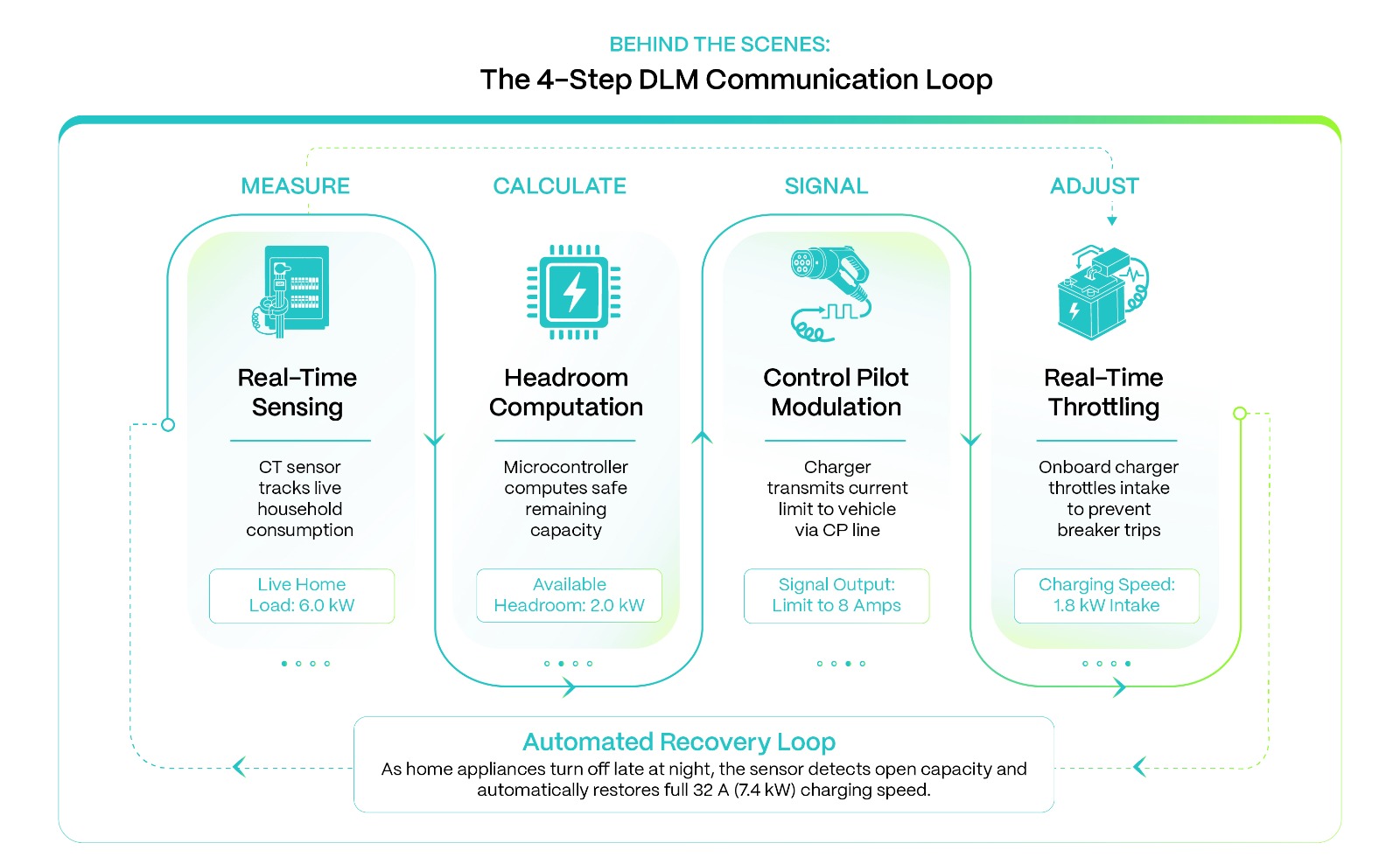
The Steps involved in the working of DLM is as follows:
1. Real-Time Sensing
A Current Transformer (CT) clamp wrapped around the main incoming phase conductor measures total line current via magnetic flux induction. The induced secondary current passes across a precision burden resistor within the charger architecture, producing a proportional AC voltage signal. High-speed sampling via an internal Analog-to-Digital Converter (ADC) calculates the True RMS (Root Mean Square) total domestic current draw ($I_{\text{household}}$).
2. Margin Calculation
3. Control Pilot (CP) Signal Modulation:
The charger regulates vehicle draw without altering supply voltage. It modulates the Pulse Width Modulation (PWM) duty cycle of the 1 kHz, $\pm 12\text{V}$ Control Pilot (CP) signal across the Type 2 interface per the IEC 61851-1 standard. The duty cycle maps directly to allowable current:
Communicating a target current of 8 A requires modulating the CP duty cycle to $13.3\%$. The vehicle's Battery Management System (BMS) and Onboard Charger (OBC) interpret this signal within milliseconds, throttling the AC-to-DC rectifier intake.
4. Automatic Recovery
As household appliances cycle off and domestic load decreases, the CT sensor detects the open capacity. The micro-controller recalculates headroom and steps up the CP duty cycle in discrete 1-Ampere increments. Once domestic demand drops to baseline night levels, the CP line signals full 32 A (7.4 kW) intake, maximizing charging rate while preserving grid integrity.
Intelligent Charging. Within Your Available Load.
Spin Air 2 AC Charger
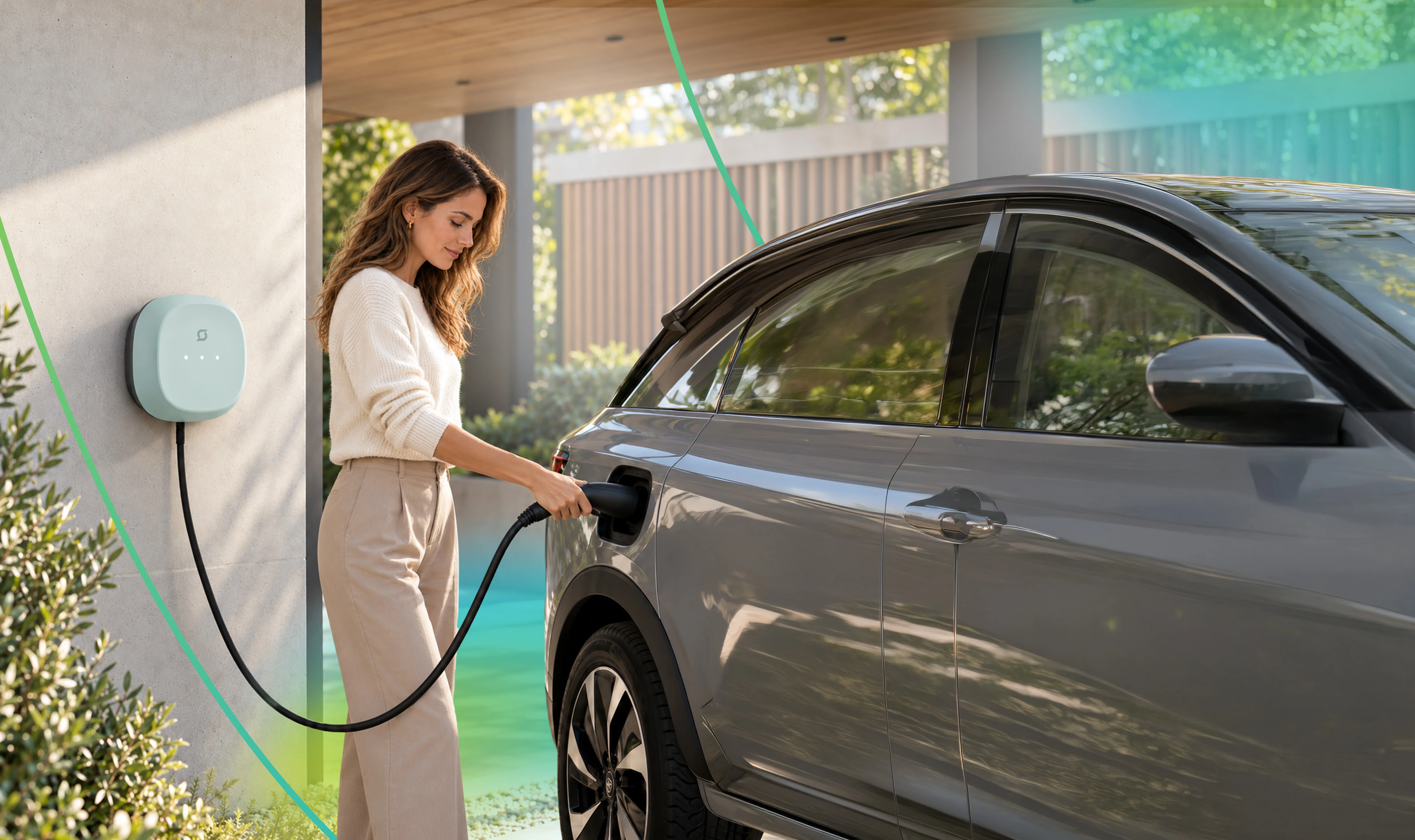
Smart home EV charging with Dynamic Load Management that adapts charging power to available household capacity in real time.
Explore Spin Air 2 →- ✓ Dynamic Load Management
- ✓ 7.4 kW Home Charging
- ✓ Real-Time Load Adjustment
- ✓ Smart & Connected
- ✓ Safe & Reliable
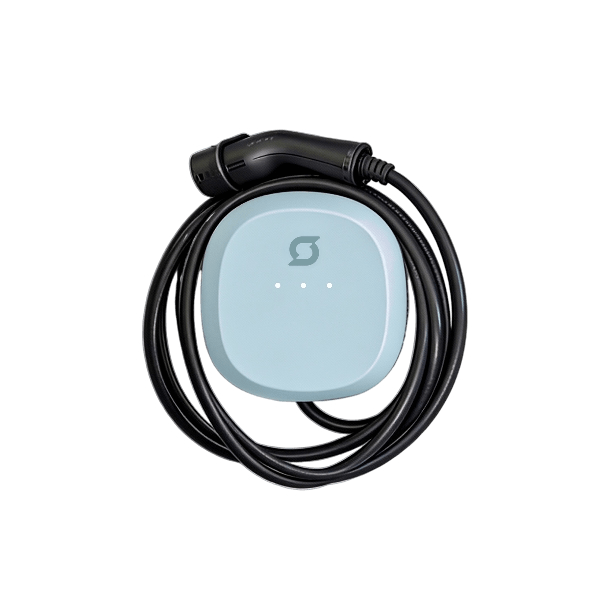
Exicom’s Spin Air Brings Intelligent Charging Into Everyday Homes
Exicom's Spin Air series incorporates Dynamic Load Management (DLM) at the hardware level, available in 7.4 kW single-phase and 22 kW three-phase models with an operating thermal window from -25°C to +55°C.
For multi-dwelling developments and shared basement setups, the proprietary SpinNet protocol enables local cluster load balancing across up to 31 networked chargers via OCPP 1.6J over Wi-Fi, Bluetooth, or 4G modem. This ensures collective concurrent demand remains within designated distribution panel limits without requiring individual utility line upgrades.
Dynamic load management transforms home EV charging from a grid constraint into an intelligent, future-ready energy solution. By pairing real-time edge control with Time-of-Day (ToD) electricity tariffs, Indian households and communities can confidently power the EV transition while ensuring a resilient, balanced energy ecosystem.
Frequently Asked Questions
Lorem ipsum dolor sit amet, consectetur adipiscing elit, sed do eiusmod tempor incididunt ut labore et dolore magna aliqua. Ut enim ad minim veniam, quis nostrud exercitation ullamco laboris nisi ut aliquip ex ea commodo consequat. Duis aute irure dolor in reprehenderit in voluptate velit esse.
Lorem ipsum dolor sit amet, consectetur adipiscing elit, sed do eiusmod tempor incididunt ut labore et dolore magna aliqua. Ut enim ad minim veniam, quis nostrud exercitation ullamco laboris nisi ut aliquip ex ea commodo consequat. Duis aute irure dolor in reprehenderit in voluptate velit esse.
Lorem ipsum dolor sit amet, consectetur adipiscing elit, sed do eiusmod tempor incididunt ut labore et dolore magna aliqua. Ut enim ad minim veniam, quis nostrud exercitation ullamco laboris nisi ut aliquip ex ea commodo consequat. Duis aute irure dolor in reprehenderit in voluptate velit esse.
Lorem ipsum dolor sit amet, consectetur adipiscing elit, sed do eiusmod tempor incididunt ut labore et dolore magna aliqua. Ut enim ad minim veniam, quis nostrud exercitation ullamco laboris nisi ut aliquip ex ea commodo consequat. Duis aute irure dolor in reprehenderit in voluptate velit esse.
Lorem ipsum dolor sit amet, consectetur adipiscing elit, sed do eiusmod tempor incididunt ut labore et dolore magna aliqua. Ut enim ad minim veniam, quis nostrud exercitation ullamco laboris nisi ut aliquip ex ea commodo consequat. Duis aute irure dolor in reprehenderit in voluptate velit esse.
.webp)