


From Rooftop to Driveway: A Practical Guide to Renewable-Integrated EV Charging for Premium Homes
.avif)
In India, the BMW i7 recently crossed the 1,000-unit sales mark, a notable milestone for a single luxury electric sedan in a still-developing EV market. Mercedes-Benz has reported that electric models now account for a growing share of their top-end sales portfolio.
This trend, especially in the luxury segment, pivots not on fuel savings, but on EVs' superior engineering: instant torque from high-density battery packs and axial-flux motors delivering seamless acceleration; regenerative braking systems that enhance efficiency and ride poise; and inherently quiet powertrains with NVH levels far below ICE counterparts, ensuring cabin serenity. Coupled with over-the-air updates for perpetual refinement and battery warranties guaranteeing 70-80% capacity retention over 200,000+ km, EVs redefine long-term value through technological supremacy.
The shift is evident in buyer behavior. Luxury customers are no longer experimenting with electric mobility; they are committing to it.
EVs are becoming popular in India’s premium segment
Electric mobility is steadily gaining ground in India’s premium automotive market. Passenger EV sales reached 1.76 lakh units in 2025, marking a 77% year-on-year increase. The luxury category has moved even faster, with sales rising 66% in early 2025 and more than 2,000 luxury EV units sold within five months. EVs now represent 11% of high-end vehicle sales in the country.
This is no longer an experimental adoption. It reflects structural movement at the top of the market. And when premium buyers adopt electric vehicles, charging becomes part of daily life almost immediately.
In premium housing communities, this transition is unfolding in real time. The garage that once sheltered a petrol or diesel flagship sedan is now home to a high-capacity battery pack on wheels. And that single decision, choosing a premium EV, quietly alters the energy profile of the entire residence.
EV owners frequently charge their vehicles at home
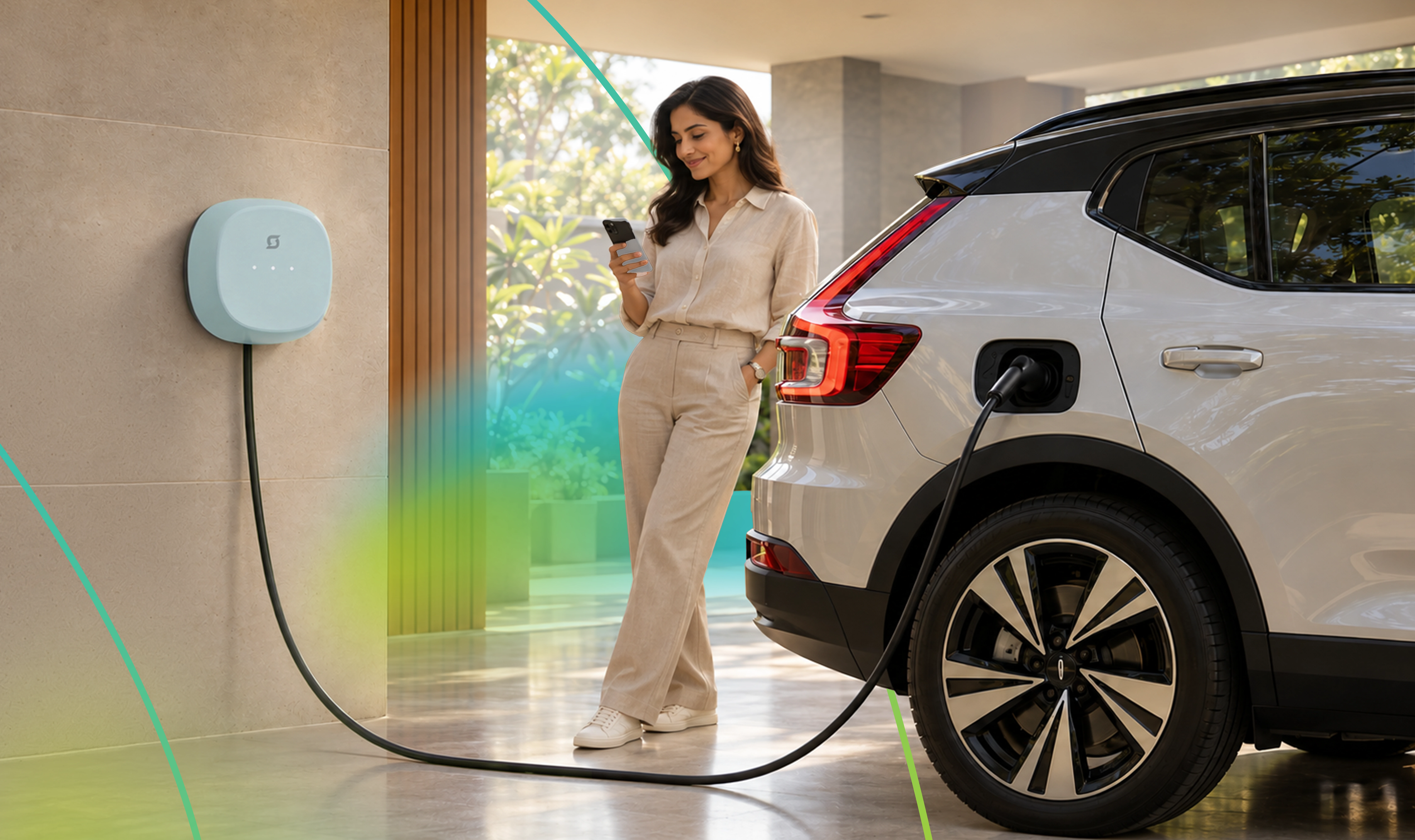
Long-term tracking of EV households indicates that nearly 80% of charging occurs at home, for the simple reason of practicality. Overnight charging fits routines. Since premium villas already have multiple private garages, there’s no lack of space; nor is there a dependency on one single car throughout the day. Home charging is therefore the default choice for this demographic.
But the convenience of home charging also needs infrastructure. A luxury EV may look elegant and understated. The electrical demand it introduces is substantial.
That is when energy management inside the home begins to change.
Energy management becomes complicated in premium homes with EVs
Premium homes already run heavy electrical environments. Multiple air-conditioning systems often operate simultaneously. Kitchen equipment draws concentrated loads during meal hours. Water heating, lighting automation, and entertainment systems overlap in usage.
Introducing a 7.4 kW EV charger into this environment shifts the balance. Empirical smart meter data show that peak-hour demand (generally 6pm to 8pm) increases by 7-14% in homes equipped with in-home EV charging.
On paper, those numbers appear manageable. In practice, they reshape how the home behaves during peak evening hours, when multiple loads converge.
The question is not simply whether the home can draw more power. It is whether it can coordinate when that power is drawn.
Infrastructure strain extends beyond the household
When clusters of premium homes adopt EV charging, the impact extends beyond individual meters. India is projected to require approximately 39 lakh charging stations by 2030. As density increases, unmanaged EV charging can strain local distribution infrastructure.
International grid data shows that rising, uncoordinated demand is increasing outage exposure. EV charging is part of a broader electrification trend, but its timing and intensity can exacerbate existing peak demand in India.
Increasing sanctioned load may address immediate concerns, but it does not automatically solve coordination challenges.
A more resilient approach is to rethink both the source and the management of energy inside the home.
Usage of renewables with battery storage creates higher energy availability
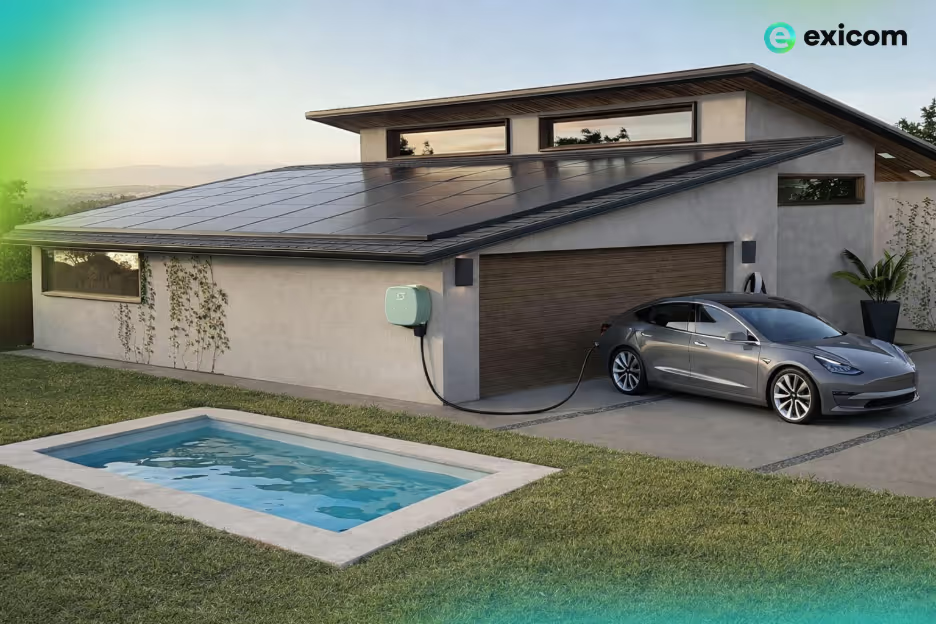
Rooftop solar introduces a structural advantage. A residential photovoltaic system in the 4-10 kW range can generate meaningful daytime electricity. Depending on annual driving distance, between 62 to 90% of EV charging demand can be met through self-generated solar power. Charging an EV with residential solar typically costs $200 to $300 annually, compared with $600 to $700 with grid electricity, and significantly more for petrol vehicles.
This reduces reliance on grid supply and stabilises operating costs.
That’s why, one needs to think of energy management as a whole; as a result of an integrated ecosystem, not some randomly arranged gadgets. A renewable-integrated ev charging ecosystem includes:
- rooftop solar arrays,
- smart EV chargers,
- battery storage,
- grid connectivity,
- the home’s distribution board
Each component has a fairly self-explanatory role. The real complexity lies in how they interact. Without coordination, solar may export excess energy while the EV later draws from the grid. Charging may push total demand beyond comfortable limits during peak hours. Storage may remain underutilised.
Integration is not about adding more equipment. It is about orchestrating what already exists.
DLM is used to coordinate between these systems and sources
Dynamic Load Management introduces that orchestration layer. Instead of treating EV charging as a fixed addition, DLM monitors total household demand in real time and adjusts charging rates accordingly.
Charging becomes responsive to the home’s overall condition.
How does Dynamic Load Management operate?
Consider a home with a sanctioned load of 15 kW drawing 10 kW from household appliances during peak hours. Adding a 7.4 kW charger without DLM would push total demand to 17.4 kW, tripping the main breaker. With DLM, the charger automatically limits its draw to 5 kW, keeping total demand at 15 kW. The EV still charges, but at a modulated rate that preserves household stability.
Load management comparison: 15 kW sanctioned capacity
DLM becomes even more powerful when integrated with rooftop solar systems. The system can prioritize charging the EV when solar generation is high, effectively using free renewable energy. When clouds reduce output, DLM reduces charging draw proportionally. Some implementations allow homeowners to configure whether solar energy should prioritize home loads first or charge the EV.
In an Italian case study, a household driving 25,000 km annually achieved 90% solar self-sufficiency for EV charging during peak solar months (May-August). During winter months (December–February), self-sufficiency dropped to 62%, demonstrating seasonal variation. DLM optimizes this balance automatically.
Dynamic charging algorithms can also limit temperature spikes during high-load sessions. Protecting battery health extends asset life and improves reliability.
So that’s about DLM. What about investing in a dedicated battery storage? Well, battery storage adds resilience in regions with frequent outages or significant time-of-day tariff differences. In stable-grid environments, intelligent load management can provide much of the required coordination without requiring extensive storage capacity. The decision should be grounded in usage patterns rather than assumptions.
Renewable integration with DLM enables long-term scalability of infrastructure
Premium households evolve. Additional vehicles may be introduced. Charging capacity may increase. Solar arrays may expand. An integrated renewable framework accommodates this growth more smoothly than disconnected installations.
A renewable-integrated charging partner has five capabilities
Selecting the right charging infrastructure partner requires evaluating capabilities beyond the charger hardware itself. An integrated system demands coordinated engineering across multiple domains.
Here’s a checklist of essential capabilities:
1. Native Dynamic Load Management support
The charger must incorporate DLM functionality at the firmware level, not as an aftermarket add-on. Native support ensures reliable real-time load monitoring and immediate response to changing conditions.
2. Solar inverter compatibility
The charging system must communicate with existing or planned solar inverters. This enables intelligent scheduling based on available solar generation and seamless handoff between solar and grid power.
3. Real-time monitoring capability
Cloud-connected monitoring provides visibility into charging sessions, power consumption, solar utilization, and system health. Remote diagnostics reduce service response times.
4. Scalable architecture
The system should accommodate future expansion: additional chargers, higher power capacity, and integration with emerging technologies like vehicle-to-home (V2H) bidirectional charging.
5. Local service support
Technical support, installation expertise, and maintenance services must be available locally. Hardware capability means little without responsive service.
It is easy to treat solar panels, EV chargers, and battery storage as separate investments. But the real transformation occurs when they operate under a single, coordinated framework. From rooftop to road, smart energy management is not about adding more components. It is about designing them to work together.
Discover more here.
Frequently Asked Questions
Lorem ipsum dolor sit amet, consectetur adipiscing elit, sed do eiusmod tempor incididunt ut labore et dolore magna aliqua. Ut enim ad minim veniam, quis nostrud exercitation ullamco laboris nisi ut aliquip ex ea commodo consequat. Duis aute irure dolor in reprehenderit in voluptate velit esse.
Lorem ipsum dolor sit amet, consectetur adipiscing elit, sed do eiusmod tempor incididunt ut labore et dolore magna aliqua. Ut enim ad minim veniam, quis nostrud exercitation ullamco laboris nisi ut aliquip ex ea commodo consequat. Duis aute irure dolor in reprehenderit in voluptate velit esse.
Lorem ipsum dolor sit amet, consectetur adipiscing elit, sed do eiusmod tempor incididunt ut labore et dolore magna aliqua. Ut enim ad minim veniam, quis nostrud exercitation ullamco laboris nisi ut aliquip ex ea commodo consequat. Duis aute irure dolor in reprehenderit in voluptate velit esse.
Lorem ipsum dolor sit amet, consectetur adipiscing elit, sed do eiusmod tempor incididunt ut labore et dolore magna aliqua. Ut enim ad minim veniam, quis nostrud exercitation ullamco laboris nisi ut aliquip ex ea commodo consequat. Duis aute irure dolor in reprehenderit in voluptate velit esse.
Lorem ipsum dolor sit amet, consectetur adipiscing elit, sed do eiusmod tempor incididunt ut labore et dolore magna aliqua. Ut enim ad minim veniam, quis nostrud exercitation ullamco laboris nisi ut aliquip ex ea commodo consequat. Duis aute irure dolor in reprehenderit in voluptate velit esse.
.webp)