



Solar EV Charging: Can Solar Power Your Electric Car?
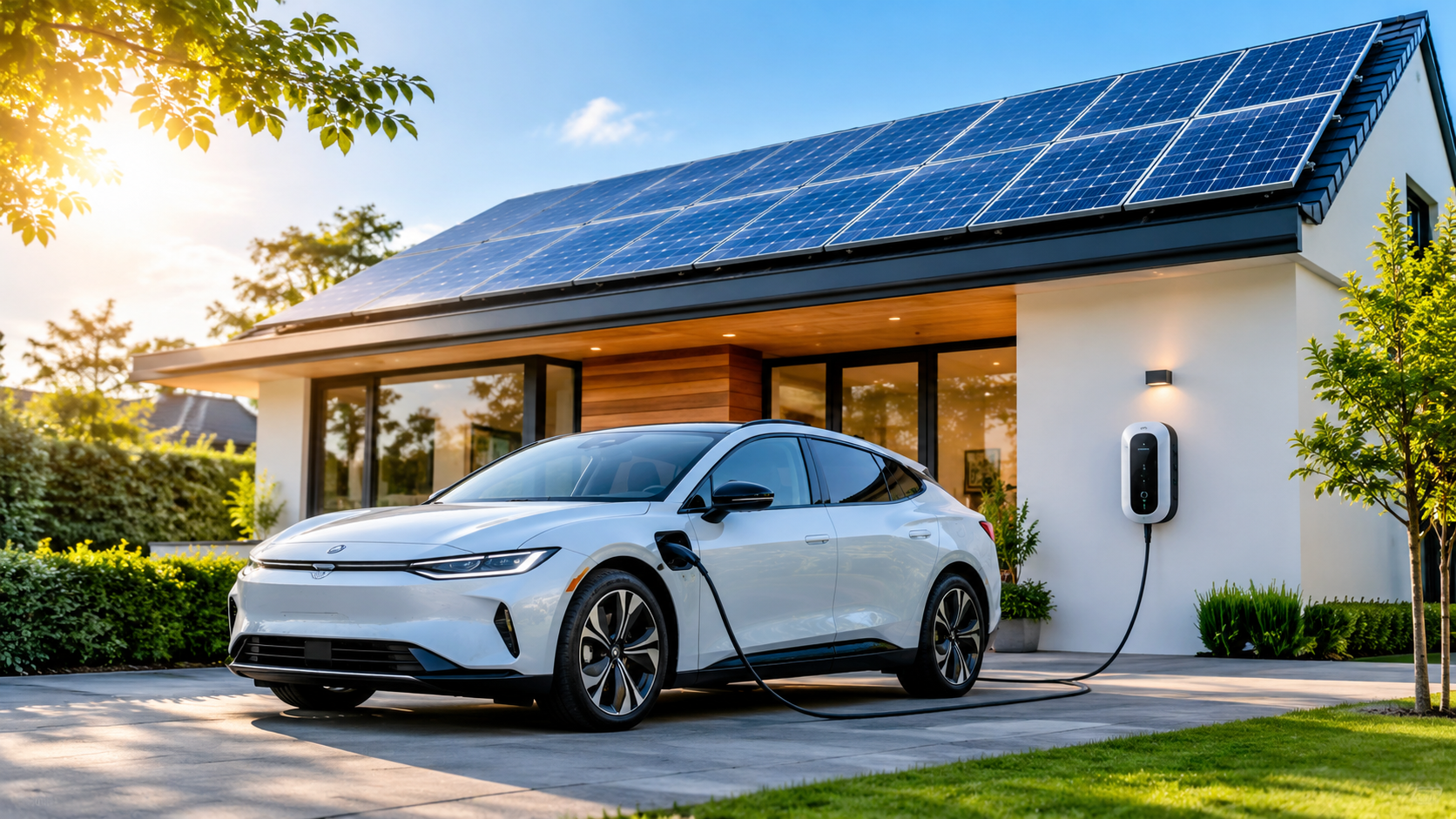
Solar power for EVs seems to be too neat an arrangement. Sun comes on the roof, electrons go from there, fuel the car, and no one pays a power bill. The truth of the matter, however, is that it’s not quite as clean as all that, although it’s certainly a reasonable proposition for many people. So let's take a closer look at how things work.
How solar EV charging really works
Your solar panels produce direct current, while your car battery also produces direct current; however, your car charger is meant for alternating current, just like the one you use at home. Therefore, there will be a need for the inverter, and the charger will also have a lot to do with conversion.
In most homes, the wiring is not wired directly into the car. Your panels are wired directly into the home's system, while the EV charger gets its power from the same source. During sunny days, your panels provide energy for both your house and the car, while on dull days, it is the grid that makes up for the shortage. This is why they refer to it as a system and not a device.
Here's yet another option that isn't used very often. In an off-grid system, solar panels are installed along with batteries and chargers. It requires a lot more money to set up and some calculations, but it works great in places where electricity supply is poor or nonexistent.
How much power does your car actually need?
The consumption of an average electric vehicle will depend on the model and weather. On average, an electric car uses from 15 to 20 kWh of energy during 100 kilometers of travel. Thus, at an average of 40 kilometers of travel per day, the electric car will consume 6 to 8 kWh per day. An average 3 kW rooftop photovoltaic installation will produce 4 to 5 kWh per kW of installation per day in sunny regions.
Therefore, a 3 kW installation will be enough for most of the commuters under optimal weather conditions.
Add the house itself, though, and things shift. Fans, fridge, water pump, television- all of it competes for the same electrons. If you want solar panels for EV charging that also run your home, you'll probably want a bigger system than you first imagined, maybe 5 or 6 kW. Run your own numbers using your electricity bill and your real driving habits. Guessing gets expensive.
The Timing Problem Nobody Warns You About
Here's the catch. Solar makes power at noon, and most people charge at night.
That discrepancy catches out many new customers. You go to work at 9, leave your car parked in an office parking lot, return home at 7, plug it in, and the sun is nowhere to be seen. All that time your panels were generating electricity, but your car was not there to use it.
There are several solutions available. If you work from home or have an irregular working schedule, it is very simple – you just charge your car during the daytime. Otherwise, if it is not possible, you can store the excess amount generated in the afternoon hours in a battery and then use it in the evening hours. Batteries are quite expensive; I will not try to conceal that. However, their price continues to fall every year. Another alternative is net-metering: you give additional electricity to the network during the day and get it back in the evening.
Workplace charging helps too. A solar charging station in an office car park lines up perfectly with daytime demand, since the cars are sitting there precisely when the sun is shining.
Types Of Setups, And Who They Suit
Not everyone needs the same thing. A few common arrangements:
A rooftop array tied to the grid, with a regular wall charger. This is the most popular choice, and for good reason. It's simple, it's affordable compared to the alternatives, and the grid acts as a safety net.
An intelligent solar EV charger that can adjust its speed based on how much energy your panels are generating. The charger monitors your energy generation and changes the charging speed accordingly, thereby helping your vehicle use excess solar energy instead of drawing from the grid. Clever, and definitely worth considering if you have great solar power but limited battery funding.
The carport with the panels integrated into the roof. It gives your vehicle shelter while simultaneously generating power through its own structure. Great choice for when your roof itself is shaded or simply ill-suited for installing panels.
And finally, there’s the standalone solar charging station that is typically installed in public places, on farms, in hotels, or fleet depots. They can be either grid-tied or stand-alone with on-board storage, very useful for areas where it would be very expensive to lay power lines.
What Does It Cost?
Prices swing wildly depending on where you live, so treat any number here as a rough guide.
A residential solar system in many markets runs from a couple of thousand dollars for a small array to well over ten thousand for a large one with storage. A wall-mounted EV charger adds a few hundred to a thousand or so, plus installation. A solar-powered EV charger with built-in smart features sits at the higher end of that range.
Then come the savings. Petrol is expensive. Grid electricity isn't free either. Once your panels have paid for themselves, which often takes five to eight years, the energy that fuels your car costs close to nothing. Panels usually last 25 years or more, so that's a long runway of cheap driving.
Check for incentives too. Many governments offer subsidies, tax credits, or reduced-interest loans for solar installations and home chargers. They change often, so look up what's current in your area rather than trusting an article, including this one.
How Many Panels Do You Need? Panel Size, Roof Space, And Sunshine
The number of panels you need will depend on three main things:
- How much you drive
- How much sun your location gets
- How much roof space you have to work with
A typical modern panel produces around 400 watts. Ten panels would provide you with roughly 4 kW of power. This is small enough to be installed in even the smallest of roof spaces, although tree shadows, water tanks, and neighboring buildings can reduce production considerably. Have an installer conduct an effective site survey for you. This will involve measuring shadowing throughout the year, determining the pitch and orientation of your roof, and being honest about any issues.
Cloudy days still produce power, just less of it. Monsoon months in particular can cut generation by half or more. Plan for that, and don't be surprised when the numbers dip.
Is It Actually Green?
Mostly, yes.
Panels do have a manufacturing footprint, and mining the materials isn't pretty. But over their lifetime, they make far more clean energy than it took to build them, usually paying back that carbon debt within a couple of years. An electric car charged on coal-heavy grid power is cleaner than a petrol car in most cases, and one charged from your own roof is cleaner still.
Recycling matters here as well. Panel and battery recycling is improving, though it's not perfect yet. Ask your installer what happens at end of life, since reputable ones will have a clear answer.
Common Mistakes To Avoid
People trip over the same few things again and again.
They undersize the system. Then they're annoyed when the grid still supplies half their charging.
They ignore the charger's compatibility. Not every wall unit plays nicely with every inverter, and some smart features only work with certain brands. Check before buying.
They skip permits. Local rules on grid connection and electrical work exist for safety reasons, and ignoring them can void your insurance or block your net metering approval.
They buy the cheapest panels without checking warranties. A 25-year warranty from a company that disappears in five years isn't worth much.
And they forget about future needs. Maybe you'll buy a second EV. Maybe your kids will start driving. Leave room to expand the system.
Should You Do It?
Ask yourself a couple of questions. Do you own your own home, or at least have a landlord who will go for it? Does your roof have good sunlight? Do you drive a lot so that savings on fuel are going to be significant? Do you have the possibility to charge your car during daytime hours, or have storage space for batteries if you don't?
If the majority of your answers are 'yes', then this kind of system is the best solution. If several answers are 'no', you might need a smaller setup, or maybe some community solar energy, or even a greener power source for your car provided by the utility.
There is one more piece of advice for you. Ask at least three installers to provide you with three estimates, and ask each one of them to calculate the costs for you, not just give you a total price.
Solar EV charging won't suit everyone, and it won't magically erase every cost. But for plenty of drivers, it turns a car into something that runs on sunlight you already own, and that's hard to argue with.
FAQs
1. What is solar EV charging, and how does it work?
Solar EV charging involves the use of solar-generated electricity for charging an electric vehicle. It could either use the power directly from the solar panels or use the battery or power grid when solar-generated power falls short.
2. Can solar panels be used to charge an EV?
Yes. Solar panels for charging an electric vehicle can produce electricity that can be utilized to charge an electric vehicle through its charger. This system may comprise solar panels, an inverter, a charger for the electric vehicle, and possibly a battery energy storage system.
3. What is a solar charging station?
A solar charging station is an EV charging setup that uses solar energy as a power source. Depending on its design, it may include solar panels, energy storage, grid connectivity, and one or more EV charging points for residential, commercial, or public use.
4. Is a solar EV charger better than a regular EV charger?
A solar-powered EV charger will reduce dependence on electricity from the grid because it will use locally produced solar energy. Nevertheless, the effectiveness of the solar EV charger will be determined by several considerations, including the amount of solar energy, the needs of EV charging, etc.
5. Can a solar-powered EV charger work when there is no sunlight?
Yes, based on how the system is configured. An EV charger powered by solar power could charge the EV even in cases where there is no generation by using energy stored in batteries or grid energy when there is no solar generation.
Frequently Asked Questions
Lorem ipsum dolor sit amet, consectetur adipiscing elit, sed do eiusmod tempor incididunt ut labore et dolore magna aliqua. Ut enim ad minim veniam, quis nostrud exercitation ullamco laboris nisi ut aliquip ex ea commodo consequat. Duis aute irure dolor in reprehenderit in voluptate velit esse.
Lorem ipsum dolor sit amet, consectetur adipiscing elit, sed do eiusmod tempor incididunt ut labore et dolore magna aliqua. Ut enim ad minim veniam, quis nostrud exercitation ullamco laboris nisi ut aliquip ex ea commodo consequat. Duis aute irure dolor in reprehenderit in voluptate velit esse.
Lorem ipsum dolor sit amet, consectetur adipiscing elit, sed do eiusmod tempor incididunt ut labore et dolore magna aliqua. Ut enim ad minim veniam, quis nostrud exercitation ullamco laboris nisi ut aliquip ex ea commodo consequat. Duis aute irure dolor in reprehenderit in voluptate velit esse.
Lorem ipsum dolor sit amet, consectetur adipiscing elit, sed do eiusmod tempor incididunt ut labore et dolore magna aliqua. Ut enim ad minim veniam, quis nostrud exercitation ullamco laboris nisi ut aliquip ex ea commodo consequat. Duis aute irure dolor in reprehenderit in voluptate velit esse.
Lorem ipsum dolor sit amet, consectetur adipiscing elit, sed do eiusmod tempor incididunt ut labore et dolore magna aliqua. Ut enim ad minim veniam, quis nostrud exercitation ullamco laboris nisi ut aliquip ex ea commodo consequat. Duis aute irure dolor in reprehenderit in voluptate velit esse.


