


Why EV Chargers Are More Than a Commodity: What European Distributors and Installers Should Look For

Think of how easy it is to recommend an EV charger to a customer's homeowner. You'll look at the specifications, check the price, and get a model that fits the bill. The job is easy, and everyone walks away happy.
But what if that same charger starts malfunctioning after six months?
The customer will most likely turn to you for help. And if the manufacturer is difficult to reach, spare parts are unavailable or warranty support is limited, resolving the issue can quickly become your responsibility.
Discussions across Reddit's EV charging communities highlight similar frustrations, with some EV owners struggling to get support when chargers develop faults or the installers who supplied them are no longer in business. Concerns about the quality and durability of lower-priced imported chargers add another dimension to the problem.
For distributors and installers, the cost of choosing the wrong charger goes beyond its purchase price. It can mean additional site visits, troubleshooting, repair costs and, most importantly, damage to customer relationships.
Europe's growing EV market is creating more opportunities for charging businesses
The demand for EV charging solutions is closely linked to the number of electric vehicles on the road. As more people switch to electric cars, the need for convenient and accessible charging at home, workplaces and public locations continues to grow.
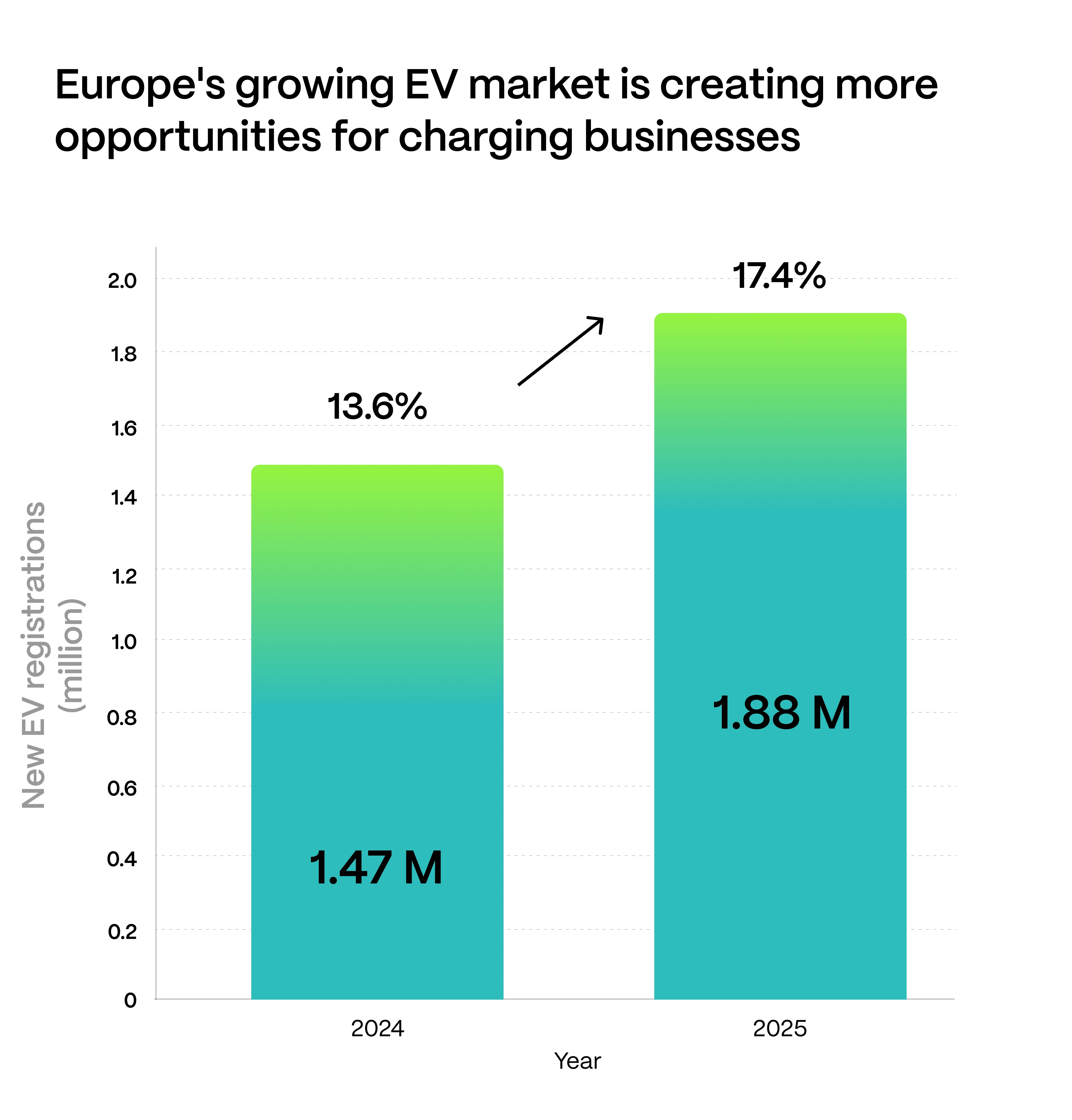
The European Union's battery electric vehicle (BEV) market provides a clear indication of this opportunity. According to the European Automobile Manufacturers' Association (ACEA), 1.88 million new battery electric cars were registered in the EU in 2025. BEVs accounted for 17.4% of new car registrations, up from 13.6% in 2024.
Home charging is particularly important in this transition. The European Alternative Fuels Observatory (EAFO) reports that more than 70% of EV recharging in Europe takes place at home or at work.
For distributors and installers, this creates a growing market for residential AC chargers, which allow EV owners to charge their vehicles while they are parked at home or at their workplace.
It also creates an opportunity to build long-term customer relationships through product recommendations, installation services and after-sales support.
But a growing market also attracts more manufacturers. And that is where the buying decision becomes more complicated.
More manufacturers are entering the market, making price a stronger selling point
As Europe's EV charging market expands, more manufacturers are competing to supply distributors and installers. This is particularly evident in the AC wallbox segment, where several products offer similar specifications, including 7.4 kW or 11 kW charging, Type 2 connectors and smart charging features.
Competitively priced imports are adding to this competition. Chargalytics' 2026 charger OEM landscape identified 85 commodity hardware companies with products in the European market, out of 329 manufacturers tracked.
With so many options available, distributors may find it difficult to differentiate between products that appear similar on paper. A lower-priced charger can offer an attractive procurement deal or help installers submit more competitive quotations.
But when two chargers offer similar specifications, does a lower purchase price necessarily make one the better business choice?
The difference often becomes clear only after installation, when product reliability, maintenance and manufacturer support start to matter.
The charging experience matters as much as the hardware
For EV drivers, the quality of a charging solution is not determined by its power rating alone. They also expect a charger to be easy to operate, consistently available and capable of delivering the expected performance. Research by Porsche Consulting and &Charge in 2025 found that while the average usability index across five European markets stood at 91%, only one in three charging points offered a truly seamless experience. This highlights an important distinction for manufacturers: making a charger technically operational is only one part of delivering a satisfactory charging experience.
For distributors and installers, this makes features such as intuitive interfaces, reliable connectivity, straightforward authentication and effective charging management important considerations when evaluating products. These features influence how customers interact with the charger long after the installation is complete.
Price-led competition can overlook the long-term value of EV chargers
As more manufacturers compete for a share of Europe's EV charging market, lower prices are becoming an important selling point. Distributors may prioritise procurement costs to protect margins, while installers look for competitively priced products to make their quotations more attractive.
However, choosing a charger primarily on its upfront price can mean overlooking factors that affect its performance and cost over time.
Lower purchase prices can lead to higher operating costs
Two chargers may offer similar power ratings and features, but their component quality, reliability and durability may differ. A product that develops recurring faults can result in repeat site visits, troubleshooting, warranty claims and premature replacements.
The European Commission's preparatory study on EV charger ecodesign uses a 10-year service life as its base-case assumption for charging infrastructure. This highlights why durability and repairability should be considered when evaluating charging products.
For installers, repeated product issues can affect customer confidence and take time away from new projects. For distributors, returns and warranty claims can reduce margins and strain relationships with installation partners.
Total cost of ownership offers a better measure of long-term value
The purchase price tells distributors and installers how much a charger costs today, but not what it may cost to install, maintain and support over its service life.
A 2022 study published in Nature Communications, analysing EV charging costs across 30 European countries, found that residential charger installation costs exceeded equipment costs in several markets. In Denmark, for instance, installation was estimated at €1,886.72, compared with €868.75 for the charger itself. The study also accounted for annual maintenance costs, estimated at 2% of equipment costs for residential and privately accessible commercial chargers and 4% for public charging stations.
This makes total cost of ownership (TCO) an important consideration. It accounts for expenses throughout a charger's lifecycle, including procurement, installation, maintenance and repairs.
For distributors and installers, evaluating TCO helps identify products that offer long-term value through reliable performance, accessible technical support and manageable maintenance costs, rather than just a competitive purchase price.
Looking beyond price helps businesses make better charging decisions
The challenge for distributors and installers is not simply to find a charger at the lowest possible price. It is to identify products that perform consistently, meet safety requirements and remain reliable throughout their service life. A few key factors can help businesses make a more informed choice.
Engineering determines charging performance and safety
A charger's advertised power rating tells only part of the story. Distributors and installers should also consider how consistently it delivers power under different operating conditions and whether its design includes the necessary protections for safe operation.
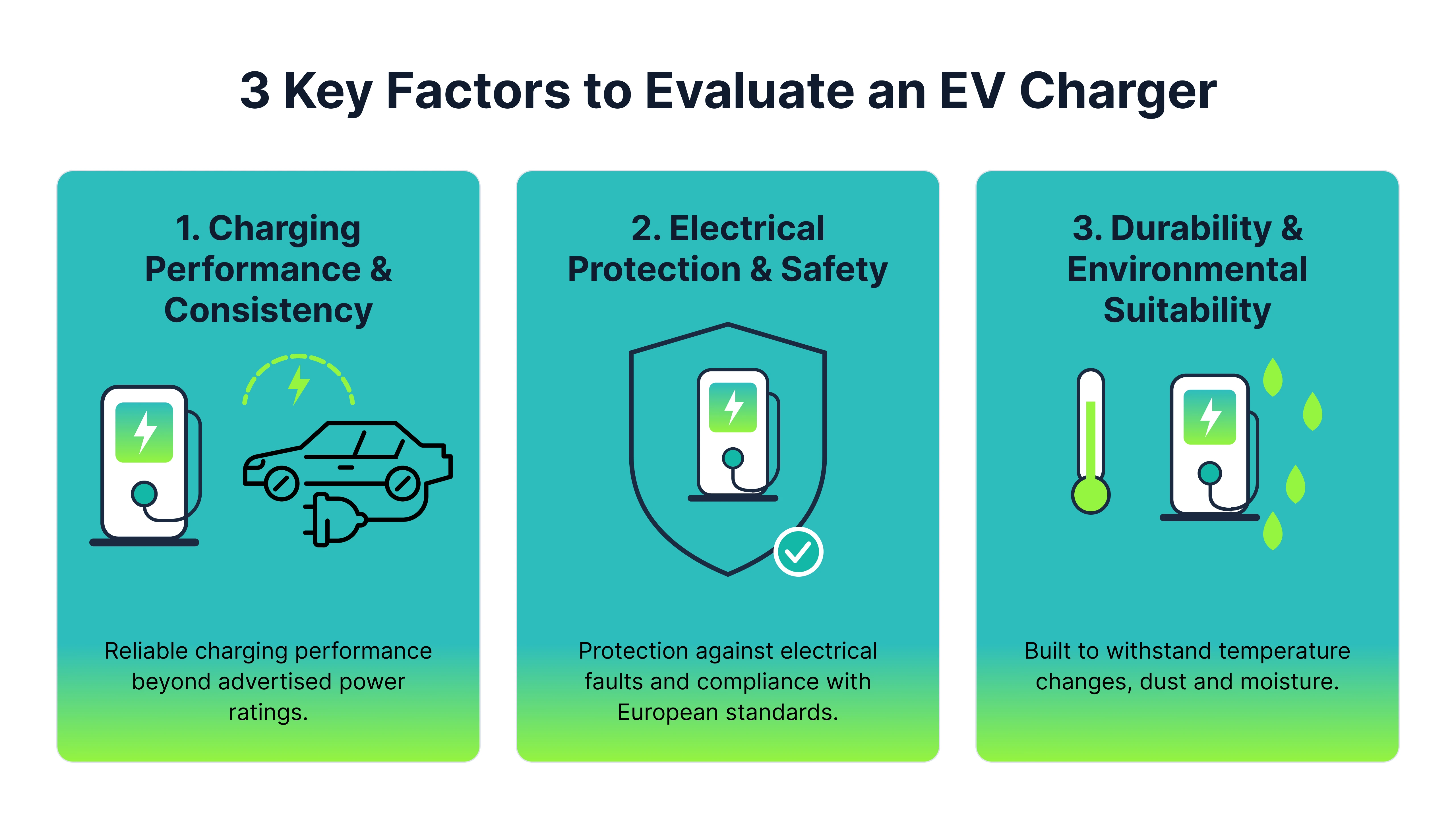
These considerations help distinguish a product that merely meets the required specifications from one engineered for dependable everyday use.
Manufacturer support influences the long-term cost of ownership
The manufacturer's responsibility does not end when the charger leaves the warehouse. Distributors and installers also need to know what happens when a product requires technical assistance, maintenance, or replacement.
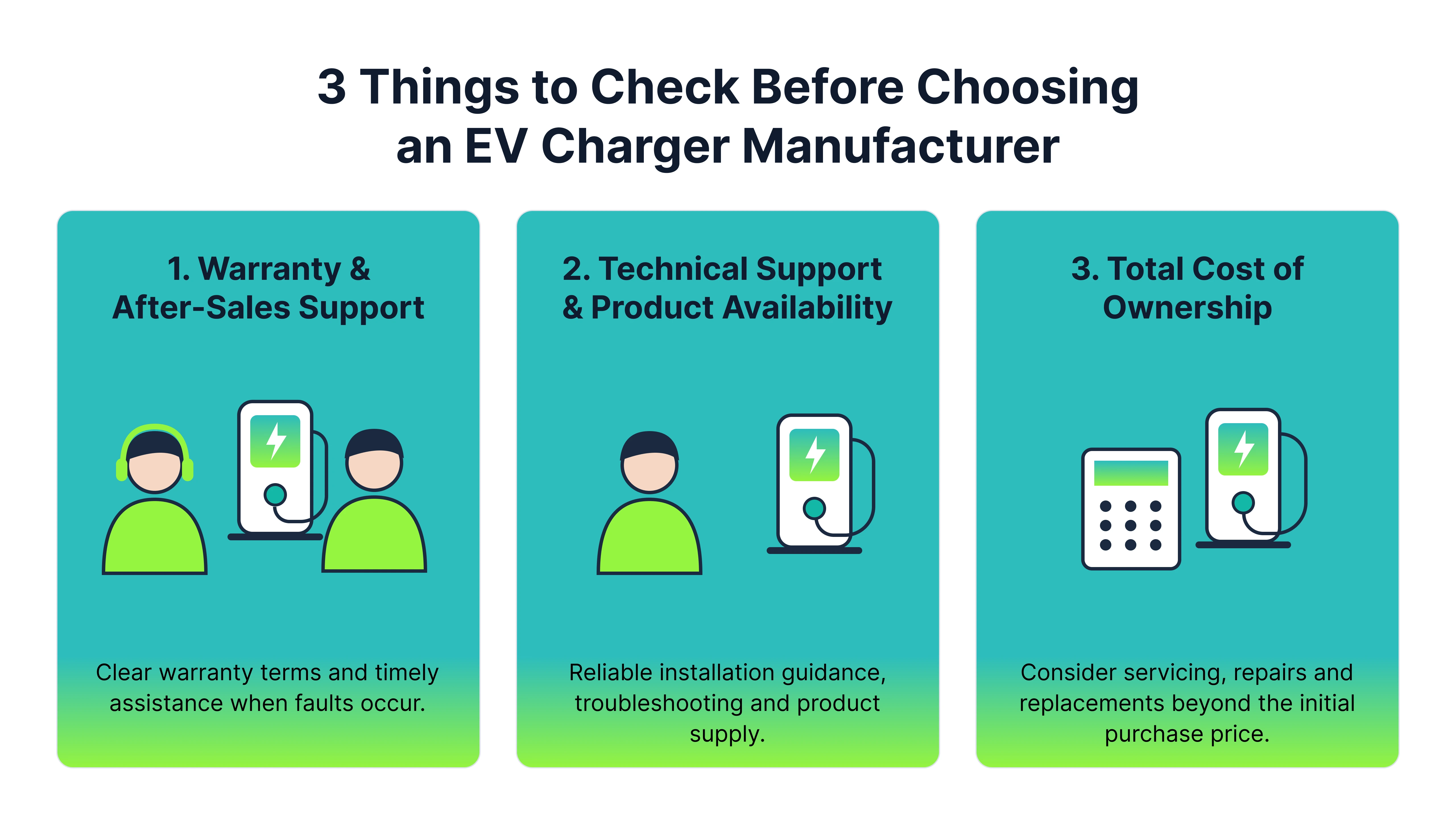
A slightly higher purchase price may prove more economical over time if the product reduces avoidable service visits and replacement costs. For distributors, reliable manufacturer support can also help build stronger relationships with installation partners.
Exicom brings engineering and reliability together in its charging solutions
These considerations make the choice of manufacturer just as important as the choice of charger. A manufacturer with a strong understanding of charging technology, product engineering and market requirements can help distributors and installers make more confident decisions.
At Exicom, we bring our experience in EV charging technology and product development into solutions designed around real-world charging needs. Take our Spin Air range, for instance. Its dynamic load management helps prevent household electrical overload, while smart connectivity allows users to monitor charging, schedule sessions and manage their chargers remotely. With IP66 weather protection and integrated electrical safety features, Spin Air is designed to deliver reliable charging across different installation environments.
But our commitment goes beyond the hardware. We understand that reliable after-sales support is equally important for distributors, installers and end customers. That's why Exicom offers remote diagnostics, on-site maintenance, software support and spare parts availability. As our support promise puts it, "Enjoy expert support at all times." This combination of product engineering and continued assistance helps our partners offer customers not just a charger, but a dependable charging experience
Annual maintenance contracts
Enjoy expert support at all times with our complete service package

Fast
Fast onsite response times and always-available spares

Secure
Maximum operational uptime with no compromise on security

Reliable
Proactively address issues with regular maintenance visits

Customised
Fully tailor SPA agreements to meet your organization’s needs

24/7 monitoring
Remotely diagnose and resolve issues via online monitoring
Choosing EV chargers for Europe? Talk to Exicom about long-term reliability and after-sales support.
Talk to an expert
Frequently Asked Questions
Lorem ipsum dolor sit amet, consectetur adipiscing elit, sed do eiusmod tempor incididunt ut labore et dolore magna aliqua. Ut enim ad minim veniam, quis nostrud exercitation ullamco laboris nisi ut aliquip ex ea commodo consequat. Duis aute irure dolor in reprehenderit in voluptate velit esse.
Lorem ipsum dolor sit amet, consectetur adipiscing elit, sed do eiusmod tempor incididunt ut labore et dolore magna aliqua. Ut enim ad minim veniam, quis nostrud exercitation ullamco laboris nisi ut aliquip ex ea commodo consequat. Duis aute irure dolor in reprehenderit in voluptate velit esse.
Lorem ipsum dolor sit amet, consectetur adipiscing elit, sed do eiusmod tempor incididunt ut labore et dolore magna aliqua. Ut enim ad minim veniam, quis nostrud exercitation ullamco laboris nisi ut aliquip ex ea commodo consequat. Duis aute irure dolor in reprehenderit in voluptate velit esse.
Lorem ipsum dolor sit amet, consectetur adipiscing elit, sed do eiusmod tempor incididunt ut labore et dolore magna aliqua. Ut enim ad minim veniam, quis nostrud exercitation ullamco laboris nisi ut aliquip ex ea commodo consequat. Duis aute irure dolor in reprehenderit in voluptate velit esse.
Lorem ipsum dolor sit amet, consectetur adipiscing elit, sed do eiusmod tempor incididunt ut labore et dolore magna aliqua. Ut enim ad minim veniam, quis nostrud exercitation ullamco laboris nisi ut aliquip ex ea commodo consequat. Duis aute irure dolor in reprehenderit in voluptate velit esse.