



EV Charging Stations in India: Complete Guide to Types, Costs & Installation
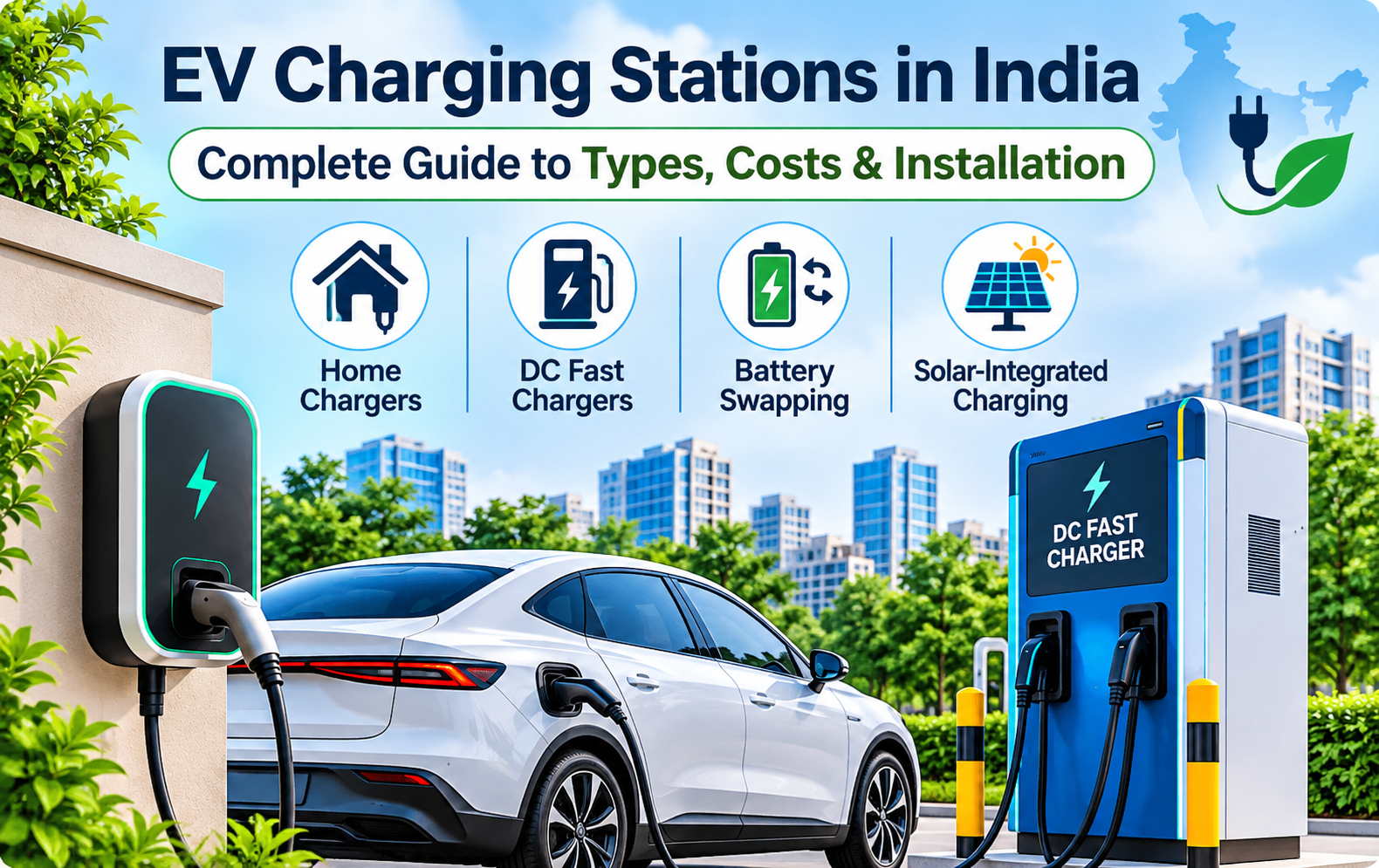
The electric mobility journey in India has transcended its "early adopters" stage. With more than 52,000 public charging stations across the country, India's EV charging infrastructure is expanding rapidly, supported by initiatives such as PM E-DRIVE, the discussion around electric mobility has evolved from "is it time to get myself an EV?" to "Where do I charge my car?" Be it your first EV or a fleet or even commercial charging infrastructure that you are looking for, it's time you knew about EV charging stations.
This guide breaks down everything you need to know about EV charging stations in India in 2026 – types, technology, costs, installation, and what's changing next.
The State of EV Charging Infrastructure in India (2026 Update)
India had more than 27,000 public charging stations as of March 2026, with Karnataka reporting 6,805 public charging stations. However, state-wise rankings can vary depending on the reporting date and methodology used.
Under PM E-DRIVE, the central government has allocated ₹2,000 crore for public EV charging infrastructure, with plans to support the deployment of approximately 72,000 public charging stations across the country. As implementation of PM E-DRIVE progresses, proposals for additional public charging infrastructure are being sanctioned across multiple states and participating public-sector entities.
Highway charging infrastructure is also expanding, with government guidelines providing for charging stations at regular intervals along major highways and expressways to support intercity EV travel. According to industry estimates, the country is going to require a major upgrade of its public charging infrastructure with increased adoption of EVs.
From an industry point of view, this upward curve denotes a business opportunity since demand for reliable and well-engineered installations of EV chargers is going to rise further.
What Is an EV Charging Station?
EV Charging Station is the facility that provides power for charging the electric vehicle batteries. Contrary to the gas pump which requires a very brief time to take place, the charging station is a bit complex as it entails the process of transforming electricity to the battery packs within a time duration ranging from 20 minutes to hours.
At its core, every EV charging station consists of:
- A power source (grid connection, often supplemented by solar or battery storage)
- Charging hardware (the EV charger unit itself, including connectors and cables)
- Communication and safety systems (for load management, billing, and fault protection)
- User interface (app-based or on-unit controls for starting/stopping a session)
As EV adoption grows across two-wheelers, three-wheelers, passenger cars, and commercial fleets, the definition of "charging station" in India has broadened to include everything from a simple home wall box to a multi-bay DC fast-charging hub on a highway.
Types of EV Charging Stations in India
Not all charging points are built the same. Understanding the different categories helps you choose the right solution, whether for personal use, a housing society, a commercial property, or a fleet depot.
1. AC Charging Stations (Level 1 & Level 2)
AC chargers are the most frequently used chargers among all types of EV chargers in residential homes and offices. These chargers are connected to the power grid for alternating currents and convert these currents into direct currents with the help of an onboard charger of the car.
- Level 1 (ordinary house plug): An ordinary 15A plug is used to deliver 1.5–3 kW of energy. Charging time for Level 1 is rather long – 8–12+ hours – but this is the easiest and cheapest option for home charging.
- Level 2: Uses a designated charging station, and the charging speed is faster compared to regular household sockets. The charging duration depends on the charging station, the car’s batteries, and its ability to take in more electricity.
2. DC Fast Charging Stations
In case of DC chargers, there is no need for onboard chargers in the cars because it uses direct currents that run directly to the battery; hence, it charges very fast in terms of the charging speed at a range of 15 kW to 240 kW. Your car will be charged from 20% to 80% within 20-60 minutes.
Common DC fast-charging standards used in India include:
- CCS2 (Combined Charging System 2): The dominant standard for most Indian passenger EVs today
- CHAdeMO: Used by select vehicle models, though less common in newer Indian launches
- GB/T: A charging standard used by some EVs, particularly certain Chinese-origin vehicle platforms and specific EV applications.
3. Battery Swapping Stations
Battery swapping may not be considered as an ideal charging station but is gaining relevance in India’s EV charging points landscape, especially for two-wheelers, three-wheelers, and last-mile fleets. Instead of waiting for their batteries to get recharged, users switch to fully charged batteries instead of using those which are discharged.
4. Solar-Integrated & Hybrid Charging Stations
Another trend that is gaining more attention in 2026 is the use of solar power and energy storage batteries (BESS) along with electric vehicle (EV) charging stations, especially on highways and at commercial places. It is helpful to reduce the dependence on the grid, increase efficiency, and enhance resilience when there is poor grid connectivity.
EV Charger Connector Types You Should Know
Choosing the right EV charger also depends on connector compatibility:
- Type 2 (AC): Standard for most AC charging in India
- CCS2: The primary DC fast-charging standard adopted by Indian passenger vehicle manufacturers
- Bharat AC-001 / Bharat DC-001: India-specific charging standards developed for affordability and localisation, commonly used in lower-cost EV segments
Always confirm your vehicle's supported connector type before selecting a charger for home or commercial installation.
Cost of Setting Up an EV Charging Station in India
Costs vary widely depending on charger type, power capacity, site readiness, and whether it's for personal or commercial use.
Home EV Charging Point Costs
- Level 1 charger: Often bundled free or low-cost with vehicle purchase; installation costs are minimal since it uses an existing socket
- Level 2 AC wallbox (3.3–7.4 kW): Typically ₹15,000–₹60,000 for the unit, plus installation (wiring, MCB upgrades, metering) which can range from ₹5,000–₹25,000 depending on the electrical work required
Commercial & Public EV Charging Station Costs
- AC charging stations (7–22 kW): Roughly ₹1–3 lakh per unit including installation
- DC fast chargers (30–60 kW): Approximately ₹8–15 lakh per unit
- High-power DC chargers (100 kW+): Can exceed ₹20–30 lakh per unit, depending on capacity and site infrastructure
Other Cost Factors
- Civil & electrical infrastructure: Costly additions due to transformer capacity upgradation, cabling and load upgrade
- Land/site preparation: Important for public/highway EV charging stations
- Software & Networking: Gateway payment systems, remote management systems, and apps
- Future electricity cost: The cost varies from state to state and it varies from ₹8 to ₹18 per kWh of energy consumed at commercial EV charging points; however, in many states there is an electricity tariff that is reduced to incentivise electric vehicles usage
Eligible charging infrastructure projects may receive financial support under PM E-DRIVE and applicable state policies, subject to the relevant eligibility criteria and implementation guidelines.
How to Install an EV Charging Station: Step-by-Step
Whether you want to install an individual charger at your residence or plan to set up an EV charging station commercially in India, the general procedure to be followed remains more or less the same:
- Site evaluation: Determine the power load capability, space requirement, and grid connectivity. In case of commercial installation, a load flow analysis would be required.
- Charger configuration: Decide the type of charger (AC/DC), power rating and connector to be used depending upon the requirements of vehicle and power source.
- Verify electricity and other relevant requirements: EV charging station is an activity that can be carried out without a license, however, the project may involve obtaining an appropriate electricity supply and increasing load, metering, and compliance with applicable central, state, local, and DISCOM requirements.
- Upgradation of existing electrical system: Upgrading of service connection, meter and wiring may be required in order to accommodate the increased load.
- Installation and commissioning: Installation of the charger and its testing by a qualified installer.
- Integration: Integration of software like payment system, remote monitoring and network connectivity through OCPP-compliant platforms (in case of commercial stations).
For residential installations, this process is usually straightforward and can be completed within a few days. Commercial and public EV charging station projects, especially DC fast-charging hubs, typically require more extensive planning, ranging from a few weeks to a few months depending on site complexity and approval timelines.
Choosing the Right EV Charging Partner
In view of the rapid development of the charging infrastructure in India, it is the engineering that will decide whether your charging point will work flawlessly for many years or not. You should seek cooperation with the companies that have experience in designing the power electronics, provide post-sale services, and develop charging systems taking into account peculiarities of the Indian electrical network, such as changes in voltage, changes in temperature, and different types of charging of the vehicles. This is especially important for commercial entities and fleet owners that purchase charging points.
The Road Ahead
Charging infrastructure in India in 2026 can be described as having features of fast-growing infrastructure development, greater government support, and more advanced technology, from solar-powered stations to intelligent, mobile-application linked stations. With the 2030 targets of EV adoption on the horizon, those who are investing in reliable and future-proof EV charging infrastructure now will be poised for success in the coming EV transition.
FAQs
1. What is the cost involved in setting up a charging station for an EV in India?
The cost involved varies greatly based on the purpose of the charger. It can be as low as ₹15,000 to ₹60,000 (without installation costs) for residential AC charger stations and ₹8 to 30 lakh or higher for commercial DC fast chargers.
2. How many EV charging stations are available in India currently?
India had over 27,000 public charging points by March 2026, and other official reports have put the country’s total above 50,000. Since the number will keep fluctuating depending on how many new stations come up, it is necessary to specify the date of reporting.
3. What is the difference between an AC and a DC EV Charger?
An AC EV charger supplies electricity as alternating current. The electric vehicle converts it to direct current through an onboard charger, which makes it slow (4-12 or more hours). On the other hand, the DC charger supplies electricity as direct current, and thus it is a lot faster, taking only 20-60 minutes, which is used for public and highway charging stations.
4. Can I install an EV charging point at home in India?
Yes. The typical installation of an EV charging station in the home environment involves either a level 1 or level 2 AC charging station, which can be easily done with the consent of your electricity provider and an appropriate upgrade of the electrical supply line in your home.
5. Which connector type is used by most electric vehicle charging stations in India?
The Type 2 connector is used in AC charging and CCS2 for DC fast charging, while some Indian passenger electric vehicles might have India-specific Bharat AC-001/DC-001 connectors and GB/T connectors.
Frequently Asked Questions
Lorem ipsum dolor sit amet, consectetur adipiscing elit, sed do eiusmod tempor incididunt ut labore et dolore magna aliqua. Ut enim ad minim veniam, quis nostrud exercitation ullamco laboris nisi ut aliquip ex ea commodo consequat. Duis aute irure dolor in reprehenderit in voluptate velit esse.
Lorem ipsum dolor sit amet, consectetur adipiscing elit, sed do eiusmod tempor incididunt ut labore et dolore magna aliqua. Ut enim ad minim veniam, quis nostrud exercitation ullamco laboris nisi ut aliquip ex ea commodo consequat. Duis aute irure dolor in reprehenderit in voluptate velit esse.
Lorem ipsum dolor sit amet, consectetur adipiscing elit, sed do eiusmod tempor incididunt ut labore et dolore magna aliqua. Ut enim ad minim veniam, quis nostrud exercitation ullamco laboris nisi ut aliquip ex ea commodo consequat. Duis aute irure dolor in reprehenderit in voluptate velit esse.
Lorem ipsum dolor sit amet, consectetur adipiscing elit, sed do eiusmod tempor incididunt ut labore et dolore magna aliqua. Ut enim ad minim veniam, quis nostrud exercitation ullamco laboris nisi ut aliquip ex ea commodo consequat. Duis aute irure dolor in reprehenderit in voluptate velit esse.
Lorem ipsum dolor sit amet, consectetur adipiscing elit, sed do eiusmod tempor incididunt ut labore et dolore magna aliqua. Ut enim ad minim veniam, quis nostrud exercitation ullamco laboris nisi ut aliquip ex ea commodo consequat. Duis aute irure dolor in reprehenderit in voluptate velit esse.


