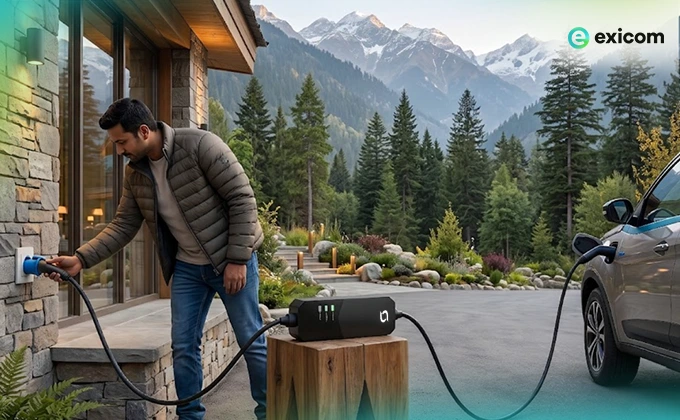



No Charger Where You Park? How a Portable EV Charger Goes Where Your Life Goes

You are parking your EV in a shared spot in a rented apartment, and you see there’s no charging point in sight. Sound familiar?
If you own an EV or are about to buy one, this blog is for you. It looks at why charging access still feels uncertain and how a portable charger can fill the gap.
More Indians are going electric. Where are they all charging?
More people are switching to electric vehicles (EVs). In 2025 India had 1.77 lakh sales of passenger vehicles. That is a 77% rise compared to 2024. This information comes from the Federation of Automobile Dealers Associations (FADA).

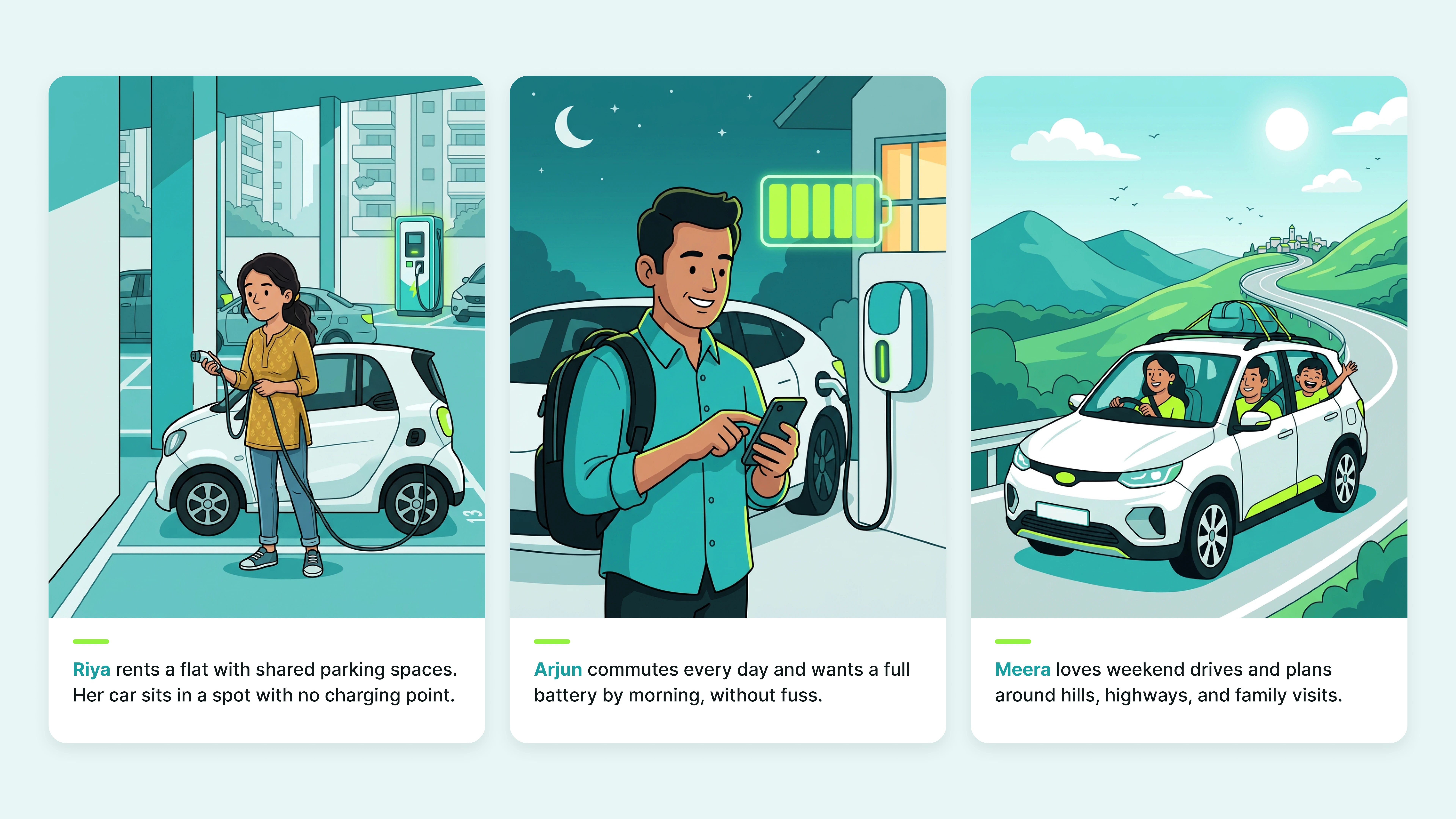
Behind that number are very different drivers:
- Riya rents a flat with shared parking spaces. Her car sits in a spot with no charging point.
- Arjun commutes every day and wants a full battery by morning, without fuss.
- Meera loves weekend drives and plans around hills, highways, and family visits.
India is working on this. The Ministry of Power’s guidelines has set a planning benchmark of installing one public charging station every 25 km on both sides of highways and roads. For home charging, the 2024 guidelines have let residential EV owners use their existing electricity connection or opt for a separate metered one.
Charging is growing, but drivers still worry about range
Now imagine you are in your car, and your battery charge is down to 30 per cent. What is the distance to the nearest charger? Will it be free? Are there other vehicles lined up? The term for that is called “range anxiety", which is the concern that your electric vehicle will be out of power before finding somewhere to charge.
The 25-kilometre standard is an objective for the network to strive toward rather than an assurance that all roads already have chargers spaced in that way. Private charging also assumes you have your own personal space to charge from.
That is the problem for Riya, Arjun and Meera. Riya has no charging point at her shared parking. Arjun can’t count on one everywhere he parks. Meera may end up at a relative’s home or a destination with limited options.
So the real question becomes: what if the charger could come with you?
Travel-friendly portable chargers are becoming popular
Think of how you carry a power bank for your phone. Now imagine something similar for your car, but far more powerful.
Portable electric vehicle chargers are available. You plug the device into a normal wall socket and can charge your vehicle at any location. The problem has always been that of time and speed.
Why portable chargers have felt slow
Most portable chargers in India are built around a standard socket, which limits how much power they can draw. Here is what that looks like:
- Typical output: Statiq’s portable charger, for example, is rated at 3.3 kW, with adjustable current of 6A to 16A to suit the socket.
- Charging time: For a 40 kWh battery, such as in the Tata Nexon EV Max, a 3.3 kW charger needs about 12 hours for a full charge.
- Compared with a wall-mounted charger: A 7.4 kW unit does the same job in about 5.5 hours, roughly half the time.
For drivers such as Riya, Arjun and Meera, this is definitely a trade-off. While a portable charger took care of the “where” dilemma, it presented the “how long” dilemma. No one would wish to spend 12 hours charging their phone.
That’s the idea behind Exicom Spin Free, a 7.5 kW portable AC (alternating current) EV charger. Most portable chargers offer lower power, but Spin Free combines portability with charging power comparable to a typical 7.4 kW wall-mounted AC charger. It gives you a charging option when a permanent setup isn’t practical, whether you’re in a rented apartment, travelling between cities or visiting family for the weekend.
What makes Exicom Spin Free different from other portable EV chargers?
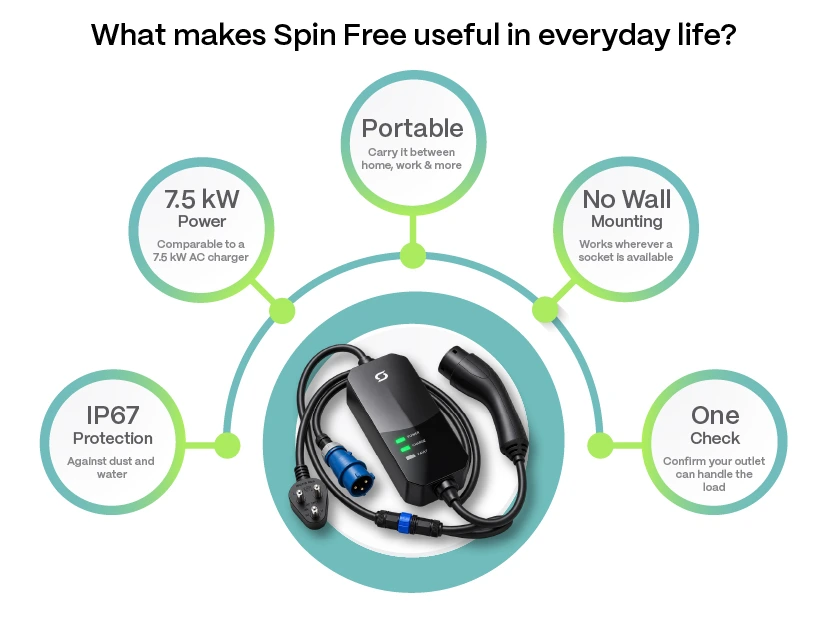
- 7.5 kW power without a permanent setup - A portable charger doesn't necessarily mean compromising on charging power. Spin Free delivers up to 7.5 kW, comparable to a typical 7.4 kW wall-mounted AC charger. This gives EV owners a high-power AC charging option without automatically committing to a permanently mounted charging unit.
- What does IP67 protection mean? - An IP67 rating indicates that an enclosure has been tested for dust protection and temporary immersion in water under specified laboratory conditions. This can be a useful feature for equipment used across different environments.
Whether you're living in a rented apartment, traveling between cities or visiting family for the weekend, Spin Free gives you another charging option when a compatible power outlet is available. You may still need an electrician to ensure the outlet and electrical installation can safely support the required load, but you don't need to mount the charger permanently on a wall.
Make spontaneous trips easier
Electric travel becomes easier when charging can adapt to your plans, rather than your plans revolving around charging. While expanding public infrastructure remains essential, a portable option like Exicom Spin Free can give EV owners more flexibility in their everyday journeys.
Because the freedom to travel in an EV should be about choosing where to go - not just where to charge.
Ready to charge on your own terms? Pick up the Exicom Spin Free 2 portable EV charger and keep your battery topped up anywhere you park.
Frequently Asked Questions
Lorem ipsum dolor sit amet, consectetur adipiscing elit, sed do eiusmod tempor incididunt ut labore et dolore magna aliqua. Ut enim ad minim veniam, quis nostrud exercitation ullamco laboris nisi ut aliquip ex ea commodo consequat. Duis aute irure dolor in reprehenderit in voluptate velit esse.
Lorem ipsum dolor sit amet, consectetur adipiscing elit, sed do eiusmod tempor incididunt ut labore et dolore magna aliqua. Ut enim ad minim veniam, quis nostrud exercitation ullamco laboris nisi ut aliquip ex ea commodo consequat. Duis aute irure dolor in reprehenderit in voluptate velit esse.
Lorem ipsum dolor sit amet, consectetur adipiscing elit, sed do eiusmod tempor incididunt ut labore et dolore magna aliqua. Ut enim ad minim veniam, quis nostrud exercitation ullamco laboris nisi ut aliquip ex ea commodo consequat. Duis aute irure dolor in reprehenderit in voluptate velit esse.
Lorem ipsum dolor sit amet, consectetur adipiscing elit, sed do eiusmod tempor incididunt ut labore et dolore magna aliqua. Ut enim ad minim veniam, quis nostrud exercitation ullamco laboris nisi ut aliquip ex ea commodo consequat. Duis aute irure dolor in reprehenderit in voluptate velit esse.
Lorem ipsum dolor sit amet, consectetur adipiscing elit, sed do eiusmod tempor incididunt ut labore et dolore magna aliqua. Ut enim ad minim veniam, quis nostrud exercitation ullamco laboris nisi ut aliquip ex ea commodo consequat. Duis aute irure dolor in reprehenderit in voluptate velit esse.