


How Dynamic Load Sharing Transforms Charging Site Economics
.avif)
In June 2025, Raghav asked ChargeX Solutions, led by Meera, to install 2 high-power DC Fast Chargers for EVs frequenting his mall. The plan looked simple, until Meera’s team ran the load assessment.
By early July, they discovered the mall’s sanctioned grid load could support only 1 EV charger at full capacity. The other would remain unusable unless the mall paid for expensive upgrades: a new transformer, thicker cabling, and fresh civil work. Raghav knew he needed two chargers to cater to the weekend traffic, reduce wait times, and ensure EV drivers didn’t return due to lack of slot availability.
Raghav is now faced with a tough choice - to sink lakhs into strengthening the electrical infrastructure for a scalable, profitable business? Or to carry on with whatever is available, knowing that this will not yield the desired ROI?
Limited Load Sanctions Are Posing a Commercial Bottleneck Against Charger Addition
Despite the apparent demand, most high-footfall sites, especially malls, office campuses, hospitality locations, and transport hubs, operate with constokrained grid capacity. Sanctioned load limitations have become the most significant commercial bottleneck preventing dense charging deployments. Even if a location has space, demand, and willingness to invest, the electrical supply often caps the number of EV chargers that can operate simultaneously.
This Is the Biggest Barrier for Dense Charging Deployments
When a CPO tries to install more DC fast chargers, the first obstacle is the need to augment the transformer. Upgrading a power transformer is capital-intensive and time-consuming, and for many sites, this cost does not create direct revenue.
Using the case of a 4 DC Fast Charger site that has the sanctioned load for only 2:
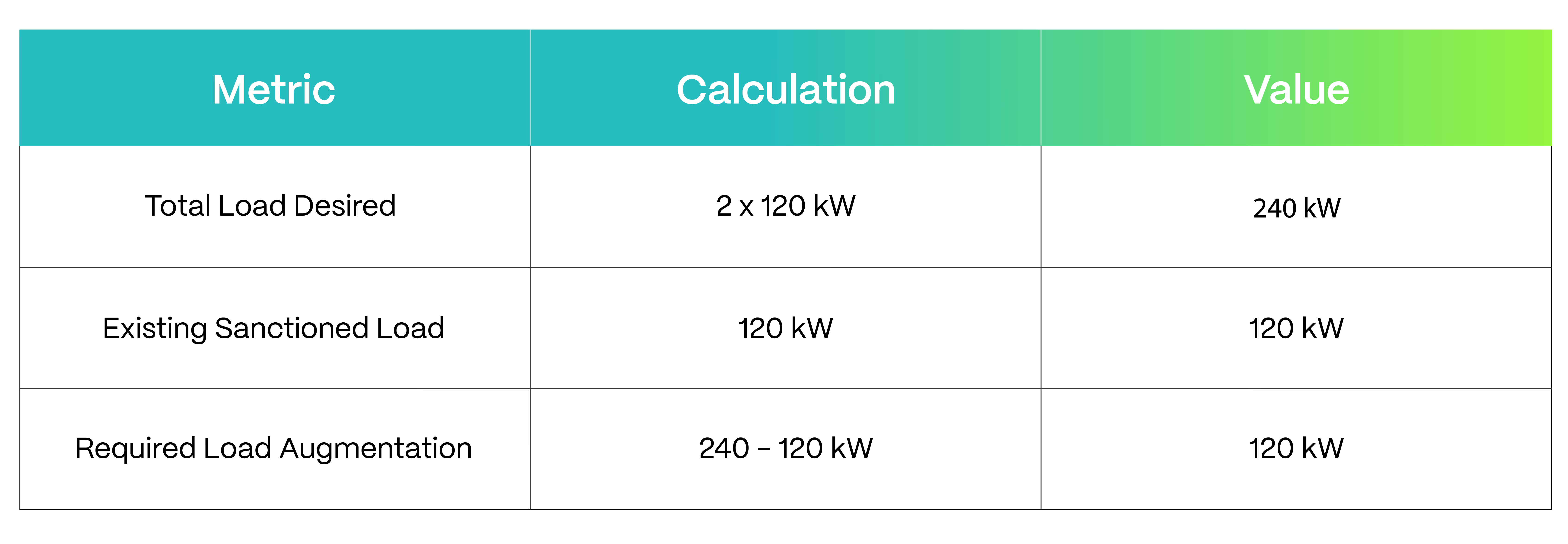
The challenge doesn’t end there. New HT/LT cabling, vacuum circuit breakers, panels, foundational work, and trenches add another ₹2.5–3 lakh. Even after capital is deployed, the project remains stuck behind regulatory approvals, construction work, and DISCOM timelines. In many regions, such upgrades can delay go-live by several months.
Let’s see the impact of these delays that the extra upgrades can cause.
- Charger Type: DC Fast Charger (120 kW)
- Operating Assumption: 15% Utilization over 24 hours daily
- Energy Delivered Daily (per gun): 162kWh (considering an estimate of 45kW battery pack)
- Charging Fee (per unit): ₹20/kWh
- Daily Gross Revenue/charging gun: 162kWh x ₹20/kWh = ₹3240
- Monthly Gross Revenue/charging gun: ₹3240/day x 30 days = ₹97200
- For an EV charging station planning 2 DC fast chargers, a three-month delay can easily translate into almost ₹10lakh in missed revenue (10 charging guns x ₹97200month x 3 months). The opportunity cost alone should push CPOs to find more innovative ways to maximize output from the load they already have.
Dynamic Load Sharing Can Solve This at Lower Costs
Dynamic Load Sharing offers a practical, commercially sound way to bypass sanctioned load barriers without compromising on charging availability.
What Is Dynamic Load Sharing (DLS)?
DLS is a smart power management system that intelligently distributes available electrical capacity across multiple chargers and guns. Instead of each charger drawing its maximum rated load, DLS monitors real-time demand, vehicle requirements, and building consumption and allocates power accordingly. This allows all chargers to operate simultaneously delivering the maximum possible power to the vehicle.
How does Real-Time Distribution of Power Work in DLS?
DLS follows three simple steps:
- Measure available electrical capacity: The system continuously monitors the sanctioned load and subtracts the building’s real-time consumption (HVAC, lighting, lifts, etc.) to determine the available power for EV charging.
- Communicate with chargers in real time: Chargers send live data, SOC, requested power, temperature, and battery parameters, to a controller or cloud-based CMS every 1–2 seconds.
- Allocate power intelligently: Available power is divided across active chargers and charging guns intelligently If only a few EVs are plugged in, each receives higher power. As more EVs connect, the system distributes power as per their requirement.
Now, obviously, different EV models have different battery capacities and different charging needs. Here’s where the main brilliance of DLS shines through. It allocates power not just according to the number of EVs, but also according to the type of EVs plugged in.
Let’s take the example of Raghav’s EV charging station here. If 2 Tata Nexon (with 30 kWh battery pack, Windsor with 38 kWh battery pack and Tata Punch with 25kWh battery pack are charging simultaneosly, DLM will intelligently allocate 30, 30, 35 and 25 kWh to 2 Nexons, Windsor and Punch
Now, each DC Fast charger has 2 charging guns. Which means, each EV charger can support 2 cars. Thus, two EV chargers support 4 cars
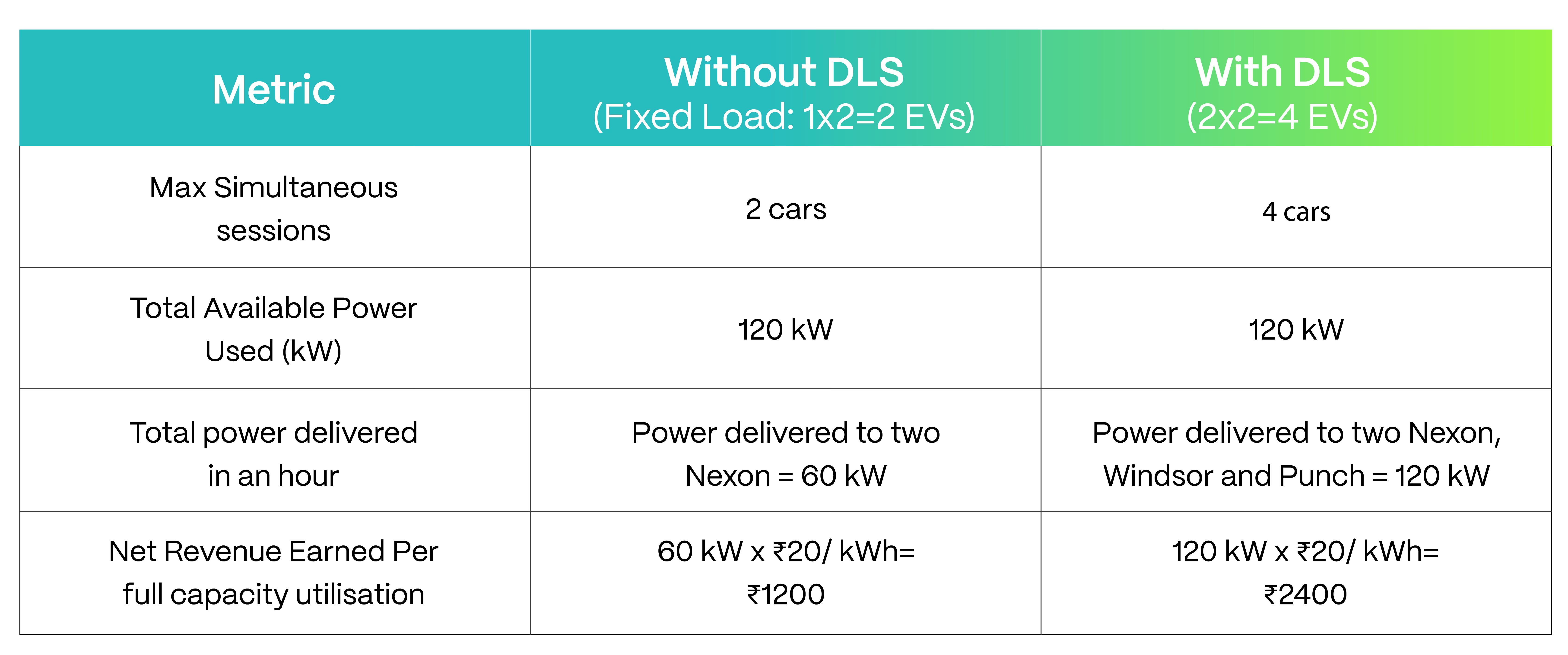
Now, one may argue that 4 cars can also be charged using one EV charger one after another. But this presents several operational hurdles in an on-ground scenario.
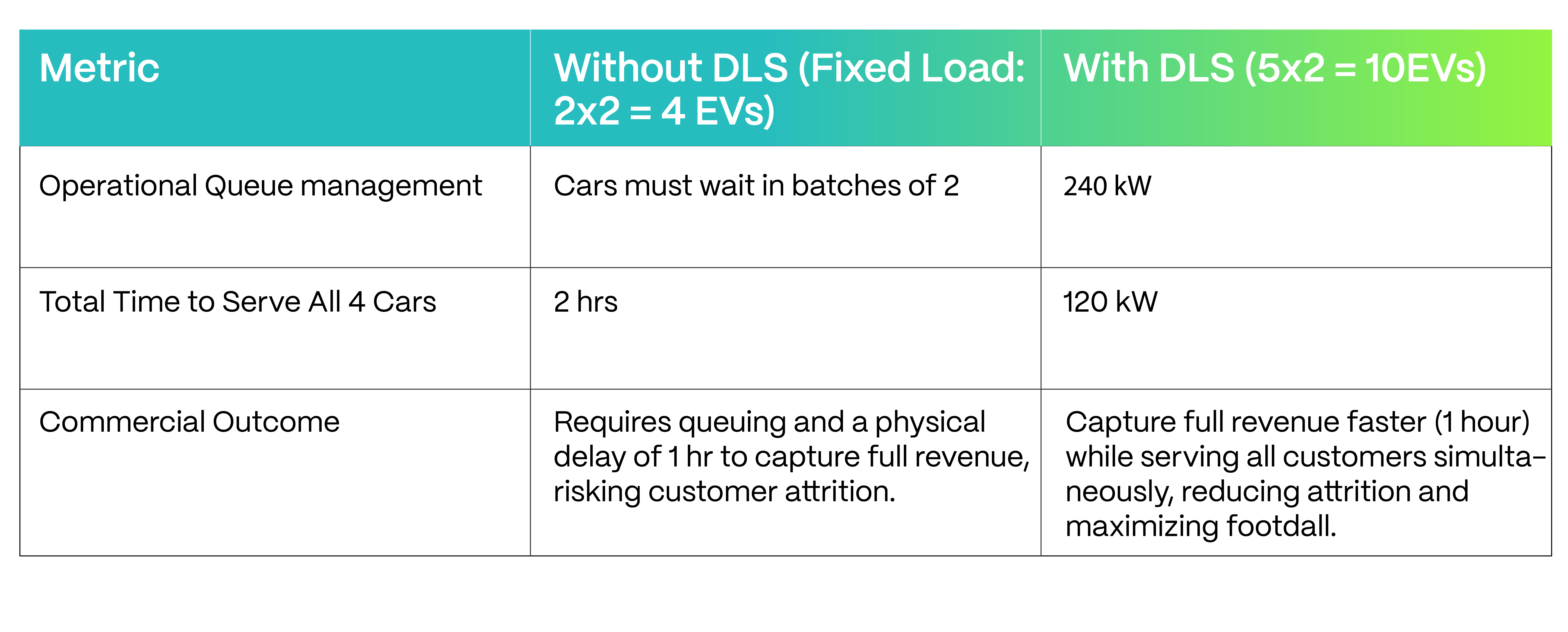
Crucially, the total time required to process all 4 customers is reduced from 120 minutes (with queuing) to 60 minutes, allowing the site to clear demand faster and generate revenue with higher transactional reliability.
Since power is optimized as per vehicle, no vehicle gets more than required power which leaves enough power in the other charging gun for a high-power vehicle. As in, if the EV charger is pre-programed to give higher priority to a fleet vehicle, more power will be allocated to it than a regular walk-in vehicle.
Also, ensuring the total draw never exceeds the sanctioned load; DLS helps sites avoid peak demand penalties, power trips, and operational disruptions. It can also optimize charging during lower-tariff windows, particularly during solar hours.
DLS Has 6 Clear Commercial Benefits
DLS delivers both immediate and long-term financial advantages for CPOs and site operators. Here’s how DLS unlocks stronger commercial performance for every charging site:
1. Costly Infra Updates are avoided, lowering capex
By eliminating the need for transformers, cabling, and other utility-side upgrades, DLS directly saves between ₹7.5 lakh and ₹20 lakh per site. It also allows smarter substation design, often reducing capacity requirements by up to 15%.
2. Deployment becomes faster, enabling quicker time-to-revenue
Since DLS uses the existing sanctioned load, deployments move faster. CPOs avoid extended regulatory processes and can go live within the standard new-connection timelines, as low as three days in metropolitan cities.
3. More sessions per day boosts asset utilization
India’s current public charger utilization sits at around 7%. DLS enables sites to install more chargers without increasing sanctioned load, pushing the location closer to the targeted 25% utilization for 2030.
4. More chargers can run on the same load, increasing earning potential
A site operating 5 EV chargers instead of 2, immediately increases its revenue potential by over 50-70%, this scale of uplift is hard to achieve through any other intervention.
5. Lower operating costs reduce tripping and maintenance
By preventing overloading and ensuring current stays within safe limits, DLS reduces site tripping incidents, lowers maintenance calls, and avoids expensive peak-demand penalties.
6. Scalable infrastructure makes it easy to add chargers anytime
DLS supports incremental expansion. Adding the next charger becomes far cheaper, often only 20% of the first charger’s installation cost, making the infrastructure truly modular.
DLS Improves Customer Experience by Increasing Stability and Slot Availability
Beyond cost and operational benefits, DLS significantly enhances the charging experience for EV drivers. Consistent power allocation ensures charging sessions remain stable, especially when users expect predictable charging rates. With fast chargers typically requiring 30–65 minutes for a 10–80% charge, uninterrupted sessions are essential.
DLS reduces site trips, keeps chargers online, and expands available charging slots, cutting wait times and eliminating slot anxiety. For commercial hosts such as malls and retail destinations, this improved reliability directly boosts customer footfall and enhances the value proposition of EV charging services.
Explore EV charging solutions here.
Frequently Asked Questions
Lorem ipsum dolor sit amet, consectetur adipiscing elit, sed do eiusmod tempor incididunt ut labore et dolore magna aliqua. Ut enim ad minim veniam, quis nostrud exercitation ullamco laboris nisi ut aliquip ex ea commodo consequat. Duis aute irure dolor in reprehenderit in voluptate velit esse.
Lorem ipsum dolor sit amet, consectetur adipiscing elit, sed do eiusmod tempor incididunt ut labore et dolore magna aliqua. Ut enim ad minim veniam, quis nostrud exercitation ullamco laboris nisi ut aliquip ex ea commodo consequat. Duis aute irure dolor in reprehenderit in voluptate velit esse.
Lorem ipsum dolor sit amet, consectetur adipiscing elit, sed do eiusmod tempor incididunt ut labore et dolore magna aliqua. Ut enim ad minim veniam, quis nostrud exercitation ullamco laboris nisi ut aliquip ex ea commodo consequat. Duis aute irure dolor in reprehenderit in voluptate velit esse.
Lorem ipsum dolor sit amet, consectetur adipiscing elit, sed do eiusmod tempor incididunt ut labore et dolore magna aliqua. Ut enim ad minim veniam, quis nostrud exercitation ullamco laboris nisi ut aliquip ex ea commodo consequat. Duis aute irure dolor in reprehenderit in voluptate velit esse.
Lorem ipsum dolor sit amet, consectetur adipiscing elit, sed do eiusmod tempor incididunt ut labore et dolore magna aliqua. Ut enim ad minim veniam, quis nostrud exercitation ullamco laboris nisi ut aliquip ex ea commodo consequat. Duis aute irure dolor in reprehenderit in voluptate velit esse.