


Smarter Charging for India's Growing Fleet Depots
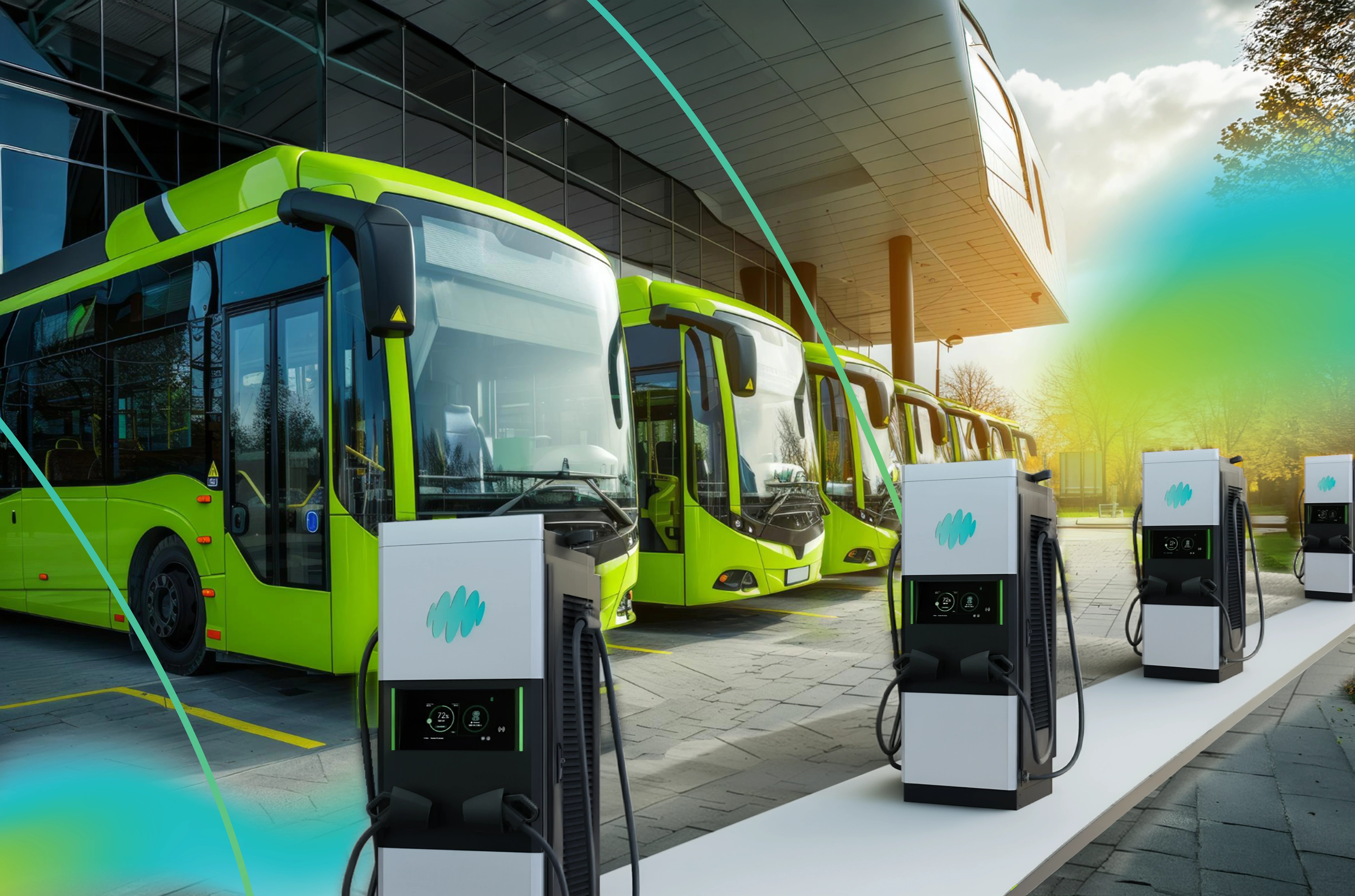
India runs over 150,000 state buses that carry 70 million passengers every day. Moving this network to electric power transfers gigawatt-hours of daily energy demand directly onto municipal power grids.
Imagine fifty 120 kW chargers powering up at once in a single bus yard. In seconds, that depot pulls 6,000 kW of power, risking transformer trips, city grid alerts, and 30% utility demand surcharges.
Setting up chargers without power management risks stranded buses and surging electricity bills. Fleet operators must balance charging speeds against route departure schedules and substation limits. This blog breaks down how smart charging and load management keep expanding Indian EV fleets running on time without exceeding substation capacity.
India's Growing Electric Fleet Is Increasing Demand For Depot Charging
Commercial EVs follow distinct duty cycles compared to personal cars. Private EV drivers spread their charging sessions across EV home chargers, workplaces, and highway plazas. Commercial fleets operate on fixed schedules and return together to central yards during set dwell windows.
This operational schedule builds multi-megawatt power demand inside individual depots. Fleet facilities must operate like dedicated utility substations to supply these daily power loads.
10,000 E-Buses Are Driving Depot Expansion
The Ministry of Housing and Urban Affairs (MoHUA) created the ₹57,613 crore PM-eBus Sewa program[1] to deploy 10,000 e-buses across 116 cities in 20 states and 6 union territories. The central government committed ₹20,000 crore in direct budget support, covering 100% of Behind-the-Meter (BTM) electrical systems.
Government data outlines the current progress across project stages:
Commercial fleet electrification extends beyond public buses. Under the PM E-DRIVE program, tenders for 10,900 e-buses were concluded by early 2026, while commercial delivery companies added thousands of cargo EVs to regional transit networks. Each e-bus carries a battery pack between 180 kWh and 320 kWh, creating high energy demand at municipal depots.
More EVs Are Increasing Depot Power Demand
Transit agencies run on strict passenger timetables. Any operational delay during overnight charging risks cascading route cancellations during morning commute hours.
Simultaneous Charging Raises Peak Demand And Costs
Buses return to operating depots in tight waves between 21:00 and 23:00 after completing evening passenger routes. When 50 to 100 buses connect to chargers at once without automated controls, every unit draws maximum rated power.
A depot with fifty 120 kW dual-gun chargers creates a sudden electrical demand spike of 6,000 kW. These sudden spikes trigger steep utility demand penalties.
Indian distribution utilities penalize peak power spikes using contract overage fees and Time-of-Day (ToD) tariff schedules. Under Delhi Electricity Regulatory Commission (DERC) rules[2], commercial consumers face a 30% surcharge on fixed demand rates if power draws exceed sanctioned contract limits. DERC also adds a 20% energy surcharge during peak night hours between 22:00 and 01:00, while providing a 20% rebate during off-peak morning hours from 04:00 to 10:00.
Unmanaged charging at 22:00 forces operators to pay peak electricity prices alongside peak demand penalties. Transit records in Delhi and Bengaluru show that demand charges account for 30% to 40% of total monthly depot electricity expenses.
Limited Grid Capacity Restricts Fleet Expansion
Distribution networks in major cities face physical supply limits near established bus yards. Getting approval for a higher sanctioned load or laying a dedicated 11 kV or 33 kV feeder line takes 6 to 12 months in Indian urban centers.
Depot yards often lack physical space for extra step-down transformers and medium-voltage switchgear units. When electrical upgrades stall, transit agencies cannot charge additional vehicles, leaving newly delivered EVs parked and unused.
Dynamic Load Management (DLM) helps address these constraints by distributing available power across multiple chargers without exceeding the depot's sanctioned load. Combined with compact, space-efficient charging systems, it can reduce the need for additional electrical infrastructure and help operators accommodate more vehicles within existing depot space.
Smart Charging Keeps Fleets Ready For Dispatch
Smart charging systems balance depot electrical boundaries with route timetables. Managing energy delivery systematically lets facilities support more EVs within existing transformer limits.
DLM Distributes Power Across Vehicles
Dynamic Load Management (DLM) monitors depot power consumption and adjusts charger output in real time. DLM sets individual charging speeds using vehicle departure times, current State of Charge (SoC), and required route distances.
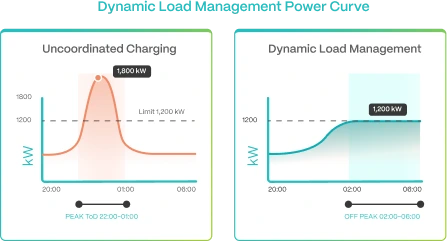
Consider a bus depot with a 1,200 kW grid connection running ten 180 kW dual-gun chargers. The total nameplate rating equals 1,800 kW, which exceeds substation capacity by 600 kW if all operate together.
DLM enforces a 1,200 kW facility limit, distributing 120 kW to each of the ten buses when they plug in at 22:00. When four buses finish charging at 02:00, the system redirects the available 480 kW capacity to the remaining six vehicles, raising their rate to 180 kW each. All ten vehicles reach full charge before their 05:30 morning dispatch without crossing the 1,200 kW cap.
Charging Data Improves Utilisation And Capacity Planning
Depot management systems track real-time telemetry, recording energy delivered, port usage rates, session lengths, and internal component temperatures. Integrating charging telemetry with fleet dispatch software directs high-power charging to buses scheduled for early long routes before vehicles assigned to short midday trips.
Accurate operational data simplifies electrical planning. Historical load trends show actual demand profiles, helping transit authorities avoid paying for oversized utility connections.
Depot Charging Requires Coordinated Power And Operations
Electrifying a commercial depot requires coordinating five practical operational variables:
Exicom Supports Smarter Fleet Charging
Exicom manufactures DC fast charging equipment and software platforms built for high-throughput commercial EV depots.
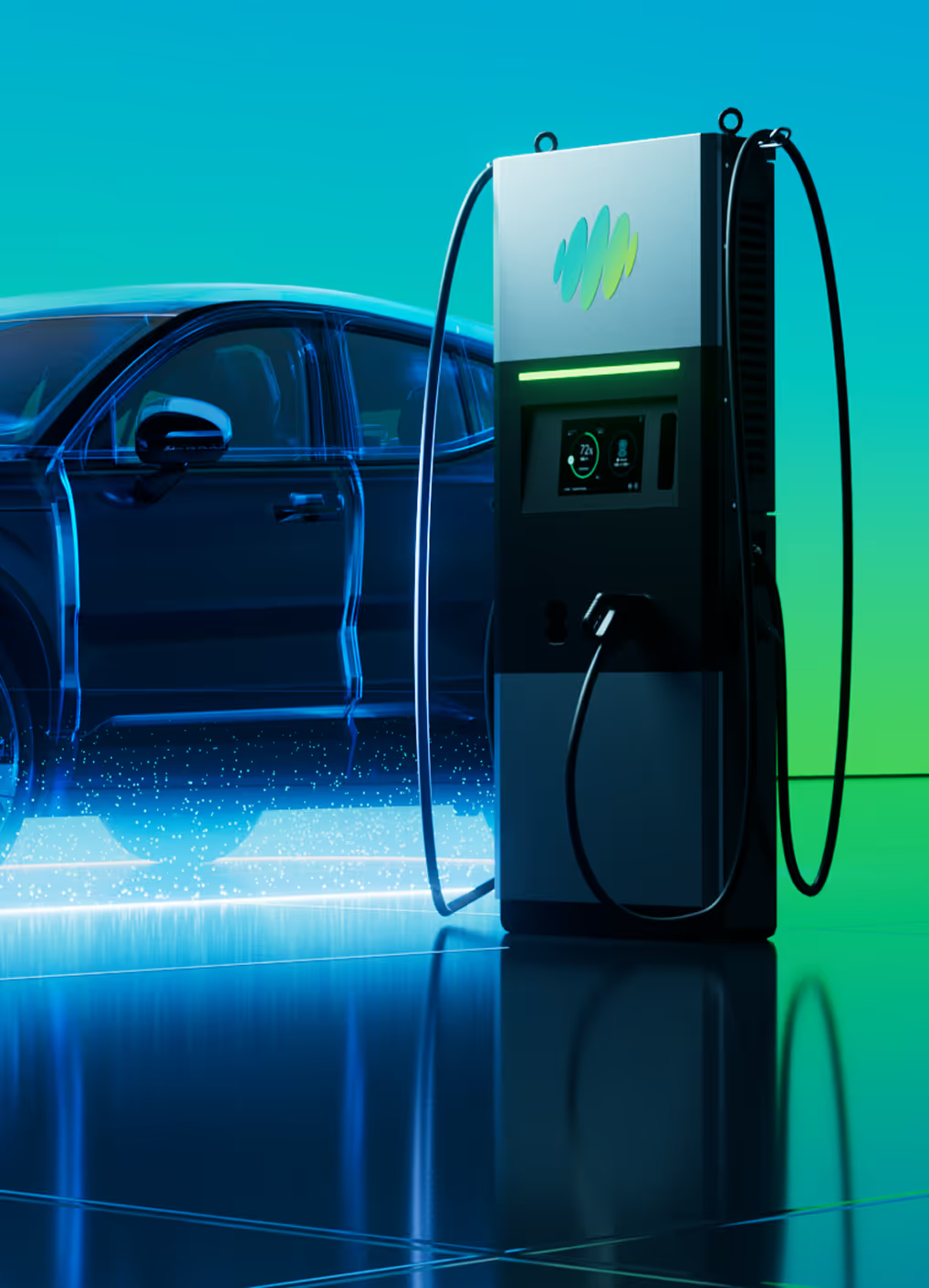
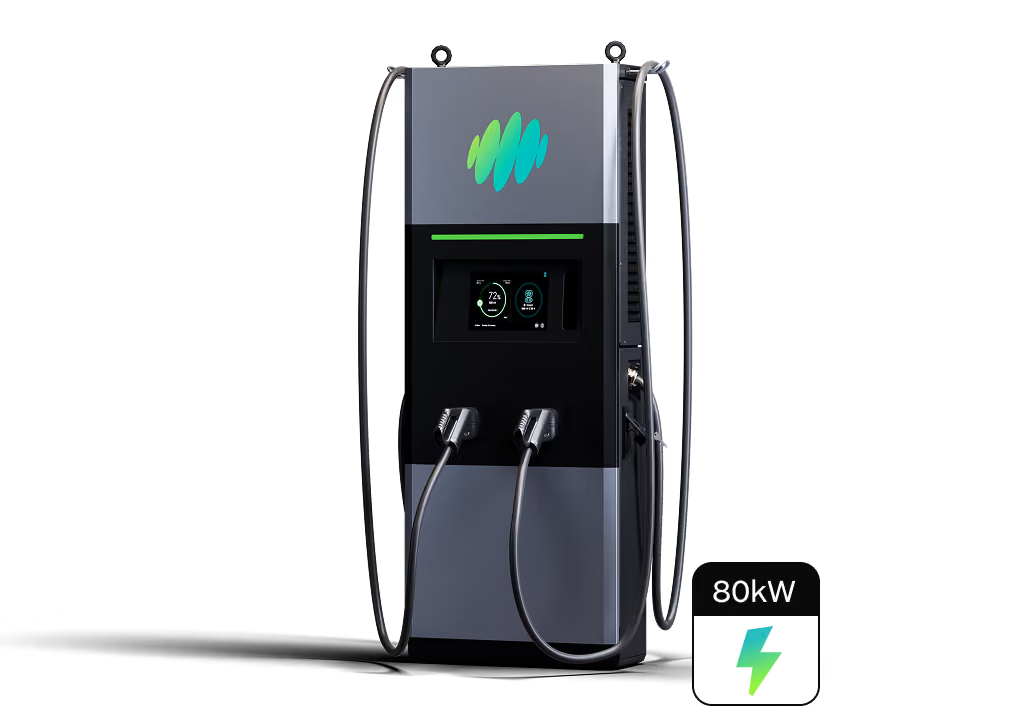
Exicom’s Slim 60 2.O offers 60 kW DC fast charging, expandable to 120 kW by connecting two units. Its power-sharing, remote monitoring and compact design make it suitable for fleet depots, reducing charging time and infrastructure costs.
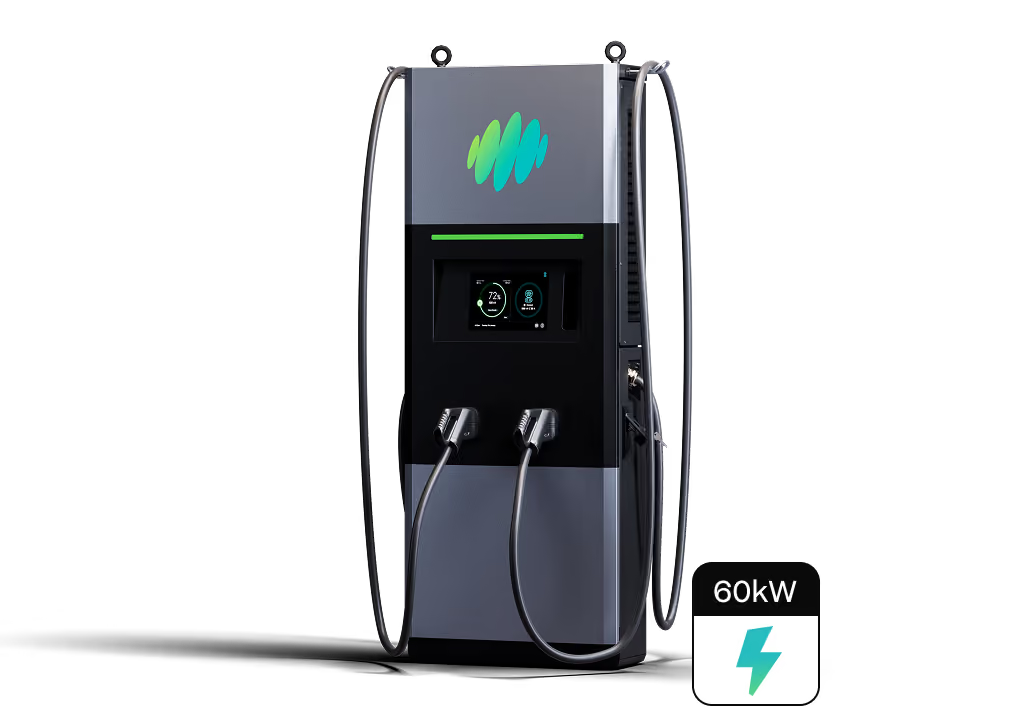
Meet Slim 60 2.0
Compact DC fast charging for commercial EV depots.
- 60 kW DC fast charging
- Expandable to 120 kW with two units
- Power-sharing capability
- Remote monitoring
For large transit facilities, the Harmony Distributed Charging System delivers up to 600 kW of centralized power, distributing energy across up to 12 dispensing points to save space in crowded yards.
For turnkey depot execution, the Exicom One model manages site assessments, civil construction, electrical substation setup, software integration, and field maintenance under a single provider.
Reliable fleet electrification depends on matching daily energy demand with utility capacity.
Coordinating charging loads with operational timetables turns constrained depot yards into dependable transit hubs.
Frequently Asked Questions
Lorem ipsum dolor sit amet, consectetur adipiscing elit, sed do eiusmod tempor incididunt ut labore et dolore magna aliqua. Ut enim ad minim veniam, quis nostrud exercitation ullamco laboris nisi ut aliquip ex ea commodo consequat. Duis aute irure dolor in reprehenderit in voluptate velit esse.
Lorem ipsum dolor sit amet, consectetur adipiscing elit, sed do eiusmod tempor incididunt ut labore et dolore magna aliqua. Ut enim ad minim veniam, quis nostrud exercitation ullamco laboris nisi ut aliquip ex ea commodo consequat. Duis aute irure dolor in reprehenderit in voluptate velit esse.
Lorem ipsum dolor sit amet, consectetur adipiscing elit, sed do eiusmod tempor incididunt ut labore et dolore magna aliqua. Ut enim ad minim veniam, quis nostrud exercitation ullamco laboris nisi ut aliquip ex ea commodo consequat. Duis aute irure dolor in reprehenderit in voluptate velit esse.
Lorem ipsum dolor sit amet, consectetur adipiscing elit, sed do eiusmod tempor incididunt ut labore et dolore magna aliqua. Ut enim ad minim veniam, quis nostrud exercitation ullamco laboris nisi ut aliquip ex ea commodo consequat. Duis aute irure dolor in reprehenderit in voluptate velit esse.
Lorem ipsum dolor sit amet, consectetur adipiscing elit, sed do eiusmod tempor incididunt ut labore et dolore magna aliqua. Ut enim ad minim veniam, quis nostrud exercitation ullamco laboris nisi ut aliquip ex ea commodo consequat. Duis aute irure dolor in reprehenderit in voluptate velit esse.