



The Real Cost of Bay Time: Why Fleets Lose Revenue to Charging Inefficiency
.webp)
Your fleet makes money on the road. Not in the parking bay.
A taxi makes money when someone's riding in it. A delivery van makes money when it drops off a package. A bus makes money when it finishes its route. A truck makes money when it delivers cargo. None of these vehicles make a single rupee while they're sitting in a charging bay.
Which makes one question increasingly important as fleets electrify: How much productive road time does your charging infrastructure create?
That's an easy thing to forget when selecting EV chargers. Fleets usually pick a charger the way they'd pick any other equipment: based on price and power rating. But a charger doesn't make money. The vehicle does, once it's back on the road.
This matters more every day. India's electric commercial vehicles are selling fast. Sales grew 163.7% year on year in June 2026, and electric buses are expected to double their market share by FY27. As more taxis, delivery vans, buses and trucks go electric, charging stops start directly affecting how much money a fleet makes.
The vehicle earns revenue. The charger's job is to get it back on the road, fast and reliably. This article looks at how much every hour of charging downtime really costs fleets, and why fast, intelligent charging actually protects a fleet's bottom line.
The Hidden Economics of One Hour Offline
The hidden cost of EV charging is not just the electricity bill. It is the time a vehicle spends unavailable for productive work.
.webp)
A vehicle sitting in a charging bay can lead to a missed trip, delayed delivery, reduced daily utilization, driver idle time, route disruption, or potential SLA impact. But one hour of downtime does not cost every fleet the same. Its impact depends on how the vehicle generates revenue and how tightly it adheres to scheduled trips, deliveries, or routes. Across a fleet, those lost hours can quickly add up.
This is why the real cost of charging is better represented as an equation:
The opportunity cost varies across fleets, but the principle remains the same: the more productive a vehicle is, the more valuable its availability becomes.
In India's 2022 CESL tender for 5,450 electric buses, Tata Motors' quoted rates ranged from ₹39.21/km for a 9-meter standard non-AC e-bus to ₹47.49/km for a 12-meter low-floor AC e-bus, including electricity costs for charging.
That illustrates why every productive kilometer matters when fleet economics are measured against kilometers delivered. It also shifts charger procurement away from CAPEX toward total cost of ownership and cost per kilometer, metrics fleet operators ultimately care about. McKinsey's research on zero-emission trucks treats dwell time as a direct TCO variable alongside fuel, maintenance, and tolls. Fleet operators evaluating EV charging infrastructure should treat it the same way.
In practice, a missed charging window can mean a missed trip, delivery slot, or route departure, incurring costs from lost fares, penalties, or even the need for an extra vehicle to cover the gap. Charging downtime, multiplied by the value of productive vehicle time, becomes an opportunity cost that never appears on the energy bill.
However, not all fleet downtime costs the same. The economic impact of charging downtime depends on how each fleet earns and operates:
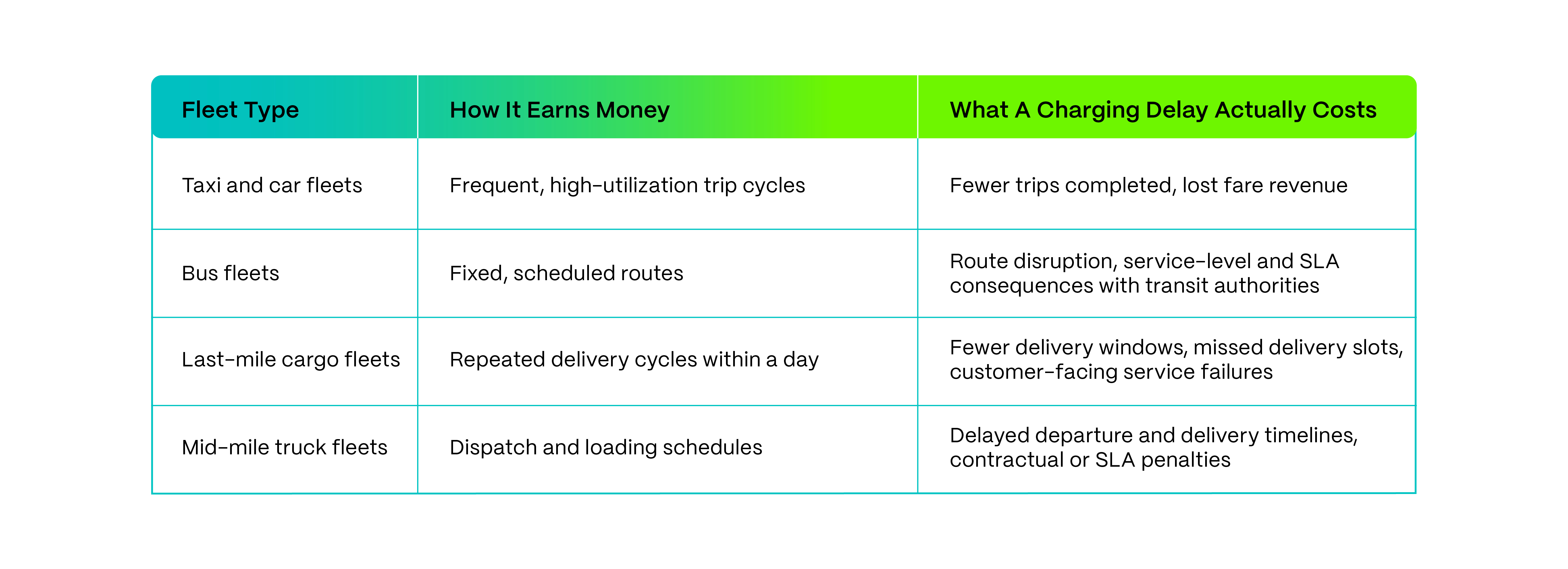
The common thread across all four archetypes is that charging time never stays contained to the charging bay. It moves downstream into trips, routes, deliveries, and contracts. Fleet operators evaluating charging infrastructure should ask which of these consequences applies to their operation, because that answer changes what "fast enough" and "reliable enough" actually mean for their fleet specifically.
Two operators running the same charger in the same city on the same power tariff can end up with completely different exposure to the same hour of downtime. A ride-hailing fleet absorbs it as a handful of missed fares. A mid-mile trucking contract with a penalty clause absorbs it as a line item on next month's invoice.
When Charging Becomes a Fleet Bottleneck
A fleet can have enough vehicles, drivers, and routes planned and still lose productivity at the depot. It happens when charging cannot keep pace with the fleet's operating schedule.
Five variables determine how that bottleneck develops:
1. Charging turnaround
How quickly can a vehicle complete its charging session and leave the bay?
2. Depot congestion
What happens when multiple vehicles need to charge around the same time?
3. Dispatch schedules
Can charged vehicles leave when the operation needs them, or does charging push dispatch windows back?
4. Vehicle availability
How many vehicles are actually ready for their next productive assignment?
5. Charging throughput
How much useful charging capacity can the depot deliver during its critical operating windows?
These variables are connected.
Longer charging turnaround → more vehicles occupying bays → greater depot congestion → delayed dispatch → lower vehicle availability.
And once vehicle availability falls below the operation's requirements, the charging infrastructure has effectively become a fleet bottleneck. This is why simply counting charging points can be misleading. Four chargers don't necessarily deliver twice the operational value of two. What matters is how much charging throughput the depot can deliver when vehicles need it.
Why Charging Power Changes the Equation
Once charging becomes a throughput problem, its relationship for high-utilization and heavy-duty fleets changes.

That chain has a direct financial outcome, because every minute a bus or truck spends charging is a minute it is not completing its route or its delivery.
Diesel refueling takes about 10 minutes, while EV charging can take 30 minutes to several hours, depending on the charger technology used. That gap is precisely why high-power charging matters more for heavy-duty applications than for passenger vehicles.
Charger technologies like Exicom's Harmony Direct 2.0 and Harmony Distributed are built around exactly this need for high-power output in fleet and heavy-duty settings. Exicom's current fleet portfolio includes DC charging solutions ranging from 60–400 kW, alongside its 600 kW Harmony Distributed Charging System. Harmony Distributed, for example, can support up to 12 charge points and dynamically allocate power in 30 kW increments based on demand.
The takeaway is that the charger a fleet should buy is a critical infrastructure design decision, as the power a charger delivers directly affects how much road time a fleet gets back.
Why Intelligence Matters Too
Installing higher-powered chargers does not automatically solve a depot's constraints. Power availability and charging efficiency are two different problems.
A depot can have multiple high-power chargers and still run into bottlenecks if that power is not managed intelligently across vehicles. This is where intelligent load management becomes as important as charger power itself. Dynamic load management and ring topology approaches allow more vehicles to charge simultaneously by intelligently distributing available power across the depot, often without requiring a grid upgrade.
For fleet operators, this utilization matters financially. The IEA estimates that increasing EV charger utilization from 5% to 30% can reduce the levelized infrastructure cost per kWh by about 80%. For electric trucks, the analysis estimates this could halve overall fuel cost per kilometer, based on 2024 prices. An intelligently utilized charging asset can support more vehicle movement from the same infrastructure.
Managing High-Power Charging Within Existing Grid Capacity
Upgrading a depot’s sanctioned grid load requires capital, complex paperwork, and lengthy DISCOM approval cycles. Intelligent power management bypasses these grid upgrade bottlenecks by maximizing every kilowatt of existing depot capacity:
- Dynamic Load Management: Reallocates available power based on vehicle demand, rather than giving every charger its maximum power at all times.
- Ring Topology: Enables multiple vehicles to charge simultaneously while managing power within the depot's available capacity.
- Live Infrastructure Visibility: Provides real-time telemetry on which dispensers are actively charging, queued, or idle to optimize vehicle turnover.
- Modular Fleet Scalability: Enables operators to add charging guns as fleet size expands over time without triggering immediate sanction upgrades.
Reliability Is Also a Road-Time Problem
There is another piece of the equation that needs attention here. A vehicle can arrive at the depot exactly on schedule and still lose road time if the charging infrastructure itself fails. Charger downtime is functionally identical to charging inefficiency. Both result in the same outcome: a vehicle that should be on the road but isn't.
This is where remote monitoring, predictive diagnostics, and preventive maintenance become part of the road-time equation rather than a back-office IT concern. Exicom’s remote monitoring system, paired with predictive diagnostics, can flag developing charger issues before they become full breakdowns. That early intervention prevents unexpected charger failures, which in turn keeps vehicle availability predictable instead of reactive.
Predictable vehicle availability compounds the same way downtime does, just in the opposite direction. Fewer unexpected charger failures across a depot mean fewer disrupted dispatch schedules across a fleet.
Unlike a diesel pump, a charger is a networked device with sensors, contactors, and software that can be monitored continuously. Fleet operators evaluating charging infrastructure should treat that connectivity as an operational asset. A charger that reports its own health before it fails protects road time in exactly the same way a faster charger does. It simply protects it by preventing downtime rather than shortening it.
The New Fleet Charging Equation
Put the pieces together, and a clearer picture of fleet charging economics emerges:
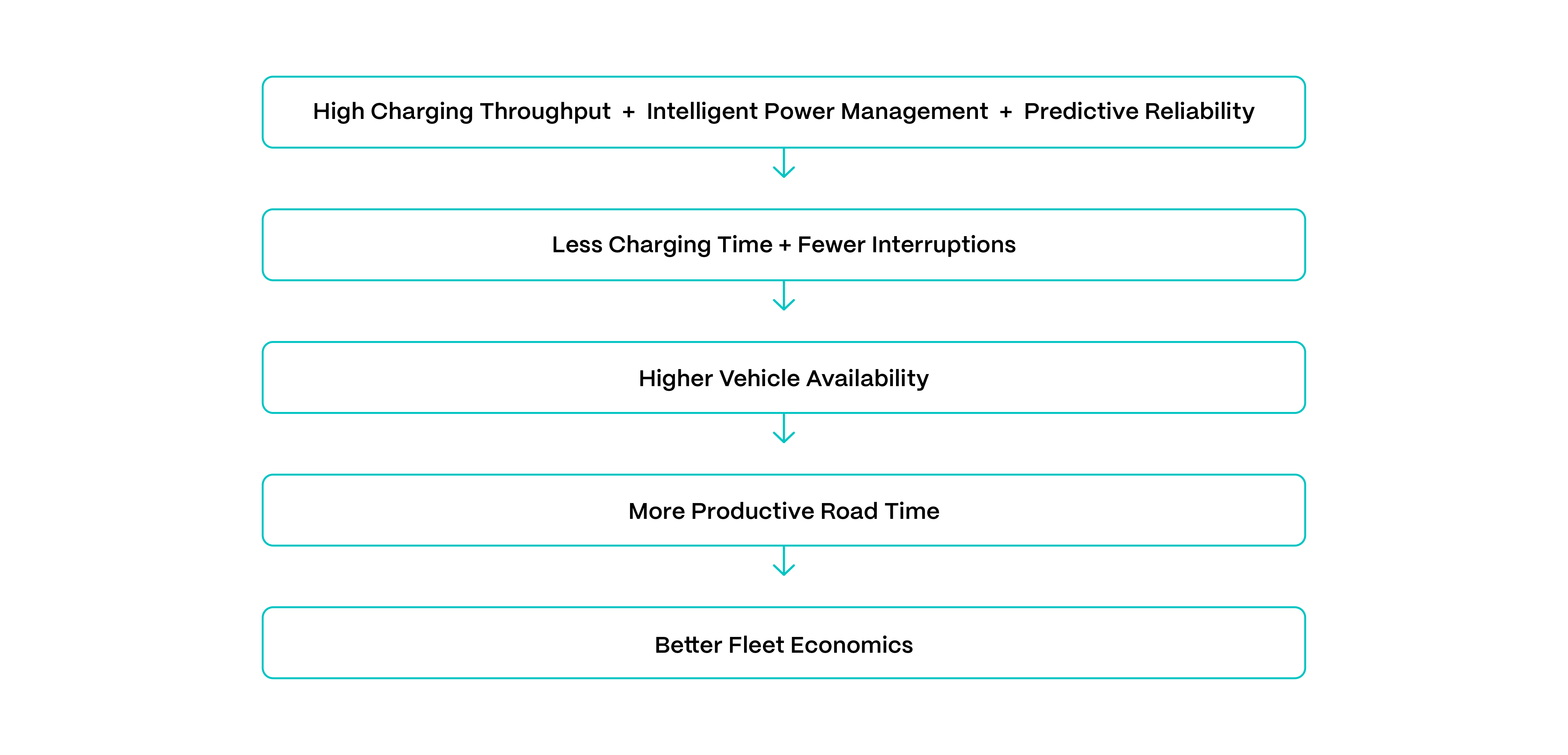
That is the equation fleet operators should be using when evaluating EV charging infrastructure, not "What does this charger cost?"
Measure Charging by What It Enables
The ideal procurement question should be "What charging infrastructure gives my fleet the lowest cost per productive kilometer?" Because roads create value. Not parking bays.
Fleet operators should evaluate charging turnaround, vehicle availability, charging throughput, infrastructure reliability, depot scalability, and lifecycle TCO together, rather than in isolation.
The best charging infrastructure is not necessarily the one that costs the least per charger. It is the one that keeps the most vehicles productive, for the longest time, at the lowest lifecycle cost. For fleets, that is the only measure that actually connects back to revenue.
Frequently Asked Questions
Lorem ipsum dolor sit amet, consectetur adipiscing elit, sed do eiusmod tempor incididunt ut labore et dolore magna aliqua. Ut enim ad minim veniam, quis nostrud exercitation ullamco laboris nisi ut aliquip ex ea commodo consequat. Duis aute irure dolor in reprehenderit in voluptate velit esse.
Lorem ipsum dolor sit amet, consectetur adipiscing elit, sed do eiusmod tempor incididunt ut labore et dolore magna aliqua. Ut enim ad minim veniam, quis nostrud exercitation ullamco laboris nisi ut aliquip ex ea commodo consequat. Duis aute irure dolor in reprehenderit in voluptate velit esse.
Lorem ipsum dolor sit amet, consectetur adipiscing elit, sed do eiusmod tempor incididunt ut labore et dolore magna aliqua. Ut enim ad minim veniam, quis nostrud exercitation ullamco laboris nisi ut aliquip ex ea commodo consequat. Duis aute irure dolor in reprehenderit in voluptate velit esse.
Lorem ipsum dolor sit amet, consectetur adipiscing elit, sed do eiusmod tempor incididunt ut labore et dolore magna aliqua. Ut enim ad minim veniam, quis nostrud exercitation ullamco laboris nisi ut aliquip ex ea commodo consequat. Duis aute irure dolor in reprehenderit in voluptate velit esse.
Lorem ipsum dolor sit amet, consectetur adipiscing elit, sed do eiusmod tempor incididunt ut labore et dolore magna aliqua. Ut enim ad minim veniam, quis nostrud exercitation ullamco laboris nisi ut aliquip ex ea commodo consequat. Duis aute irure dolor in reprehenderit in voluptate velit esse.


%20(1).webp)

