



Electrical Conduit Provisioning
What is Conduit Provisioning?
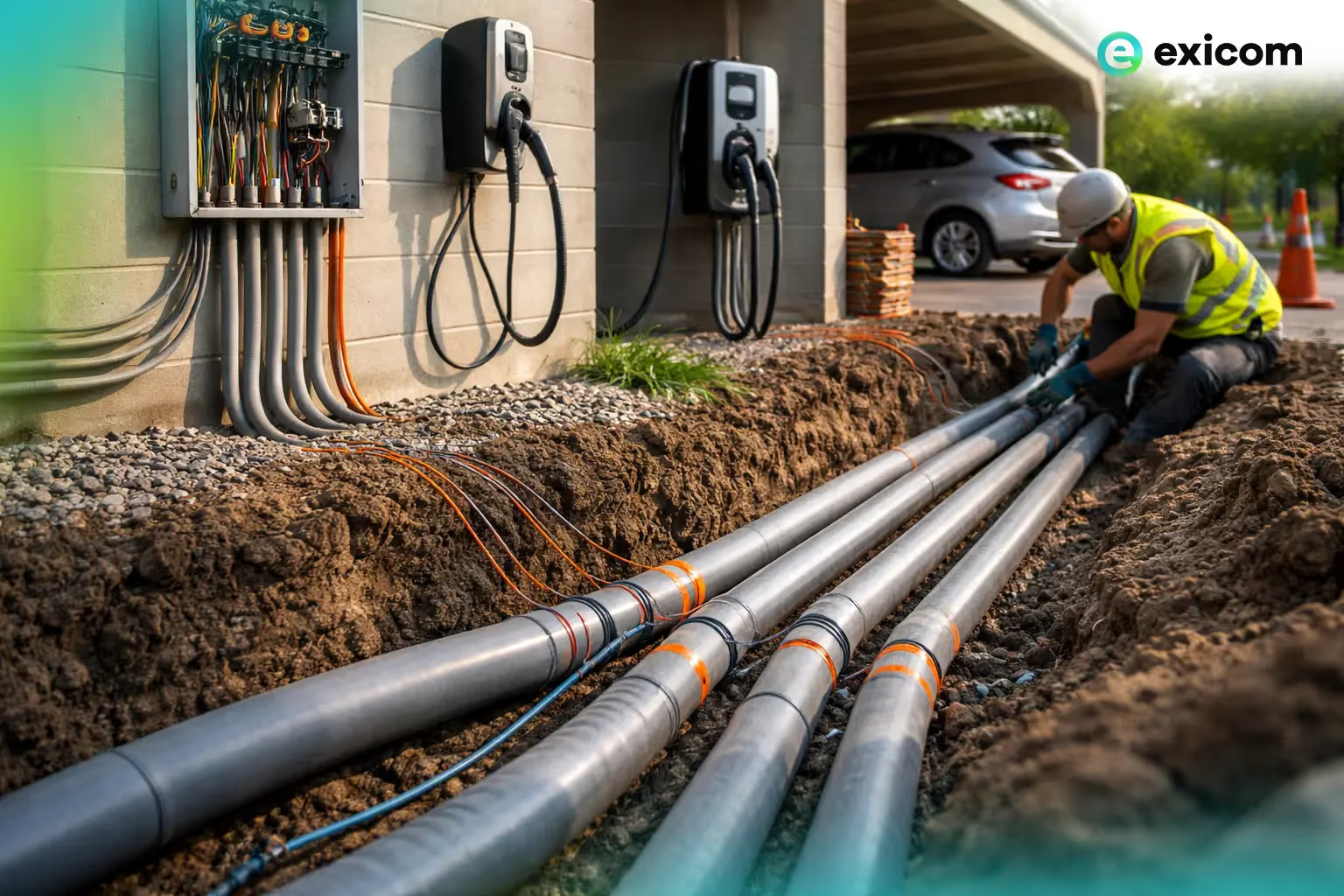
Conduit provisioning involves the installation of empty, protective structural channels ,usually robust plastic or metal tubing; during the civil construction phase of a building or parking structure. In the development of electric vehicle infrastructure, installing conduits in EV designs guarantees that physical pathways are integrated into concrete slabs, trenches, and walls, enabling property owners to run high-voltage electrical wiring later without costly demolition or structural modifications.
Expanded Explanation of Infrastructure Economics
For property developers, fleet operators, and commercial enterprises, building design must adapt to long-term electrification trends. In the past, electrical infrastructure layout followed a purely reactive model where wiring was installed only when a specific asset or machine was purchased. Under modern real estate and facility standards, this approach creates massive financial friction.
At a novice level, electrical conduit installation can be seen as establishing an underground road network before the vehicles come. Running vacant protective piping through a parking structure or depot floor during the first concrete pour removes the necessity to core drill through structural slabs, open walls, or excavate asphalt when installing chargers later.
Transitioning to a technical perspective, conduit provisioning turns a static civil asset into an adaptable, future-ready energy node. A high-output public or fleet facility requires dense clusters of three-phase power lines.These cables produce heat loads, need strong physical grounding, and should be protected from moisture, physical damage, and electromagnetic interference (EMI). Installing a specialized infrastructure network of hidden conduit wiring ensures that future high-power fast chargers can be easily connected, maintaining manageable budgets for future installations.
How Conduit Provisioning in EV Systems Works
Executing a seamless, expandable charging infrastructure network relies on aligning four foundational physical and electrical layers during early site development:
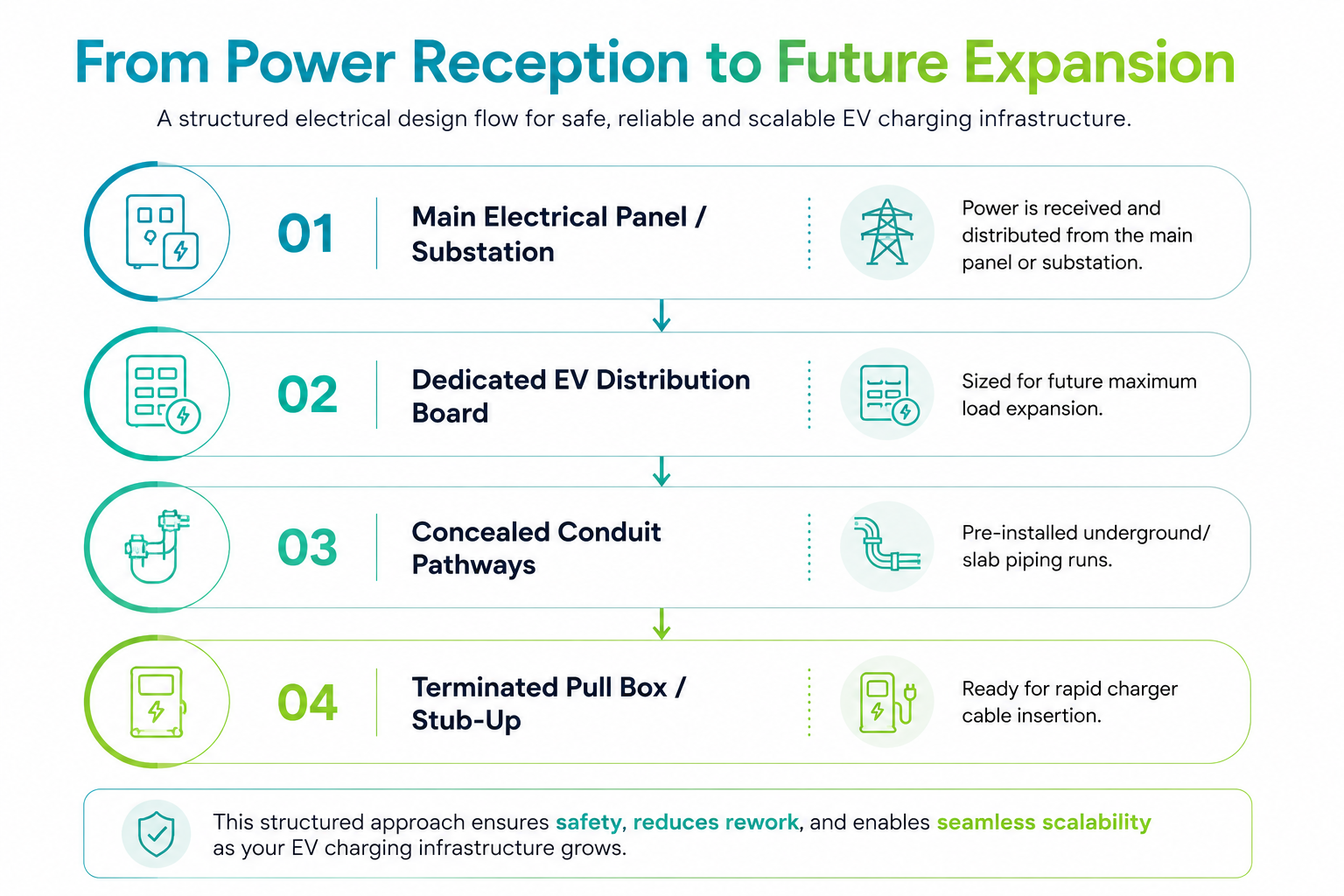
- Main Electrical Panel / Substation: The upstream utility point where high-voltage power enters the commercial property boundary.
- Dedicated EV Distribution Board: A centralized electrical panel dedicated exclusively to EV load management, equipped with isolated circuit breakers.
- Concealed Conduit Pathways: The pre-installed underground, surface-mounted, or cast-in-slab piping runs that form the continuous, empty structural channels.
- Terminated Pull Box / Stub-Up: The physical termination point where the empty conduit emerges at a designated parking bay, capped and fitted with a nylon pull-string for immediate wiring access.
Technical Asset Analysis: Conduit System Configurations
Selecting the correct material and installation architecture dictates the long-term resilience and scaling capacity of commercial charging installations.
Real-World B2B Use Cases
- Consumers: Benefit from widespread charger availability in apartment complexes and retail hubs. Pre-provisioned conduits mean multi-family housing complexes can activate personal charging points on demand without community infrastructure disputes.
- Businesses: Commercial offices and shopping malls use pre-installed wiring paths to scale their visitor charging spots incrementally, matching charger deployment to actual customer adoption curves.
- Fleets & Infrastructure Players: High-volume logistics hubs and commercial Charge Point Operators (CPOs) install high-diameter embedded runs to ensure they can scale up from 60 kW destination units to 240 kW or 400 kW ultra-fast chargers without halting site operations.
Financial Performance Metrics
The financial logic of pre-installing charging paths centers on avoiding structural retrofitting costs. Comparative field metrics show the distinct economic variance between proactive provisioning and reactive installation:
India Market Context and Competitive Landscape
India's public and commercial charging infrastructure market is scaling rapidly, driven by major technology providers like Exicom Tele-Systems, Tata Power, and Jio-bp.
- Policy Guidelines: The Ministry of Housing and Urban Affairs (MoHUA) has revised its Model Building Bye-Laws to require that all commercial structures and multi-family residential units set aside a minimum of 20% of their overall parking space for EV charging. Crucially, the guidelines stipulate that these spots must feature full electrical conduit provisioning and structural load planning.
- Market Costs: The baseline conduit provisioning in ev cost within the Indian market ranges from ₹100 to ₹250 per linear foot for standard Schedule 80 PVC installations, depending on diameter requirements (typically 2-inch to 4-inch inner diameter to handle thick commercial copper cables). This minor upfront cost saves operators from expensive concrete cutting and road-breaking charges later.
Operational Strategies by Industry Segment
- Fleet Operators: Run dense depot hubs where operations depend on predictable vehicle turnaround times. By installing oversized underground conduits early, they can scale up charger capacities as their commercial delivery fleets shift from light three-wheelers to heavy-duty trucks.
- CPOs: Partner with commercial spaces under long-term land leases. Selecting sites that feature pre-installed structural pathways allows CPOs to speed up commissioning timelines by up to 75%, shifting quickly from site design to active revenue generation.
- Enterprises & Commercial Real Estate: Protect their architectural investments by integrating hidden distribution paths during development. This guarantees that their parking areas appear immaculate, preserving high asset values while staying completely equipped for upcoming tenant energy needs.
Infrastructure Challenges and Mitigations
Final Thought
Pre-installing infrastructure pathways is a fundamental prerequisite for sustainable e-mobility scaling. Treating energy delivery and civil architecture as a single, unified system allows commercial property developers and logistics operators to eliminate future expansion bottlenecks. Investing in reliable path planning ensures that scaling up charging infrastructure remains a simple software and cable upgrade, rather than an expensive structural overhaul.

