



AC vs DC Charging for EVs: Differences, Speed, Cost & Use Cases
.avif)
As the global transition to electric mobility accelerates, understanding the infrastructure that powers it is absolutely critical. Whether you are an EV owner optimizing your daily commute or a Charge Point Operator (CPO) mapping out a profitable public network, knowing the exact mechanics of AC vs DC charging EV technology dictates your operational efficiency, infrastructure costs, and overall vehicle uptime.
What is the main difference between AC and DC EV charging?
What is AC Charging?
The electrical grid transmits power in Alternating Current (AC), but electric vehicle batteries can only store power in Direct Current (DC). When you plug an EV into an AC charger (commonly referred to as Level 1 or Level 2 charging), the power flows into the vehicle's internal Onboard Charger (OBC).
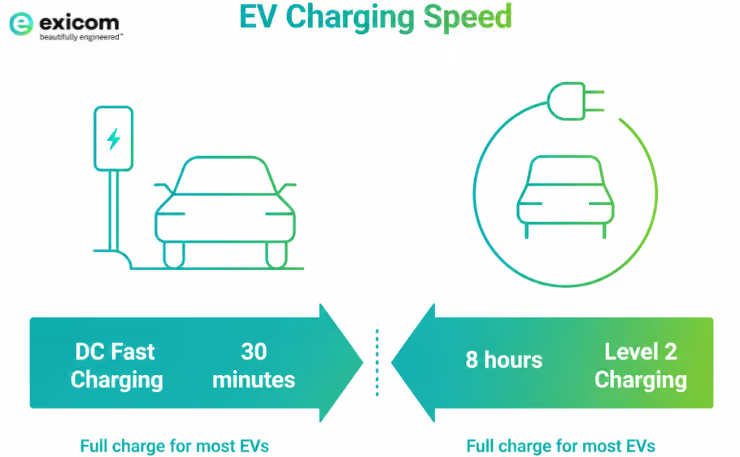
The OBC acts as a heavy-duty converter, transforming the grid's AC power into DC power to safely charge the battery cells. Because the OBC must be small and light enough to travel inside the car, its conversion capacity is physically limited. This is why AC charging is generally slower, typically delivering power between 3.3 kW and 22 kW. It is the absolute standard for scenarios where the vehicle is parked for extended periods.
What is DC Charging?
DC Fast Charging (often called Level 3 charging) flips the script by moving the power converter out of the vehicle and into the charging station. Because a public DC station does not have the space or weight constraints of a passenger car, it houses massive, highly efficient power electronics.
By bypassing the vehicle's onboard bottleneck, DC chargers pump power directly into the battery. This allows for an incredible surge in energy transfer. Modern DC fast chargers range from 30 kW for urban top-ups to massive 400 kW+ ultra-fast chargers found on major highway corridors, capable of adding hundreds of kilometers of range in mere minutes.
AC vs DC Charging: Key Differences
To understand the core difference AC DC charging infrastructure presents, operators and owners must look at speed, cost, and grid impact.
Which is Better: AC or DC Charging?
The decision between Level 2 vs DC fast charging is not about which technology is inherently "better"; it is entirely dependent on vehicle dwell time and strategic placement. The choice depends on usage:
- Home charging: AC is cost-effective and completely sufficient for overnight replenishment.
- Fleet operations: DC enables high uptime and fast turnaround, ensuring commercial vehicles stay on the road generating revenue.
- Public infrastructure: DC attracts users, reduces wait time, and eliminates highway range anxiety.
- Mixed environments: A hybrid AC + DC strategy works best for comprehensive coverage (e.g., placing DC chargers for quick top-ups and AC chargers for all-day employee parking at the same tech park).
Real-World Use Cases
Understanding AC vs DC charging EV dynamics is critical for matching hardware to the correct user demographic.
- Homes and Residential Complexes: AC charging is the undisputed king here. Vehicles are parked overnight, meaning an affordable 7.2 kW or 11 kW AC charger easily tops up the battery while the owner sleeps, utilizing cheaper off-peak electricity tariffs.
- Workplaces and Tech Parks: Employee vehicles sit in parking lots for 8–9 hours a day. Deploying a large bank of smart AC chargers is highly cost-effective for enterprises and provides a massive green perk to employees.
- Commercial Fleets (Last-Mile): E-commerce delivery fleets utilizing 2-wheelers, 3-wheelers, or light electric trucks primarily use AC hubs overnight. However, for 24/7 high-utilization taxi fleets (like Uber/Ola), 30 kW or 60 kW DC chargers are deployed at strategic urban hubs for mid-shift "snack charging."
- Highways and Public CPOs: For Charge Point Operators running highway stations, DC charging is the core product. The business model relies on high throughput—getting cars charged and back on the road in under 30 minutes to maximize transaction revenue and minimize queueing.
Cost & Infrastructure Comparison
The cost AC vs DC EV infrastructure setups is drastically different, deeply impacting the financial modeling for CPOs and fleet operators.
- AC Charging: Features much lower installation costs and standard grid requirements, making it highly scalable for mass deployment.
- DC Charging: Requires a significantly higher upfront hardware cost (CapEx) but offers vastly better daily transaction revenue potential due to high throughput.
- Grid Load: DC infrastructure requires sophisticated load balancing, dedicated high-voltage transformers, and meticulous power planning with local utility boards.
- ROI: Fast charging offers a much faster payback period in high-traffic, low-dwell-time locations, provided the utilization rate remains consistently high.
Impact on Battery & Efficiency
Does the high EV charging speed AC vs DC offer damage electric vehicle batteries?
The short answer is: modern Battery Management Systems (BMS) heavily protect the battery, but excessive DC fast charging generates significant heat, which is the primary enemy of lithium-ion cell longevity.
When utilizing DC fast charging, the vehicle's BMS communicates directly with the charger. This is why you see a charging curve. A DC charger will blast energy into the battery from 10% to 80% very quickly. However, once the battery hits 80%, the internal resistance and heat rise sharply. To protect the cells from degradation and thermal runaway, the BMS forces the DC charger to severely throttle the speed for the final 20%.
For optimal battery health over a 10-year lifespan, automakers recommend using AC charging for daily needs and reserving high-power DC fast charging for long-distance travel or operational emergencies.

