



Precision Manufacturing in EV chargers : Exicom
.png)
Welcome back to our blog series, “Beautifully engineered, Masterfully manufactured.” In our last post, we took you behind the scenes of our new Hyderabad facility, the place where our biggest R&D dreams finally met the factory floor.
But here’s the thing: a visionary design is only as good as the tools used to build it. When you’re dealing with high-power electronics, there is zero room for "close enough." That’s why our first deep dive is all about Precision.
Precision is the most important feature of high-quality EV Chargers
By precision, we are not only referring to the fit of the casing or the aesthetic finish when it comes to manufacturing EV chargers. We are discussing the integrity of high-power electronics that needs to handle hundreds of kilowatts of power and communicate to complicated vehicle batteries and to move grid loads. The industry has come to an extent where accuracy has shifted its status to being a value-add to a system level requirement. The reason is that EV chargers are uniquely demanding. A charger is in the wild, unlike consumer electronics that are kept in climate-controlled living rooms. It is exposed to the merciless sun, monsoon rain, and the physical wear of thousands of users. In this environment, a deviation of even a few microns in a solder joint or a slight variance in a voltage regulator can cascade into a complete system failure.
It's one thing to build a perfect prototype, but it’s quite another to ensure the 5,000th unit on your network performs exactly like the first.
Maintaining precision becomes difficult with scale
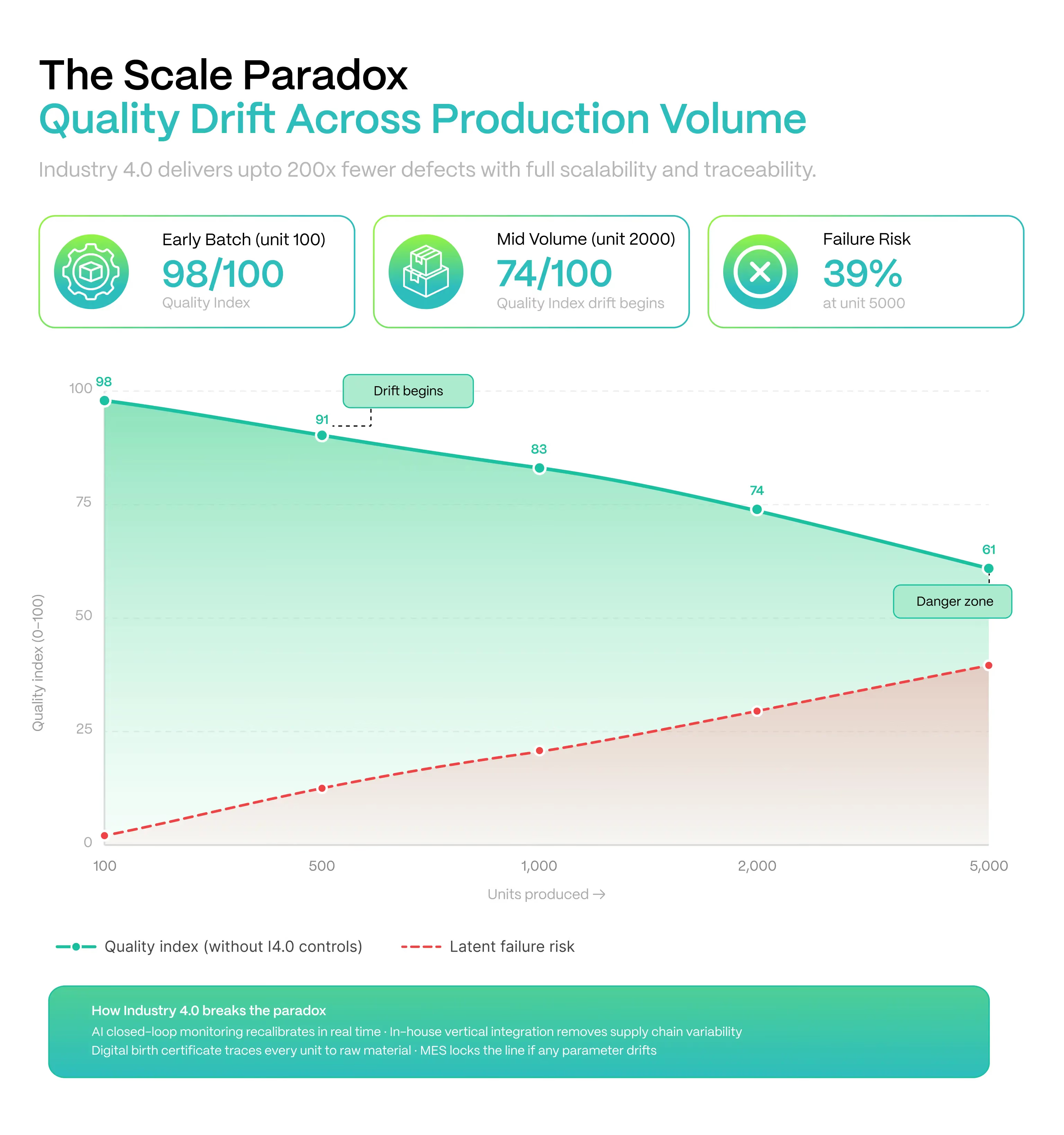
With the EV market shifting towards millions of units instead of thousands, manufacturers are confronted with what has been called the Scale Paradox. Theoretically, the more you produce, the better you should be; in practice man-volume production frequently results in quality drift. This is caused by small, almost invisible changes in the production process, like a small difference in viscosity of solder paste or erosion of a mechanical jig and starts adding up. This is a dreadful prospect for a CPO. It implies that the first 100 chargers that you purchased have worked flawlessly but the next 500 could harbor some defects that will not come to light until after six months of field service. This is also made complicated by the tolerance stack up where a single component may be within its limits, but when combined together, its variation may cause an end product that is inherently unstable.
The greatest risk of stack-up of tolerance is most apparent with complex electronics such as an EV charger. Suppose that a power module is a little above its thermal limit, and that a fan is a little below its cooling capacity. On a case-by-case basis, both pass inspections. They combine to form a charger that overheats during a summer day in Hyderabad with temperatures of 45o C, resulting in a thermal shutdown at the time when the CPO should be registering high revenues.
It is not the failure of design, but failures of precision at scale.
In the absence of a manufacturing system that will help in real-time detecting these drifts, the CPO is then left as the de-facto tester of the product in the field which is a position no operator would wish to hold.
And the volume of deployment is only one part of the problem.
Diverse supply chain needs further complicate this
The contemporary international supply chain, although effective in commodities, presents a big source of variation to high-precision electronics. There are numerous charger vendors that work using a distributed model of the charger, where PCBAs are purchased through one vendor, enclosures through another, and power modules through a third vendor. This forms a black box in the production cycle. An example is a vendor swapping a capacitor grade or PCB resin to save money or deal with a shortage. Although the part still corresponds to the basic electrical spec, its thermal expansion coefficient may be a bit different. Once that component is incorporated into a charger, it adds a new variable, which the manufacturer has not considered.
In the case of Exicom, the answer to this is not the use of the so-called Lego-block approach but deep vertical integration. Exicom has the ability to design and produce all system-level PCBAs and power conversion modules in-house, removing variability associated with third-party sourcing. When the production team and the engineering team are operating at the same roof, a specification change is reflected immediately on the controls of the manufacturing process. The new Hyderabad facility is an example of this in-house philosophy where the facility was constructed to address the issues of scale by deploying Industry 4.0 automation.
Overcoming the Scale Paradox requires moving beyond simple assembly toward a philosophy of absolute control. You cannot fix a 'tolerance stack-up' in the field. You have to prevent it at the micron level.
This is why we’ve built our entire manufacturing ecosystem around five core dimensions of precision, ensuring that the ten-thousandth charger is just as reliable as the first.
EV charging manufacturing needs to embed precision in every stage
To be reliably scaled, accuracy must be an active component of the assembly line smartness. Exicom’s Hyderabad facility, spread across 18.4 acres with a 130,000 sq. ft. electronics plant, is a testament to this philosophy. This is a digitally linked modular manufacturing platform. To a CPO, this plant is a 10x growth of the past Gurugram locations which can make 100,000 AC chargers and 4,000 DC chargers in a year, and the infrastructure is prepared to scale to 300,000 and 6,000, respectively.
Precision in EV charger manufacturing has 5 dimensions
Exicom to embed precision is designed based on the five dimensions that have been identified by industry research as important to the longevity of EV infrastructure.
- Process Precision ensures zero-defect execution by utilizing smart assembly lines and AI vision to eliminate human error at every stage.
This level is at the lowest level of the assembly of the brains of the charger- the PCBAs. Exicom has internalized this process vertically such that all boards that enter into a rectifier or a controller are assembled to the automotive-grade standards. This starts with an ISO Class 8 Clean Room, a controlled condition that limits air particles to avoid dust contaminating solder joints. A single microparticle of dust in a solder joint in the high-voltage EV charging world may lead to intermittent connection and create a latent failure that may not show up months later.
The SMT lines of Exicom have high-speed that is 120,000 components per hour (CPH) and the accuracy of the SMT lines is 300 m. A 30 microns is less than a quarter of the thickness of a human hair. This degree of precision ensures that parts fit in their pads to the point of forming a strong solder attachment that can handle the vibrations and thermal strains of the field. Moreover, 3D Solder Paste Inspection (SPI) is employed to identify the volume and area of the solder paste prior to components being placed, with 60-70% of potential defects being identified at the earliest point possible.
- Product Precision operates at a microscopic scale to place foundational components with an accuracy of ±30 microns using high-speed SMT technology.
When the PCBAs are completed, the emphasis switches to the Box Build or the final assembly. Structural integrity of the charger is a key safety consideration to a CPO. Exicom employs modular assembly lines, which focus on repeatability and data-driven implementation. Digital Torque Control is one of the most remarkable attributes of the DC and AC lines.
The digital torque guns of Exicom are connected to the central Manufacturing Execution System (MES); in the case, the screw is not tightened to the programmed torque, the system indicates it, and the unit cannot move to the next station. This is supplemented by Vision Camera Validation. In several steps, the positioning of cables is checked by high-resolution cameras to ensure that all routing is done properly and that all connectors and components are in place. This Poka-Yoke (mistake-proofing) process changes assembly into an operation that relies on human expertise to one that is controlled by a system-level check. To the CPO, this implies a charger that comes on-site with no assembly errors, minimizing the Dead on Arrival (DOA) accidents that may wreck the schedule of a project.
- Environmental Precision validates long-term resilience by pushing every charger past its limits under extreme stress and harsh climate conditions.
Indian environmental conditions are some of the most challenging in the world for electronics. Normal testing does not usually indicate how a charger will perform after two years of use. Exicom addresses this through environmental precision testing that mirrors real-world deployment. The plant has special Burn-In Chambers, thermal validation equipment whereby chargers are run to full capacity to identify early failure in life.
One important development that has been made here is the replacement of the neutral salt spray test with humidity-controlled corrosion test. Experiments indicate that 75 percent relative humidity testing at full energization gives a much better prediction of field performance and that the difference in reliability prediction in such materials as carbon steel and aluminum is reduced by a factor of 100 or more. Exicom is so dedicated to this degree of environmental precision that a charger that is to be installed in a coastal station in Chennai is as trustworthy as a charger in the dry Rajasthan heat.
- Interoperability Precision guarantees flawless communication between our hardware and any vehicle or grid through advanced software control.
Only the software that controls the hardware makes the EV charging ecosystem as good as it can be. This is so that the charger can interoperate perfectly in a multi-vendor environment: vehicles of multiple OEMs, grid backends of multiple software vendors, and local energy management systems. Exicom does this by having an in-house research and development team of more than 280 engineers to design and test the firmware and communication protocols. This will be with strict compliance with the OCPP 2.0.1 standard and ISO 15118 which will lay the future of vehicle-to-grid (V2G) and plug-and-charge functionality.
An Exicom software stack can carry out virtual commissioning; thousands of charging scenarios can be simulated by the software stack before the first physical unit is created. This lowers the chance of software crashes in the field and makes certain that firmware updates can be deployed across the fleet of a CPO with 100 percent confidence.
- Lifecycle Precision establishes total accountability by creating a digital "birth certificate" that tracks the entire manufacturing history of every unit.
The final dimension of precision is the most forward-looking: lifecycle data integrity. Every charger that leaves the Exicom facility has a complete "digital birth certificate." Exicom employs laser serialization and the ability to trace material by MES to track each unit back to the delivery of raw material and the eventual delivery. This implies that should one CPO experience a certain component failure in a single charger, Exicom will be able to recognize instantly all other chargers in the fleet that have a component of the same batch.
With this degree of lifecycle accuracy, the actual predictive maintenance is made possible. Data-driven insights enable CPOs to identify trends about performance drift rather than waiting until a charger breaks, preventing any downtime. This will convert the maintenance model into a cost-center to a strategic advantage.
Precision manufacturing boosts EV charger reliability
The ultimate value proposition of precision manufacturing for a CPO is the drastic improvement in field reliability. Downtime is not only a lost transaction in the high stakes world of public charging; it is a loss of consumer confidence. By embedding precision into every stage of the manufacturing process, Exicom provides CPOs with a product that is designed for maximum uptime and minimum total cost of ownership (TCO).
CPOs that collaborate with a manufacturer focused on accuracy can enjoy numerous benefits on the market. To begin with, there is a decrease in Operational Expenditure (OPEX). Whenever a technician must come on-site to adjust to a "nuisance trip" or a mechanical issue, the profitability of that station declines. The exact manufacturing minimizes these field interventions by ensuring that the main causes of failure; bad solder joints, loose connections, and environmental degradation are removed before the charger has left the manufacturing facility.
Second, the accuracy of production facilitates quick scaling. The lines at Exicom are modular and digitally controlled, which means that they can increase production, but not deteriorate quality. To a CPO who wants to roll out 500 stations in a national highway system, the guarantee that unit 500 will work in exactly the same way as unit 1 is one of the preconditions of the project financing and the stability of its operations.
Lastly is the brand advantage. A CPO that boasts 99.9% uptime will have the most loyal market share in a market where customers are growing increasingly skeptical of so-called ghost chargers (stations that are visible on apps but not on the roads in practice). This reliability is not by the chance of maintenance; it is a product of the precision manufactured into the product at the Exicom Hyderabad plant.
Ultimately, the switch to EVs is a challenge to infrastructure stability. The onus of proof as Charge Point Operators is on the uptime of your networks. The only solution to this challenge on a large scale is precision manufacturing, as applied in the state-of-the-art Hyderabad plant of Exicom.
Learn more about us here.
Frequently Asked Questions
Lorem ipsum dolor sit amet, consectetur adipiscing elit, sed do eiusmod tempor incididunt ut labore et dolore magna aliqua. Ut enim ad minim veniam, quis nostrud exercitation ullamco laboris nisi ut aliquip ex ea commodo consequat. Duis aute irure dolor in reprehenderit in voluptate velit esse.
Lorem ipsum dolor sit amet, consectetur adipiscing elit, sed do eiusmod tempor incididunt ut labore et dolore magna aliqua. Ut enim ad minim veniam, quis nostrud exercitation ullamco laboris nisi ut aliquip ex ea commodo consequat. Duis aute irure dolor in reprehenderit in voluptate velit esse.
Lorem ipsum dolor sit amet, consectetur adipiscing elit, sed do eiusmod tempor incididunt ut labore et dolore magna aliqua. Ut enim ad minim veniam, quis nostrud exercitation ullamco laboris nisi ut aliquip ex ea commodo consequat. Duis aute irure dolor in reprehenderit in voluptate velit esse.
Lorem ipsum dolor sit amet, consectetur adipiscing elit, sed do eiusmod tempor incididunt ut labore et dolore magna aliqua. Ut enim ad minim veniam, quis nostrud exercitation ullamco laboris nisi ut aliquip ex ea commodo consequat. Duis aute irure dolor in reprehenderit in voluptate velit esse.
Lorem ipsum dolor sit amet, consectetur adipiscing elit, sed do eiusmod tempor incididunt ut labore et dolore magna aliqua. Ut enim ad minim veniam, quis nostrud exercitation ullamco laboris nisi ut aliquip ex ea commodo consequat. Duis aute irure dolor in reprehenderit in voluptate velit esse.

.webp)

