


EV vs Petrol Car: EV Charging Cost & 10-Year ROI
Being an upper middle-class person in India is kind of a tricky experience. There’s the pressure to do well, you know, the house, the car, and typical stuff. There’s also the responsibility of acknowledging your privilege and giving back to society. Many upper middle-class Indians now want to make responsible and environmentally sustainable lifestyle decisions. Purchasing an electric vehicle (EV) is one of them. This transition to zero-emission electric mobility is often marketed through a lens of environmental responsibility. Maybe that was necessary in the initial days of the product. But not anymore. Yes, EVs are eco-friendly, but their practical advantages extend far beyond reduced emissions.
EVs are proving to be better cars, and not just for the environment
EVs offer a fundamentally superior driving experience, mechanical simplicity, and significant operational advantages that make them great cars in their own right. Here are some distinct perks over their petrol (ICE) counterparts:
- Unlike ICE vehicles, which require gear shifts and engine acceleration curves to deliver power, EVs provide maximum torque from zero revolutions per minute. This translates directly into reduced driver fatigue and enhanced passenger comfort during daily commutes and longer journeys.
- Electric vehicles do not use reciprocating engines, resulting in zero vibrations and a completely silent cabin. This is an important experience factor for many buyers, especially those who regularly navigating noisy Indian metros.
- An EV drivetrain contains only about 20 to 25 moving parts, in stark contrast to ICE vehicles which contain anywhere between 200 - 2,000. Fewer moving parts means exponentially fewer potential failure points. EVs are consequently more reliable than their ICE counterparts, and their servicing costs are typically 40% to 50% cheaper than ICEs over long-term ownership.
So why aren’t more people switching to EVs?
Many prospective EV buyers hesitate because of range anxiety and higher upfront costs
Comparable EVs and ICE models often differ by ₹2-4 lakhs upfront. The EV charging infrastructure of India is still developing. This raises valid concerns about affordability and value proposition among upper middle-class enthusiasts, many of whom make vehicle purchases on loans and EMIs.
But this approach only focuses on the initial price tag rather than thinking of total long-term costs. It also misses crucial information on many tax benefits and other waivers available to EV buyers, which effectively narrows the price difference.
Here’s a typical case for mid-sized SUVs or sedans:
But GST norms are variable. Most subsidies and waivers are also applicable only for the first 10,000-20,000 EVs of the region. This also doesn’t account for the day-to-day realities of driving. What makes EVs the value-for-money purchase even if financial incentives didn’t exist?
That’s where we get into the real perk: The liberty to charge one’s EV at home.
Home charging using the correct set up ensures the EV pays for itself within 4-5 years
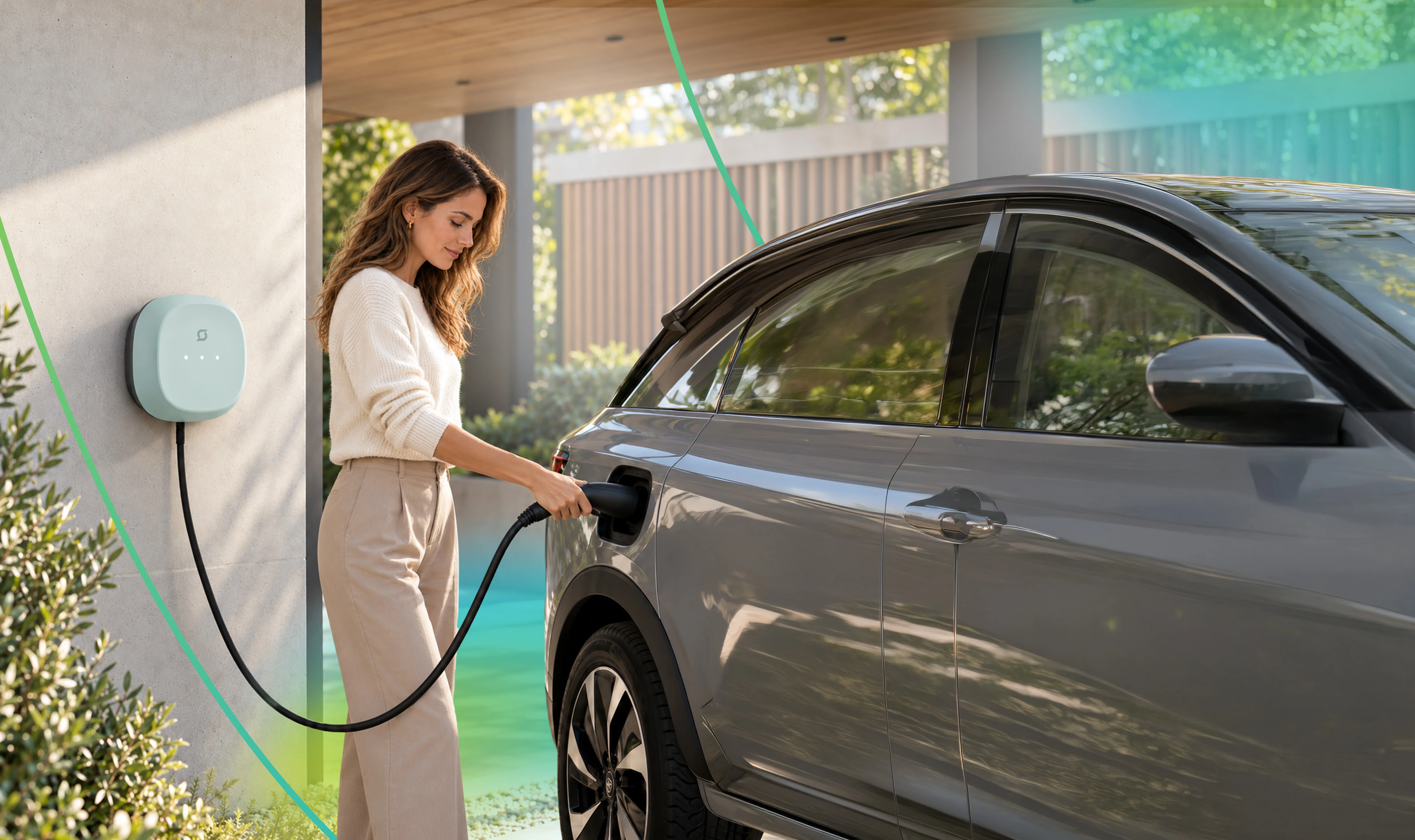
The cornerstone of EV value proposition lies in home charging infrastructure. A properly configured home charging setup transforms the economics of EV ownership, enabling the vehicle to pay for itself through operational savings. Like we have mentioned in our previous blogs, 80% EV owners are charge their vehicles at home, and it’s simpler than it appears on paper. Still, allow us to give you an overview.
Home charging setup is done in 4 steps
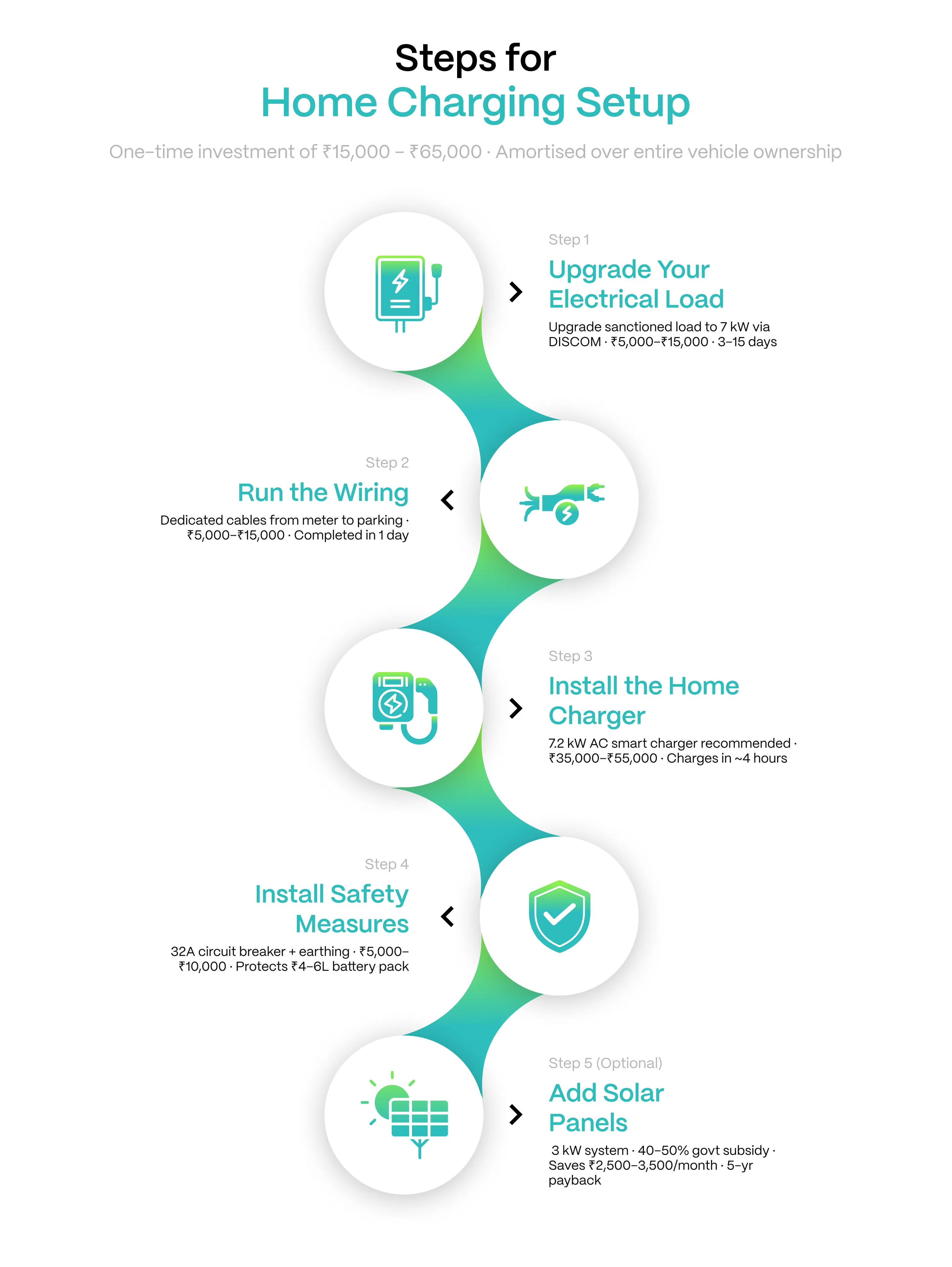
Establishing a home charging infrastructure is a one-time investment that unlocks decades of operational savings. The process involves regulatory approvals, electrical upgrades, hardware installation, safety checks, and costs between INR 15000 – INR 65000.
While the initial investment may appear substantial, it is amortized across the vehicle’s entire ownership period. When viewed as a 10-year amortization, the annual cost of 1,500 to 6,500 becomes negligible in comparison to operational savings.
Here is the step wise process with cost and timeline estimates:
Step 2: Run the wiring
Step 3: Install the home charger
Step 4: Install necessary safety measures
Step 5 (optional): Add solar panels for the ultimate upgrade
- Step 1: Upgrade your electrical load
Gear shifts and engine acceleration curves to deliver power, EVs provide maximum torque from zero revolutions per minute. This translates directly into reduced driver fatigue and enhanced passenger comfort during daily commutes and longer journeys.
- Step 1: Upgrade your electrical load
Most residential connections currently have a sanctioned load of just 2 to 4 kW, which isn't enough for efficient EV charging. You'll need to contact your local DISCOM to upgrade your load to 7 kW.
This upgrade generally costs between ₹5,000 and ₹15,000. In major metros, approval takes 7 to 15 days, though smaller cities might do it in 3 to 5 days. If you live in Delhi for eg, the government mandates expedited approvals within 7 days.
- Step 2: Run the wiring
A professional will need to run dedicated cables from your electricity meter to your parking spot.
This usually costs ₹5,000 to ₹10,000, but can reach up to ₹15,000 if you have underground parking or a long distance from the electrical room. It is typically completed in 1 day.
- Step 3: Install the home charger
While car manufacturers usually provide a basic 3.3 kW charger, upgrading to a 7.2 kW AC wall box is highly recommended. A basic charger takes about 8 hours to charge a typical 40-50 kWh battery, whereas the 7.2 kW AC smart charger cuts that down to just 4 hours. 7.2kW AC smart Chargers generally cost between ₹35,000 and ₹55,000, depending on how premium you want it to be. - Step 4: Install necessary safety measures
A ₹5,000 to ₹10,000 investment in crucial safety gear (like a 32A circuit breaker and earthing) is non-negotiable. It protects your car's expensive battery pack, which would cost as high ₹4 to 6 lakhs to replace if damaged by voltage fluctuations. - Step 5 (optional): Add solar panels for the ultimate upgrade
If you want to eliminate your running costs entirely, you can install a 3 kW rooftop solar system. In India's typical 4 to 6 peak sun hours, this system will generate 12 to 18 kWh daily, which is more than enough to cover an overnight EV charge.
Solar panels cost roughly ₹1.8 lakh upfront, but the government provides a 40% to 50% subsidy. At current electricity tariffs of INR7-8 per unit, a 3 kW system eliminating 12-15 kWh daily saves INR 2,500- 3,500 monthly. Over a 5-year payback period before subsidies, the financial return on the solar investment approaches INR 1.5-2.1 lakh in pure savings. After payback, all subsequent generation is profit.
Solar integration transforms the EV from a cost-saving measure into a comprehensive energy independence solution. For the aspirational upper-middle class, this combination provides protection against future electricity tariff increases, which in India have historically escalated at 6-8% annually. By generating own electricity, households essentially insulate themselves from this cost inflation.
ROI is seen in savings on fuel costs and maintenance bills
The operational savings gap between EVs and ICE vehicles is substantial across all metrics. Home charging at residential electricity rates provides crucial advantage. Residential electricity in India ranges from INR 5-7 per unit in metro areas to INR 4.5-6 in non-metros. A 50 kWh EV battery charged at home costs approximately INR 250-350, less than half, and sometimes even 1/3rd of an equivalent refuel of petrol or diesel.
When maintenance is factored in, the advantage expands further. An ICE vehicle costs approximately INR 10-12 per km when maintenance is included (INR 3.21 fuel + INR 5.3-6.8 maintenance amortized per km). The EV costs approximately INR 2.5-3.5 per km total (including battery degradation and maintenance). This represents a 70% total operational advantage when comprehensive lifecycle costs are considered. This significantly lowers the running costs of EVs compared to ICEs. Following is a summary compiled from recent Indian fleet studies.
Okay, but there’s still the upfront cost to think about. EVs are cheaper to run on a day-to-day basis, but at one point does it break even with ICEs? Here’s our Total Cost of Ownership (TCO) Anallysis, done over 10 years.
Baseline Projections taken from official TCO calculation frameworks:
- Vehicle Profile: Premium compact SUV (EV vs. petrol equivalent)
- Annual Mileage: 12,000 km/year (typical for metro upper-middle class)
- On-Road Purchase Price: Our initial example of INR 16,50,000 (EV) vs. INR 13,00,000 (ICE)
- Annual Running & Maintenance: INR 20,400/year (EV) vs. INR 1,02,000/year (ICE)
- Battery degradation: Negligible impact over 10 years for modern LFP batteries
- Electricity tariff: INR 6.5/unit, fuel price: INR 100/liter
This projection is conservative and excludes several additional benefits:
- Residual value advantages: EV batteries retain 70–80% capacity after 8–10 years. Used EV batteries have significant value for second-life applications in stationary storage. A degraded EV battery worth -2 lakh for second-life deployment provides valuable end-of-life recovery.
- Fuel price inflation protection: Petrol and diesel prices have historically increased 6–8% annually in India. By generating own electricity, EV owners insulate themselves from this inflation. This advantage multiplies in later years.
- Vehicle-to-Grid (V2G) income potential: As grid infrastructure evolves, EV owners can earn income by supplying stored battery power during peak demand. Future opportunities for load-balancing revenue could add ,000–20,000 annually to EV owner economics.
- Premium resale values: The EV market in India is rapidly appreciating. Used EVs command premium resale values as demand continues accelerating. A 5-year-old EV often retains 55–65% of purchase value, compared to 45–55% for ICE equivalents.
- Insurance and registration savings: Ongoing insurance premiums for EVs are typically 10–15% lower than ICE equivalents. Registration renewals cost nothing in states offering permanent registration for EVs.
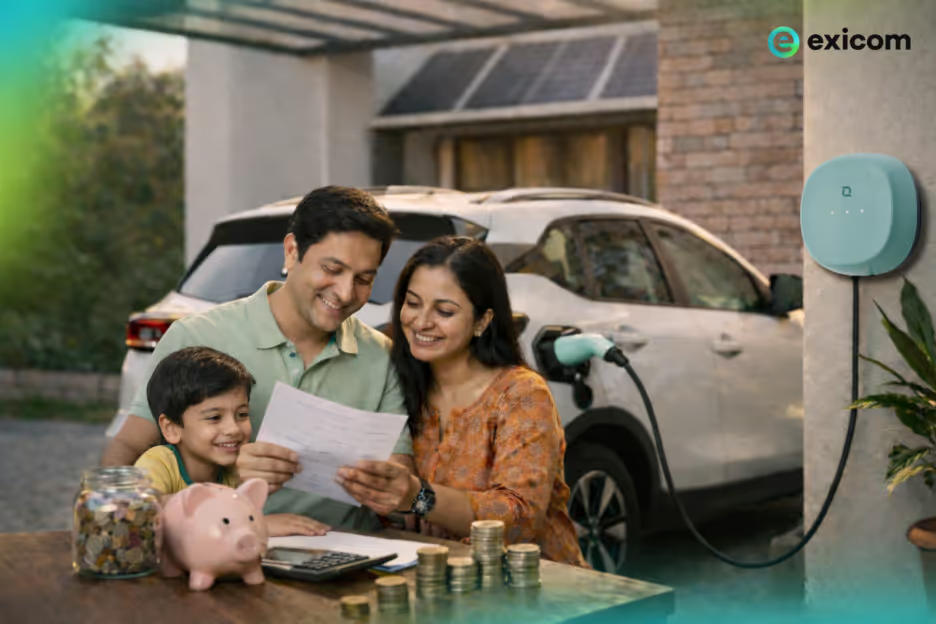
In essence, these advantages highlight the strong long-term value of electric vehicles for thoughtful buyers in India, with home charging offering superior efficiency and protection from escalating fuel prices.
Discover more here.
Frequently Asked Questions
Lorem ipsum dolor sit amet, consectetur adipiscing elit, sed do eiusmod tempor incididunt ut labore et dolore magna aliqua. Ut enim ad minim veniam, quis nostrud exercitation ullamco laboris nisi ut aliquip ex ea commodo consequat. Duis aute irure dolor in reprehenderit in voluptate velit esse.
Lorem ipsum dolor sit amet, consectetur adipiscing elit, sed do eiusmod tempor incididunt ut labore et dolore magna aliqua. Ut enim ad minim veniam, quis nostrud exercitation ullamco laboris nisi ut aliquip ex ea commodo consequat. Duis aute irure dolor in reprehenderit in voluptate velit esse.
Lorem ipsum dolor sit amet, consectetur adipiscing elit, sed do eiusmod tempor incididunt ut labore et dolore magna aliqua. Ut enim ad minim veniam, quis nostrud exercitation ullamco laboris nisi ut aliquip ex ea commodo consequat. Duis aute irure dolor in reprehenderit in voluptate velit esse.
Lorem ipsum dolor sit amet, consectetur adipiscing elit, sed do eiusmod tempor incididunt ut labore et dolore magna aliqua. Ut enim ad minim veniam, quis nostrud exercitation ullamco laboris nisi ut aliquip ex ea commodo consequat. Duis aute irure dolor in reprehenderit in voluptate velit esse.
Lorem ipsum dolor sit amet, consectetur adipiscing elit, sed do eiusmod tempor incididunt ut labore et dolore magna aliqua. Ut enim ad minim veniam, quis nostrud exercitation ullamco laboris nisi ut aliquip ex ea commodo consequat. Duis aute irure dolor in reprehenderit in voluptate velit esse.
.webp)