


Industry 4.0: The new role of Automation in EV Charger Manufacturing
Welcome back to our manufacturing series, where we take you through our journey of optimizing key processes for production at scale. This one is particularly close to our hearts, because this represents a revolution in our own way of doing things.
Most CPOs think their biggest enemy is the unreliable grid. It isn't. The real enemy is a "Friday afternoon" assembly error, a single screw that wasn't torqued to spec or a solder joint that looked fine to the human eye but had a microscopic void. In the EV industry, uptime is the only metric that matters, yet 99.9% reliability is impossible if your hardware is built with 20th-century manual processes.
True network reliability demands flawless manufacturing
Continuity of service is a core element of the economics of the EV charging industry. In the case of a Charge Point Operator (CPO), a charger that is technically online but does not start a session is a liability, which is undermining revenue and brand equity. Observations in the market today show that, although most of the networks claim high availability, the first-time charge success rate (FTCSR) frequently speaks contrary. Reported failures in almost 1 out of 3 charging attempts have been observed in mature markets, and a large fraction of these failures occur on units that seem to be functioning properly, as per the network management software. This difference, commonly known as the reliability gap, poses a deep challenge to CPOs who are trying to recoup high capital expenditure.
Hardware unreliability has serious financial consequences for CPOs. In addition to the now loss of transaction revenue, CPOs also stand to incur increasing operational expenses (OpEX) due to field service visits, which have an average cost of between ₹5,000 and ₹15,000 per occurrence. When such costs are multiplied by a network of thousands of chargers, the difference between 90% uptime and 95% uptime amounts to the difference between a profitable business and that which is unsustainable. Moreover, regulatory measures like the National Electric Vehicle Infrastructure (NEVI) program in the United States and the Alternative Fuels Infrastructure Regulation (AFIR) in Europe are now starting to make strong uptime requirements, and a failure to meet this requirement may result in the withdrawal of essential government subsidies.
The real quality in this area demands a manufacturing system where each part is serialized, each operation is quantified, and every possible failure mode is eliminated by smart automation
Traditional, semi-automated assembly lines fail to prevent microscopic defects at scale
With the production volumes to serve the global demand of hundreds of thousands of new charging ports, the constraints of the traditional manufacturing models become an acute chokepoint. Manual assembly or simple semi-automated assembly, although suitable for a small-batch prototyping phase, adds a degree of variability that cannot be tolerated by the high stakes of public DC fast charging. Human intervention, at the scale of thousands of units, becomes the main cause of unmeasurable errors and quality drift, and the quality of the product can vary depending on the fatigue of the operators, their level of skills, or the environmental conditions.
One of the key issues in conventional assembly is the manufacturing of power electronics and Printed Circuit Boards (PCBs). Even the best technicians can make mistakes when it comes to manual soldering, which can lead to microscopic faults that are not visible to the naked eye but are disastrous in practice. These flaws are cold solder joints, in which the electrical bond exists, but the physical bond is weak, and inadequate fillets, in which the solder coverage falls below the required level of thermal cycling life. These microscopic fractures increase with time in an EV charger that has to handle high currents and can work in extreme temperatures, as low as –20 deg C and as hot as 75 deg C, causing intermittent failures or complete system failure.
The physics of electrical connections necessitates precise thermal management during the soldering process. Manual irons are also characterized by intermittent tip temperature and dwell times which can either overheat delicate semiconductors or never heat flux to the point of activating it, causing premature oxidation. Moreover, old factories are usually not well controlled in terms of environment and thus dust and moisture can penetrate the components before it is sealed. This underscores the importance of not just a factory but rather to have zero-defect excellence; it is necessary to take the most critical and high-precision processes in-house and subject them to complete automated control.
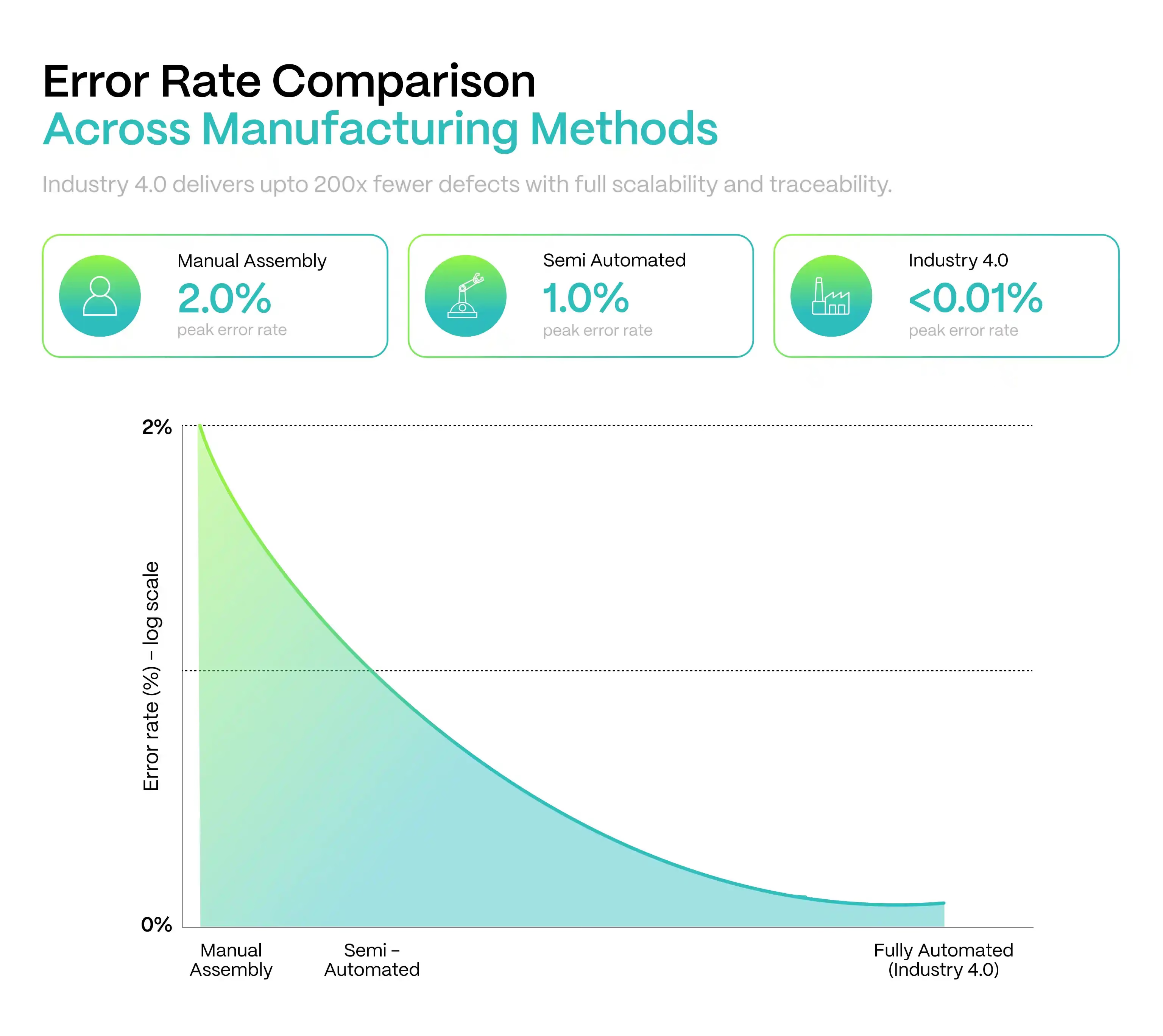
Digital genealogy is also lacking in traditional manufacturing, which also complicates supporting post-deployment. When a supplier determines that a particular lot of capacitors or contactors is defective, a manual factory may not be able to determine which chargers were fitted with that component. This contributes to extensive, inefficient blanket recalls that cause a strain on CPO resources and harm to consumer confidence. Actual network reliability requires a shift towards Industry 4.0, in which all screws and all solder joints are scanned, and their profile is stored in a central database, allowing a level of accuracy that will kill the failure points before they even get to the field.
Exicom achieves manufacturing excellence through best-in-class automation
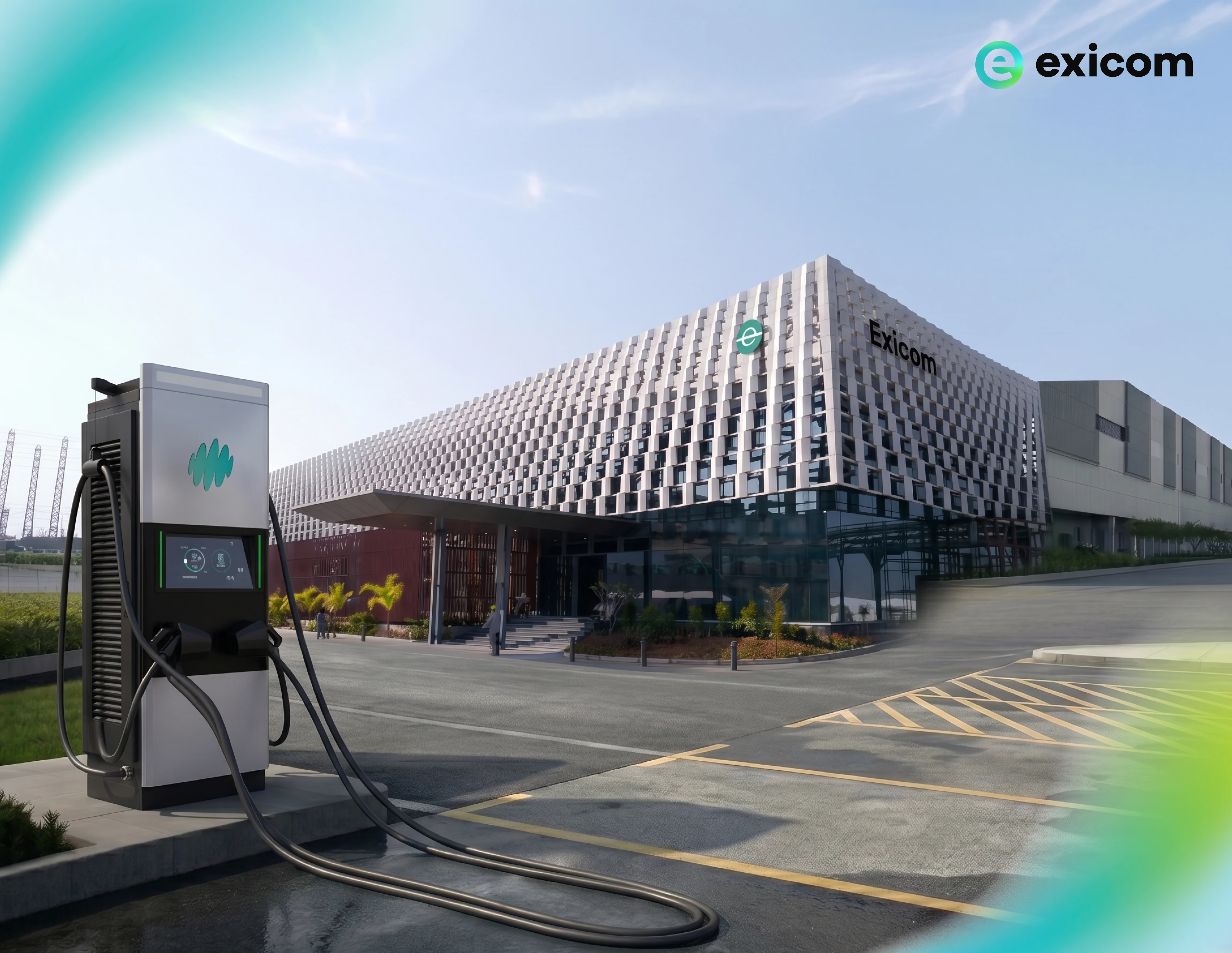
To overcome the challenges of the contemporary EV infrastructure, Exicom has established a state-of-the-art integrated manufacturing plant in Hyderabad, which was developed with the ground-up design to reflect the concepts of Industry 4.0. This 216-crore investment is a large step towards manufacturing power electronics with a 2.5X increase in production capacity to address the domestic and international demand. The plant is not just an assembly factory but an electronically linked ecosystem with all machines being linked to a central monitoring system that documents the production parameters in real time.
With extreme accuracy, error-free and extensive traceability ingrained into the very DNA of the manufacturing process, Exicom can guarantee every charger is produced to automotive-grade quality. This automation emphasis is the main assurance of zero-defect production by CPOs. The plant runs an advanced Manufacturing Execution System (MES) which monitors the data at the component level, such as the torque values, the vision camera inspection results, and the real-time environmental measurements. The resulting data-driven methodology enables us to identify bottlenecks instantly and to correct the drift of the processes in advance so that the ultimate product could be constructed to withstand the stresses of high-power public charging.
Microscopic accuracy in PCB production is achieved through ISO 8 cleanrooms and advanced SMT mounters
The fundamental intelligence and power conversion of an EV charger is in its complicated power electronics. Even sub-micron contaminants in these high-density circuits can cause a dielectric breakdown or signal noise. Exicom has taken measures to reduce such risks by having an ISO 8 cleanroom environment on its Surface Mount Technology (SMT) lines. Such a controlled environment guarantees the assembly of delicate electronics under closely monitored levels of air purity, temperature and humidity and eliminates the latent defects caused by dust and moisture as is common with traditional factories.
Exicom has high speed SMT mounters within this cleanroom that can precision to $\pm 30 \mu m$. Such accuracy is crucial to the location of the small-pitch components mounted in the controller platform of the Harmony Direct 2.0 which must be capable of handling thousands of data points/seconds during a charging session. The system eliminates human error in assembling important electronics, so that all solder joints are accurately aligned and each component is placed with complete accuracy.
Exicom has also increased its SMT process using 3D Automated Optical Inspection (AOI) systems. The 3D AOI contrasts with the conventional 2D inspection that can be deceitful by lighting shadows or changes in the appearance of solder, as it is a volumetric representation of all solder joints. This enables the system to quantify the specific quantity of the solder applied and detects "insufficient fillets" or "misalignments" with a degree of precision that is vastly greater than human ability. In the case of a CPO, this microscopic attention has the direct effect of power modules that are more efficient and less susceptible to thermal fatigue and thus directly relates to the capability of the charger to provide full rated power at all times even in extreme 50-degree ambient temperatures.
It is such dedication to manufacturing high precision electronics that enables Exicom to dominate the market in high-capacity DC fast chargers. Capability to manufacture proprietary controller platforms internally, with such strict oversight, makes the heart of the charger as strong as the physical case itself.
Advanced robotics ensure seamless material handling and perfect assembly
It does not take only human labor to produce heavy-duty power electronics in an efficient, safe way, but instead a smooth flow of sophisticated robotics. Exicom has taken the factory operations to the next level using a fleet of Automated Mobile Robots (AGVs) to transport materials within the company. These robots also make sure that heavy parts like the high capacity rectifiers and transformers employed in the Harmony Direct 2.0 are transferred between workstations without chances of physical contact or vibration damages that might be experienced when the parts are transferred manually.
During the assembly stage, high-end 6-axis Robotic Arms are using tasks that are highly repeatable and those that demand extreme force control. Such robots are especially useful in the application of thermal interface materials (TIMs) and the control of the palletization of the completed units. Contact between semiconductors and their heatsinks should be flawless in high-power charging; any air gap may result in localized overheating and thermal runaway. Robotic arms guarantee that the appropriate amount of thermal paste is put on each unit with consistent pressure, a consistency unachievable when done by hand during an eight-hour shift.
Robotics is also implemented in the end-of-line processes whereby the end-of-line processes have been fully automated with palletization systems that pack and secure the chargers as per the international shipping requirements. This minimizes the chances of structural damage during transit, a common, but frequently ignored, cause of out-of-the-box failures. Automating the heavy lifting and high-precision motions, Exicom not only enhances throughput but also introduces a physical mistake-proofing layer that safeguards the integrity of the charger inside and out, beginning with the initial material acceptance stage up to the last phase of shipping.
Digital mistake-proofing eliminates human error at every workstation.
Digital mistake-proofing in the industry 4.0 paradigm is realized through making it impossible to have an error spread throughout the assembly line. Exicom has achieved this excellently through its multi-layered digital mistake-proofing platform at each workplace. This system turns the assembly line into a smart network that checks every activity prior to letting the product pass to the next level.
One of the pillars of this system is high-resolution vision cameras used to conduct stepwise visual validation. When a charging cabinet is being assembled by an operator, vision sensors check that all cables are laid properly; all connectors are completely packed, and no foreign objects are present in the unit. When a camera notices an anomaly in the programmed golden image, the workstation will lock down and alarm on the MES will be activated. This will make sure that any issues of infant mortality, i.e., defects leading to a unit failing soon after deployment are detected and fixed within the factory walls.
In addition, Exicom has also removed paper-based manuals from confusion by using Digital Work Instructions (DWI). Interactive, screen-based protocols guide operators and offer 3D visualizations and real-time feedback. This is accompanied by digital torque guns that have been IoT-enabled. The precise torque exerted on a screw in a busbar or terminal in high-voltage power electronics is important; excessively loose, the connection will arc; excessively tight, the terminal will crack. Exicom's torque guns are programmed with the exact specifications for each screw and communicate directly with the MES. It is not until the gun has indicated that the programmed value of the torque has been attained and that the data is recorded against the unique serial number of the charger that the screw is considered complete.
This computerized thread establishes a standard of responsibility and accuracy that is the trademark of contemporary automotive manufacturing. To the CPO it is the reassurance of ultimate peace of mind, that is, the knowledge that their chargers were manufactured by a process in which human error was systematically designed out.
Automated sorting and laser welding engineer flawless battery packs
In the case of CPOs with fleets or high-volume highway sites, the combination of energy storage and high-power battery packs is becoming increasingly popular. The battery pack manufacturing line of Exicom is no exception as it is subjected to strict automation requirements with a special emphasis on such crucial parameters as safety and energy density. The process starts with a completely automated cell sorting, whereby every single cell containing lithium-ion is analyzed on its internal resistance and voltage stability. This guarantees that each module is made up of matched cells avoiding imbalances, which cause a decrease in pack life and safety concerns.
Connection of cells to busbars is the most crucial step in assembling a battery pack. Most manufacturers are employing ultrasonic welding or mechanical welding; Exicom employs high precision laser welding. Laser welding is a non-contact process which produces a deep, narrow weld with a small heat-affected zone (HAZ). This is important since too much heat in welding may destroy the sensitive internal chemistry of the lithium-ion cells. The laser welding at Exicom is at least 10 times faster than the conventional process, and the joints made are stronger in mechanical properties and have lower electrical resistance.
Laser welding decreases heat generation at the weld point by lowering the resistance, and this reduces heat production at the weld point during the high-current discharge cycles, which enables the battery pack to be more efficient and long lasting. This technological perfection makes the energy storage systems offered by Exicom not only reliable, but also future-ready, able to cope with the high-intensity duty cycles of commercial fleets and ultra-fast charging stations.
Exicom’s mastery of automated manufacturing is building trust
The long-term goal of the investment made by the company in automation is to create an environment of trust whereby CPOs can develop their networks with full confidence. With the highly demanding IATF 16949 automotive-grade quality management standard, Exicom manages to regulate every part of its manufacturing process, including the choice of suppliers, to the final burn-in testing, with a philosophy of continuous improvement and risk reduction. This certification is not merely a badge, but it is a commitment to a Quality Management System (QMS) that is focused on the prevention of defects and the minimization of variation throughout the whole supply chain.
- Fast Deployment: Exicom can deploy at scale: Having increased its capacity by 2.5x at the Hyderabad facility, it can scale up to large rollouts without the delays in lead times delays that can be common with infrastructure projects.
- Continuous Revenue: Exicom offers continuous revenue by providing chargers that simply do not fail, allowing CPOs to maximize their utilization rates, and eliminate the losses caused by failed charging sessions and costly field service visits.
- Future-Proof Scalability: Exicom chargers have a modular design and are digitally connected, which is based on Industry 4.0 standards, allowing remote firmware updates and predictive maintenance by the Harmony Connect RMS.
The quality of manufacturing of the charger is the strongest marketing instrument of CPO in a world where EV drivers are likely to choose a trusted station and shun the one with a reputation of being unreliable. With India and the world aiming at net-zero targets, Exicom is an all-encompassing solution, offering the Beautifully Engineered hardware to drive the shift towards sustainable mobility. As a Charge Point Operator, the emphasis that Exicom places on manufacturing excellence is what ensures that their network uptime is their most asset.
The analytic study of the manufacturing infrastructure of Exicom shows that there is a definite relationship between the industrial automation and profitability of networks. In the case of CPOs, selecting a hardware vendor is not only a procurement decision, but it is a strategic investment in network reliability. Going to Industry 4.0 is not an option, but a necessity to survive the high-volume, low-margin reality of mature EV markets.
According to the evidence provided, the following strategic measures should be taken by CPOs:
- Audit for Traceability: Make sure your hardware vendor can provide component-level birth certificates for each unit. This information is the basis of current risk control and plays a key role in specific maintenance and recall efficiency.
- Emphasize Automotive Standards: Find IATF 16949 as a standard. Automotive quality systems rigor is the only demonstrated method of assuring 10 years of serviceability of public infrastructure.
- Invest in Predictive Over Reactive: Use systems such as Harmony Connect that consider the data obtained throughout the manufacturing process to make predictions of failures in the field. The only way to have 99.9% real-world uptime is with a charger that notifies you of a possible fault before it takes place.
Exicom adherence to these ideals has ensured that its chargers are not only in line with current standards, but its products are designed to dominate the EV revolution in the world over the next few decades. Exicom is not only creating EV chargers, but the infrastructure of trust that will transform electric mobility into the new global standard, with its mastery of automated manufacturing.
Frequently Asked Questions
Lorem ipsum dolor sit amet, consectetur adipiscing elit, sed do eiusmod tempor incididunt ut labore et dolore magna aliqua. Ut enim ad minim veniam, quis nostrud exercitation ullamco laboris nisi ut aliquip ex ea commodo consequat. Duis aute irure dolor in reprehenderit in voluptate velit esse.
Lorem ipsum dolor sit amet, consectetur adipiscing elit, sed do eiusmod tempor incididunt ut labore et dolore magna aliqua. Ut enim ad minim veniam, quis nostrud exercitation ullamco laboris nisi ut aliquip ex ea commodo consequat. Duis aute irure dolor in reprehenderit in voluptate velit esse.
Lorem ipsum dolor sit amet, consectetur adipiscing elit, sed do eiusmod tempor incididunt ut labore et dolore magna aliqua. Ut enim ad minim veniam, quis nostrud exercitation ullamco laboris nisi ut aliquip ex ea commodo consequat. Duis aute irure dolor in reprehenderit in voluptate velit esse.
Lorem ipsum dolor sit amet, consectetur adipiscing elit, sed do eiusmod tempor incididunt ut labore et dolore magna aliqua. Ut enim ad minim veniam, quis nostrud exercitation ullamco laboris nisi ut aliquip ex ea commodo consequat. Duis aute irure dolor in reprehenderit in voluptate velit esse.
Lorem ipsum dolor sit amet, consectetur adipiscing elit, sed do eiusmod tempor incididunt ut labore et dolore magna aliqua. Ut enim ad minim veniam, quis nostrud exercitation ullamco laboris nisi ut aliquip ex ea commodo consequat. Duis aute irure dolor in reprehenderit in voluptate velit esse.