



What solutions exist for EV charging in dense urban areas?
.avif)
Modern cities are running short on space. Roads stay crowded for most of the day. Parking is difficult in many urban areas. Almost every usable corner already serves a purpose.
Now, EV adoption is accelerating on top of that.
Electric mobility is no longer a future discussion. It is already part of the daily urban movement. The real issue today is infrastructure readiness.
The question is simple.
Where do all these vehicles charge in dense cities?
At a small scale, charging looks easy. A vehicle plugs in and the battery charges. The car moves again.
But cities operate differently.
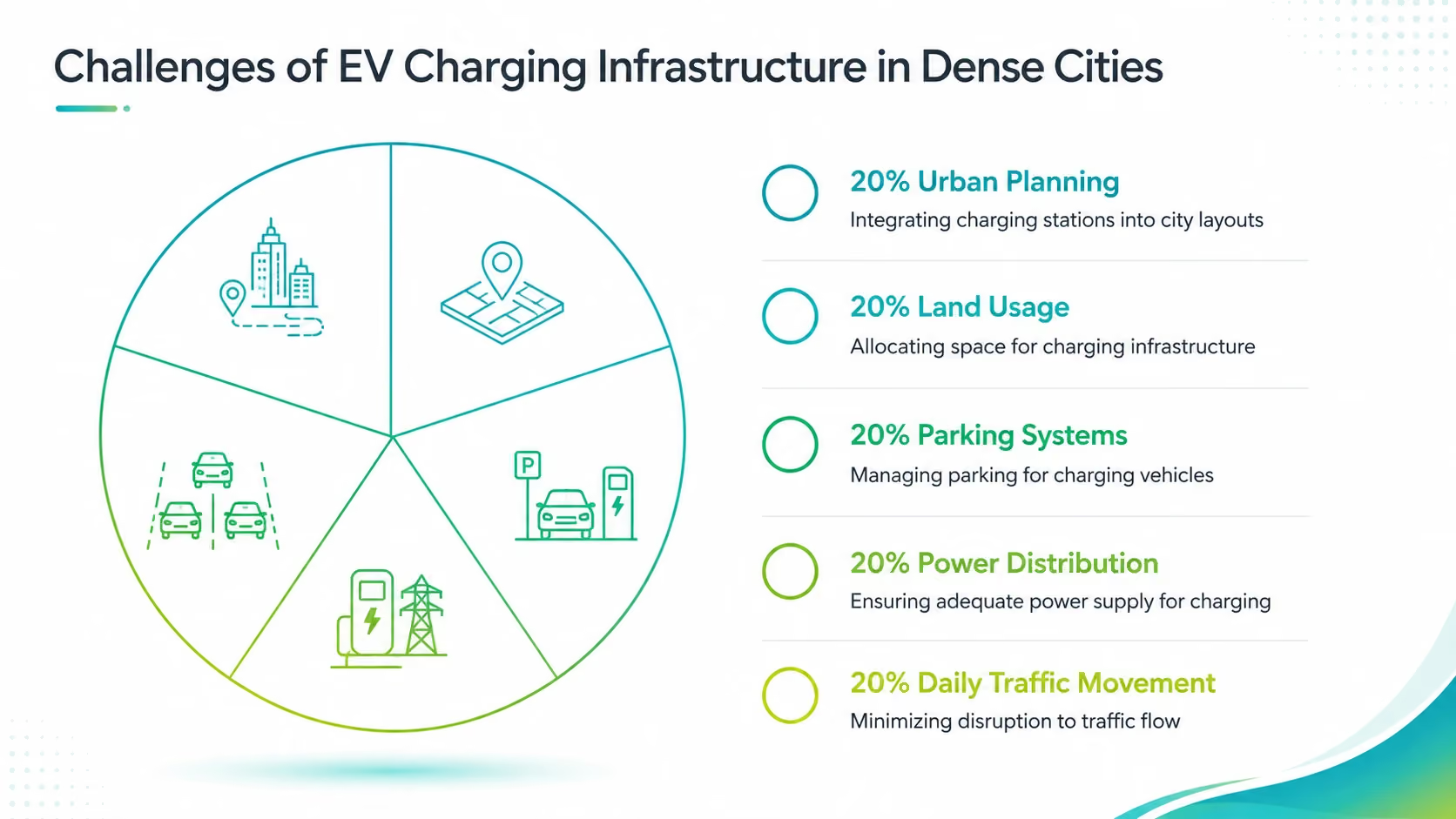
When thousands of EVs need charging access at the same time, the challenge becomes larger than technology alone. It starts affecting:
- Urban planning
- Land usage
- Parking systems
- Power distribution
- Daily traffic movement
That is where the conversation begins to shift.
Demand Is Quietly Outpacing Charging Infrastructure
India’s charging network has expanded steadily in recent years. By early 2026, the country had nearly 29,000 public charging stations.
At first glance, that sounds encouraging. But the larger picture still shows a gap. India currently has roughly one charger for every 235 EVs. Global markets operate at much stronger ratios, often between 1:6 and 1:20. The pressure becomes visible in everyday situations.
Drivers often experience:
- Longer waiting periods
- Difficulty locating chargers
- Uneven infrastructure distribution
- Chargers that remain non-operational
The challenge is no longer just about adding more stations. Reliability and placement now matter equally.
Infrastructure Begins to Follow Where Vehicles Already Stay
The charging industry is slowly changing its approach.
Earlier deployments focused mainly on available space. Chargers were installed wherever land or parking existed. That model had limitations. Many stations were not located where EV demand naturally concentrated.
Now the focus is shifting towards behaviour-based infrastructure planning. Instead of forcing users to travel specifically to charge, EV charging infrastructure is moving closer to locations where vehicles already park.
This change is becoming visible across sectors.
Residential Complexes
Home charging remains one of the most convenient solutions. Still, access remains limited. At present, only about 55% of EV owners have access to residential charging. New housing projects are beginning to include EV-ready parking layouts and electrical provisions.
Offices
Corporate campuses are steadily introducing workplace charging. This helps support employees while also reducing pressure on public charging stations during peak hours.
Retail Spaces
Shopping malls and commercial centres are using parking time more efficiently. Vehicles can charge while consumers shop, dine, or spend time inside the property.
Fleet Depots
Commercial operators are building captive charging systems for logistics and fleet operations. This reduces downtime and improves operational continuity.
Overall, infrastructure planning is becoming more practical. Charging is being integrated into existing movement patterns instead of creating entirely new ones.
Parking Is Turning into the New Energy Layer of Cities
Future-Proofing Assets: The Necessity of Interoperability and Open Standards
For parking spaces to reliably function as the new energy layer of dense cities, real estate developers and charge point operators (CPOs) must design around open communication architecture. Relying on closed, proprietary hardware creates immediate vendor lock-in risk. If a hardware manufacturer shuts down or its software backend degrades, the physical charging asset risks becoming obsolete.
To shield structural real estate investments from rapid technological obsolescence, installations must strictly leverage open industry standards:
OCPP (Open Charge Point Protocol): The universal application language linking the physical EV charger to a cloud-based Central Management System (CMS). While older installations commonly utilize OCPP 1.6J, modern deployments prioritize OCPP 2.0.1 and OCPP 2.1. These advanced protocols support native ISO 15118 "Plug & Charge" sequences, dynamic smart pricing data, and biometric or localized transaction events directly at the terminal.
OCPI (Open Charge Point Interface): The core protocol driving network-to-network roaming capabilities. While OCPP connects your specific charger to your management dashboard, OCPI enables different CPOs and eMobility Service Providers (eMSPs) to speak to each other.
.avif)
Integrating both protocols ensures long-term operational flexibility. A commercial charging unit deployed today will remain entirely interoperable by 2030, automatically routing transaction metrics, supporting generic UPI smartphone application payments, and accepting charging commands across entirely different vehicle brands and mapping networks.
Parking infrastructure is evolving. Earlier, parking simply meant temporary vehicle storage. That role is changing quickly. Today, parking spaces are increasingly becoming energy access points. Several sectors have already started adapting.
Hospitality Sector
Hotel groups such as Marriott International and IHG Hotels & Resorts have started integrating EV charging into regular guest infrastructure.
Charging is slowly becoming a standard offering alongside:
- Wi-Fi
- Parking
- Basic hospitality services
Retail Sector
Retail environments are moving in the same direction. In cities such as Delhi and Mumbai, mall-based charging stations are influencing customer behaviour.
Businesses are noticing:
- Higher dwell time
- Better convenience perception
- Stronger customer preference
Corporate Campuses
Companies such as Infosys and Google are also integrating charging infrastructure into sustainability planning. Many organisations now view EV readiness as part of long-term environmental commitments.
Fuel Retailers and Automakers
Fuel companies and vehicle manufacturers are also expanding access to charging across cities. The rollout is gradual. But the direction is clear.
Charging infrastructure is no longer developing as isolated stations alone. It is becoming part of broader urban infrastructure networks.
Locations Start Creating Measurable Business Value
Charging infrastructure is beginning to influence business performance.
In urban markets, access to charging is increasingly shaping customer decisions.
For example:
- Hotels with EV charging become more attractive to travellers
- Retail spaces benefit from longer customer visits
- Offices improve employee convenience
- Residential projects strengthen long-term market value
The economics are changing too. Well-positioned fast-charging stations in India can now achieve breakeven within roughly 24 to 36 months. After that point, the return profile improves considerably.
Charging infrastructure is gradually shifting from a cost centre to a business asset.
Value Forces Real Estate to Rethink Design Fundamentals
Real estate planning is also changing alongside EV adoption. Several Indian states have already introduced EV-related infrastructure mandates.
Mitigating Grid Impact: The Mechanics of Dynamic Load Management (DLM)
The risk profile is severe if electrical loads are treated statically after a building scales from two baseline chargers to a collection of 20 or more. Synergizing peak draw scenarios from multiple electric vehicles, coupled with central HVAC systems, elevators, lighting, and other equipment is especially dangerous. The combined demand may be greater than the capacity of the Grid Connection Point (GCP). In such cases, the peak demand (and related costs) will increase. The building’s main circuit breaker will trip, and power will be cut to the entire building.
To bypass this ceiling without investing in high-capital, physical grid or transformer upgrades, real estate developers rely on software-driven Dynamic Load Management (DLM).
Unlike rigid static balancing ,which partitions a fixed, permanent fraction of power to every single charger whether active or idle , DLM functions via a continuous digital control loop:
Continuous Feeder Sampling: Smart digital meters or CT clamps are added to the main electrical intake panel. They are designed to sample the total aggregated power draw many times per second.
Algorithmic Headroom Computation: The DLM central software retrieves the changing non-EV electric loads (elevators, appliances, and lights, etc.), and automatically adjusts the site’s maximum fuse rating. The remainder is reserved fluidly for charging.
Real-Time Current Reallocation: OCPP standardized signals (or commands) are utilized. The algorithm adjusts the maximum allowed current ($kW$) per charging port.
For example, in a 20-bay parking lot, when only 3 cars are plugged in, they will all get the same maximum charging rate. However, when 20 cars are plugged in during peak winter, the DLM system will recognize the increase, and automatically reduce the current across all active charging stations. This ensures all cars receive charging and keeps the property under the peak demand limit.
As a result, newer projects in cities such as Hyderabad and Pune are increasingly including:
- Higher electrical load capacity
- Pre-installed conduits
- Smart energy management systems
- Future-ready parking infrastructure
Older buildings remain more difficult.
Retrofitting often involves:
- Wiring limitations
- Structural constraints
- Approval delays
- Shared cost concerns among residents
This gap between old and new infrastructure may become one of the biggest urban challenges over the next decade.
Response Will Define How Cities Scale in the Next Decade
Dense cities will not depend on one single charging solution. The future will likely involve multiple systems working together.
These include:
- Distributed charging inside parking areas
- Fast-charging hubs at high-demand points
- Battery swapping for commercial fleets
- Renewable energy integration
- Smart infrastructure planning using real-time data
India’s future charging requirement remains extremely large.
Meeting that demand will depend on several factors:
- Policy execution
- Infrastructure investment
- Grid capacity
- Urban planning efficiency
- Operational reliability
The long-term direction is already visible. Execution will determine how quickly cities adapt.
Charging Is Quietly Becoming Part of Everyday Urban Life
Charging is slowly becoming less visible in daily life. Right now, users still face friction.
Common issues include:
- Searching for available chargers
- Waiting for charging access
- Encountering unreliable infrastructure
But deployment patterns are changing.
Charging is increasingly appearing in locations where vehicles already remain parked:
- Residential basements
- Office complexes
- Shopping centres
- Commercial parking areas
That shift changes the experience completely. Drivers no longer need to make separate charging trips every time. Charging starts happening during normal daily routines. The transition will probably feel gradual rather than dramatic. Over time, charging infrastructure will become part of the background of urban life.
Neither new nor disruptive, but normal.
Frequently Asked Questions
Lorem ipsum dolor sit amet, consectetur adipiscing elit, sed do eiusmod tempor incididunt ut labore et dolore magna aliqua. Ut enim ad minim veniam, quis nostrud exercitation ullamco laboris nisi ut aliquip ex ea commodo consequat. Duis aute irure dolor in reprehenderit in voluptate velit esse.
Lorem ipsum dolor sit amet, consectetur adipiscing elit, sed do eiusmod tempor incididunt ut labore et dolore magna aliqua. Ut enim ad minim veniam, quis nostrud exercitation ullamco laboris nisi ut aliquip ex ea commodo consequat. Duis aute irure dolor in reprehenderit in voluptate velit esse.
Lorem ipsum dolor sit amet, consectetur adipiscing elit, sed do eiusmod tempor incididunt ut labore et dolore magna aliqua. Ut enim ad minim veniam, quis nostrud exercitation ullamco laboris nisi ut aliquip ex ea commodo consequat. Duis aute irure dolor in reprehenderit in voluptate velit esse.
Lorem ipsum dolor sit amet, consectetur adipiscing elit, sed do eiusmod tempor incididunt ut labore et dolore magna aliqua. Ut enim ad minim veniam, quis nostrud exercitation ullamco laboris nisi ut aliquip ex ea commodo consequat. Duis aute irure dolor in reprehenderit in voluptate velit esse.
Lorem ipsum dolor sit amet, consectetur adipiscing elit, sed do eiusmod tempor incididunt ut labore et dolore magna aliqua. Ut enim ad minim veniam, quis nostrud exercitation ullamco laboris nisi ut aliquip ex ea commodo consequat. Duis aute irure dolor in reprehenderit in voluptate velit esse.
.webp)

