



What Is Workplace EV Charging? 2026 Guide for Indian Businesses
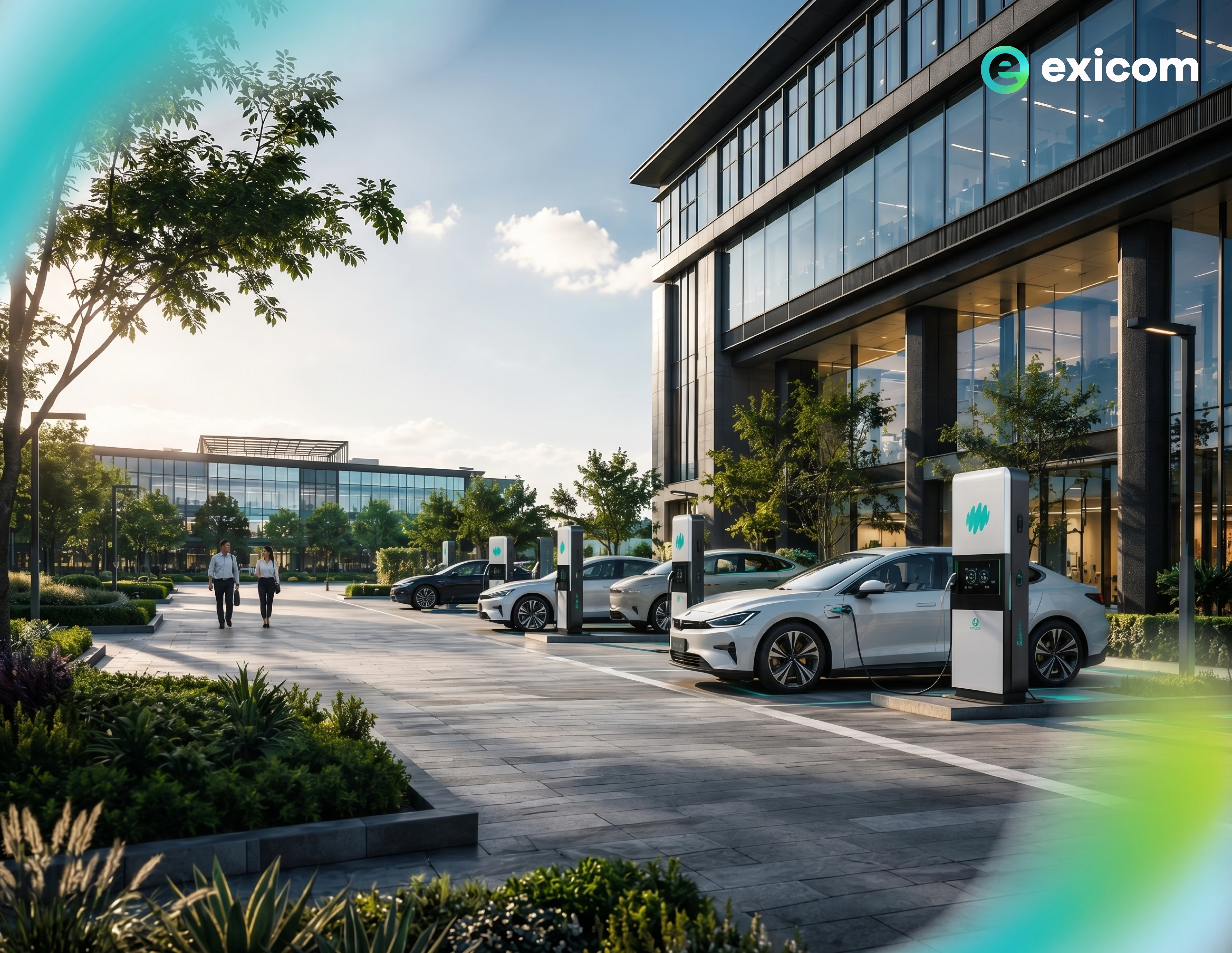
By 2026, Workplace EV Charging has evolved from a sustainability "nice-to-have" into a critical infrastructure requirement for the modern office. In India, employees who have access to charging at work are six times more likely to transition to an electric vehicle. For businesses, this infrastructure is a powerful tool for employee retention, especially for the urban workforce living in high-rise apartments where home charging installation remains a logistical challenge.
What is Workplace EV Charging?
Workplace EV Charging refers to the provision of electric vehicle supply equipment (EVSE) within office parking lots, corporate campuses, or commercial business parks specifically for the use of employees, visitors, and company-owned fleets.
It typically utilizes Smart AC Charging systems integrated with a Charging Management System (CMS) to monitor energy consumption, automate employee billing, and manage load distribution.
Real-World Understanding
For most employees, a workplace charger is the primary alternative to home charging. Technically, it is a semi-public charging model that bridges the gap between private home chargers and high-speed public highway chargers.
Because office vehicles usually remain stationary for 6 to 9 hours, the technical focus is on Charge Modulation. Rather than delivering high power instantly (which can spike a building's electricity demand), workplace systems use Dynamic Load Balancing. This ensures that the available power is shared intelligently across all plugged-in vehicles without exceeding the building's sanctioned load or triggering expensive "Maximum Demand" penalties from the DISCOM.
How It Works: The Operational Flow
A modern workplace charging ecosystem follows a circular technical flow:
- Identity Verification: Employee scans a QR code or taps an RFID card → System checks the "Employee Whitelist."
- Power Handshake: The charger communicates with the vehicle’s Battery Management System (BMS) to determine the State of Charge (SoC).
- Smart Allocation: The CMS assesses the building’s current power usage → Allocates safe power levels to the car.
- Charging Session: Electricity flows (typically 7.4kW AC) → Real-time data is sent to the HR/Admin dashboard.
- Completion & Notification: User receives a push notification when full → Idle fees may apply if the car isn't moved, ensuring bay turnover.
Types & Variants: Comparing Workplace Solutions
The choice between AC and DC chargers in an office setting depends on the specific user profile.
Real-World Use Cases
- Employees: Urban professionals who lack dedicated charging points at their residential apartments.
- Businesses: Tech parks like Manyata (Bengaluru) or Magarpatta (Pune) using charging as an ESG-linked carbon offset.
- Fleets: Last-mile delivery partners (e.g., Zomato, BigBasket) using office hubs for "top-up" charging during shift changes.
Cost and Efficiency (2026)
The financial viability of workplace charging is driven by the low "service cost" per unit compared to public stations.
India Context
- Policy Support: Under the PM E-DRIVE scheme (2024-2026), the Indian government has earmarked ₹2,000 crore for charging infrastructure, with subsidies often covering 70-100% of "upstream" infrastructure costs for semi-public sites.
- Electricity Tariffs: Most states (e.g., Maharashtra, Delhi, Karnataka) offer a concessional EV tariff ranging from ₹5.50 to ₹8.50 per unit.
- Legal Standing: The Ministry of Power has declared charging a "De-licensed Activity," meaning any office can set up stations without an electricity resale license.
- Mandates: New commercial building codes now require 20% of all parking spots to be EV-ready with conduits and power points.
Business / Industry Section
- For Enterprises: Treat charging as a "Tax-Deductible Business Expense" under Section 32 of the Income Tax Act (Depreciation on EV assets).
- For CPOs (Charge Point Operators): The "Asset-Light" model is popular, where the CPO installs hardware at no cost to the company and recovers investment through employee charging fees.
- For Facility Managers: Software integration with the Building Management System (BMS) is vital to prevent peak-hour grid overload.
Final Thought
Workplace EV charging is the silent engine behind India's green transition. By providing a reliable "destination charge," businesses aren't just installing hardware; they are de-risking the EV purchase decision for their entire workforce. In the near future, an office without a charger will be as obsolete as an office without Wi-Fi.

