



Quality Control and Traceability in manufacturing of EV chargers
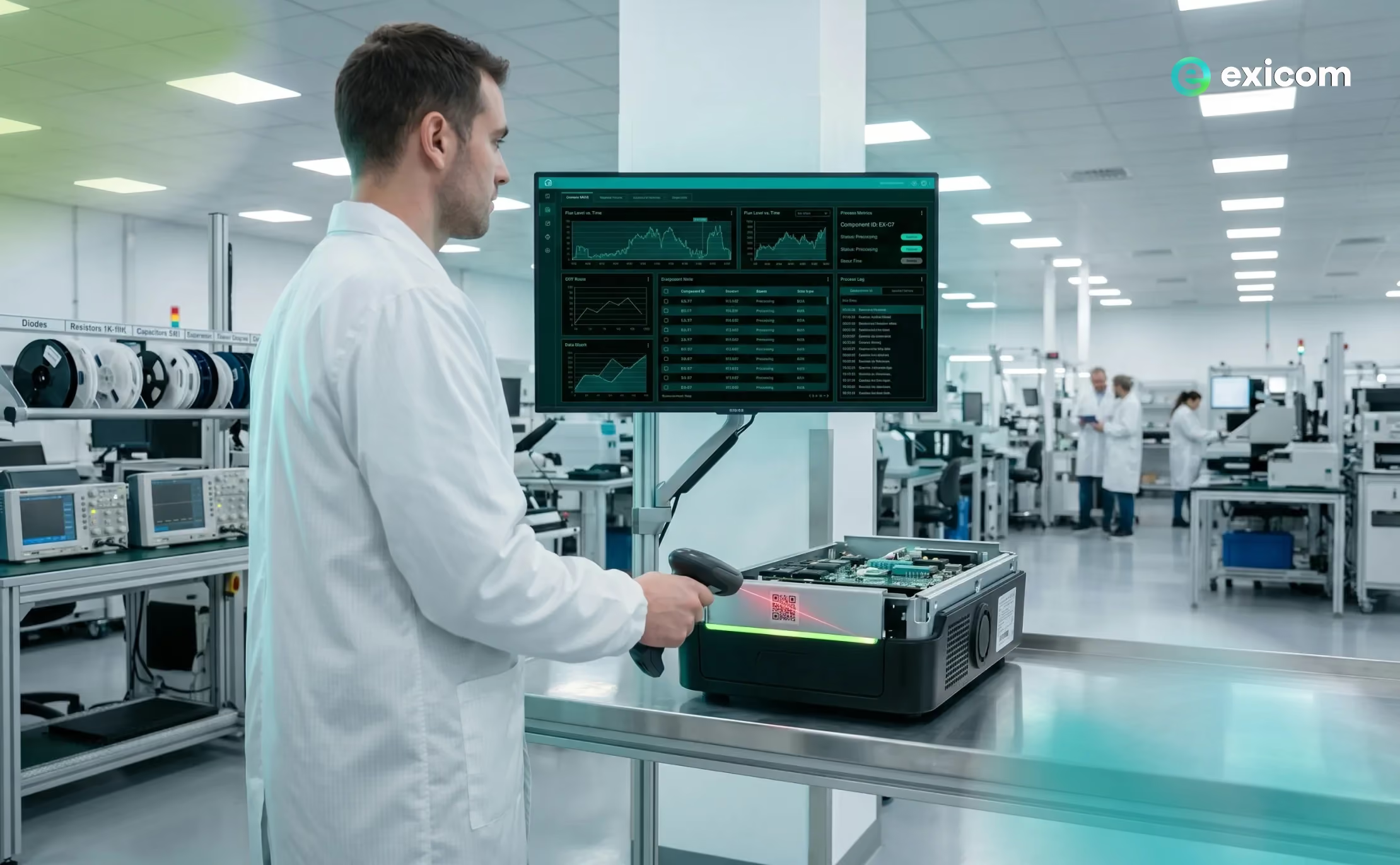
The most expensive sound in this industry is the silence of a charger that won't start.
Right now, across the country, thousands of units are sitting in the sun, and for most CPOs, those boxes are 'black holes' of data. When someone fails, you’re losing a client for eternity. The most troubling aspect is that you can't tell if the failure was a singular incident or a fundamental flaw lurking in 5,000 other units. That lack of data is a massive, unhedged liability on your balance sheet.
Creating safe EV chargers needs track record of every component
2026 will be the biggest transition to EV yet. India has experienced a 400% increase in EV charging stations over the last 2 years, with the goal of installing over 72,000 public charging stations to meet growing demand. Scaling this quickly is a huge risk, however. You aren't deploying hardware; you're deploying mission critical energy infrastructure.
Modern manufacturing needs to change to keep this rapid scaling. Manual logs and batch-level "good enough" checks are no longer possible. All units leaving the factory should have a verifiable, digitized data trail.
Un-trackable components turn minor defects into widespread network risks
It's extremely difficult and time-consuming to determine the cause of an event that happens on the field if there's no deep traceability. If a particular batch of contactors begins to fail in a high-temperature environment without any knowledge as to which of your 1,000 chargers are equipped with those contactors, then you have a large liability to deal with.
Defects that are un-trackable can lead to a pervasive network risk. You end up in what McKinsey refers to as "pilot purgatory," unable to scale since you are always firefighting.
- Slow Root Cause Analysis: If you don't have data, then your techs are just guessing. They could be replacing a power module, because the actual problem was a wiring error in the sensors during assembly.
- The cost of "Blanket" fixes: Absence of tracking means that failed batches of components cannot be identified. You may need to conduct expensive mass maintenance or a full recall of hundreds of chargers just to be on the safe side rather than fix 10 units.
- Revenue Leakage: Revenue is lost every hour; a charger is not in use. Having to pay to fix the damage (Rs. 47000- 1,89,000 per incident) is typically a small price to pay in high-traffic areas when compared to the loss of driver's trust and repeat business.
Manufacturing EV chargers requires end-to-end digital traceability architectures
Exicom’s Hyderabad facility provides a comprehensive resolution to these complications by transitioning from "Traceability as a Record" to "Traceability 4.0." This concept, coined to describe the current phase of global manufacturing, involves the union of product tracking, component genealogy, and process parameters to achieve the highest level of manufacturing effectiveness. At Hyderabad, this is achieved through a multi-layered digital architecture that ensures every charger has an immutable, searchable DNA.
This is how we have created the information and traceability system for the industry to be totally transparent:
1. Inbound Integrity: WMS, GRN Labeling, and FEFO Controls
The traceability journey starts at the warehouse with inbound integrity, WMS, GRN Labeling and FEFO Controls. Exicom uses a complex Warehouse Management System (WMS) as well as Goods Received Note (GRN) labelling system. All incoming components (high-power capacitors to plain connectors) are given a digital identity on arrival. This guarantees that the material origin is recorded prior to any assembly is started.
The facility has in place strict FIFO (First-In-First-Out) and FEFO (First-Expired-First-Out) control measures, to avoid potential aged component failures. Shelf life is critical in power electronics, such as electrolytic capacitors. By using FEFO gating to ensure only components within their optimum performance range get to the assembly line, a common cause of "infant mortality" in field hardware is eliminated.
2.The Mark of Precision: YJ-LINK Laser Marking
After a Printed Circuit Board Assembly (PCBA) is placed into the line, it is marked with laser technology YJ-LINK. Unlike conventional stickers which can fade or come off, laser marking produces a 2D barcode or QR code that is permanent and at high resolution in the substrate itself.
The YJ-LINK system is equipped with a Z-axis servo motor allowing marking at different heights and an internal vision camera, which can identify the PCB pattern and save marking in perfect positioning. This precision marking will then become the "anchor" for the unit's digital twin, and every subsequent process – soldering, component placement and testing – will be linked to this particular unit ID.
3. Digital Genealogy: Parent-Child Data Relationships
The "Parent-Child" data relationship is at the heart of Exicom's accountability model. A modern charger is not just one piece of equipment but a whole system of systems. Here at Hyderabad the final assembly number (aka the "Parent") is digitally connected to the sub-assemblies (aka the "Children") that make up the device, which include power modules, rectifiers, and controllers.
This hierarchy is also applicable to “nth level” genealogy, which means that Exicom can go back through the finished harmony direct 2.0 charger power modules and to the individual serial numbers of the semiconductor dies in those power modules. If a particular power module fails in the field, for the CPO, this means that they can immediately tell that the other power modules in the same power module lot or with the same component lot are the same "siblings" and alert the operator prior to a larger failure.
4. Real-Time Accountability: Server-Backed Data Logging and MES Integration
The Hyderabad plant is a "digitally connected manufacturing system" that logs data in real time to the server and integrates with MES. All equipment on the assembly line is connected to a Manufacturing Execution System (MES). This system can gather real-time information such as torque values during assembly, soldering temperatures and high-resolution images captured by inspection cameras.
Importantly, all this data is server-side. Many factories store data on machine controllers locally, which makes resetting the machine or the network a possible cause of "gaps". Exicom's server logging functions prevent any data loss in production and keeps an immutable log of the data changes. This enables forensic root cause analysis (RCA) to be conducted and identify whether a failure was caused by a mechanical "wiring slip-up" or a "stray interference" problem that occurred during a particular shift.
5. Interoperability Testing: The Final Quality Gate
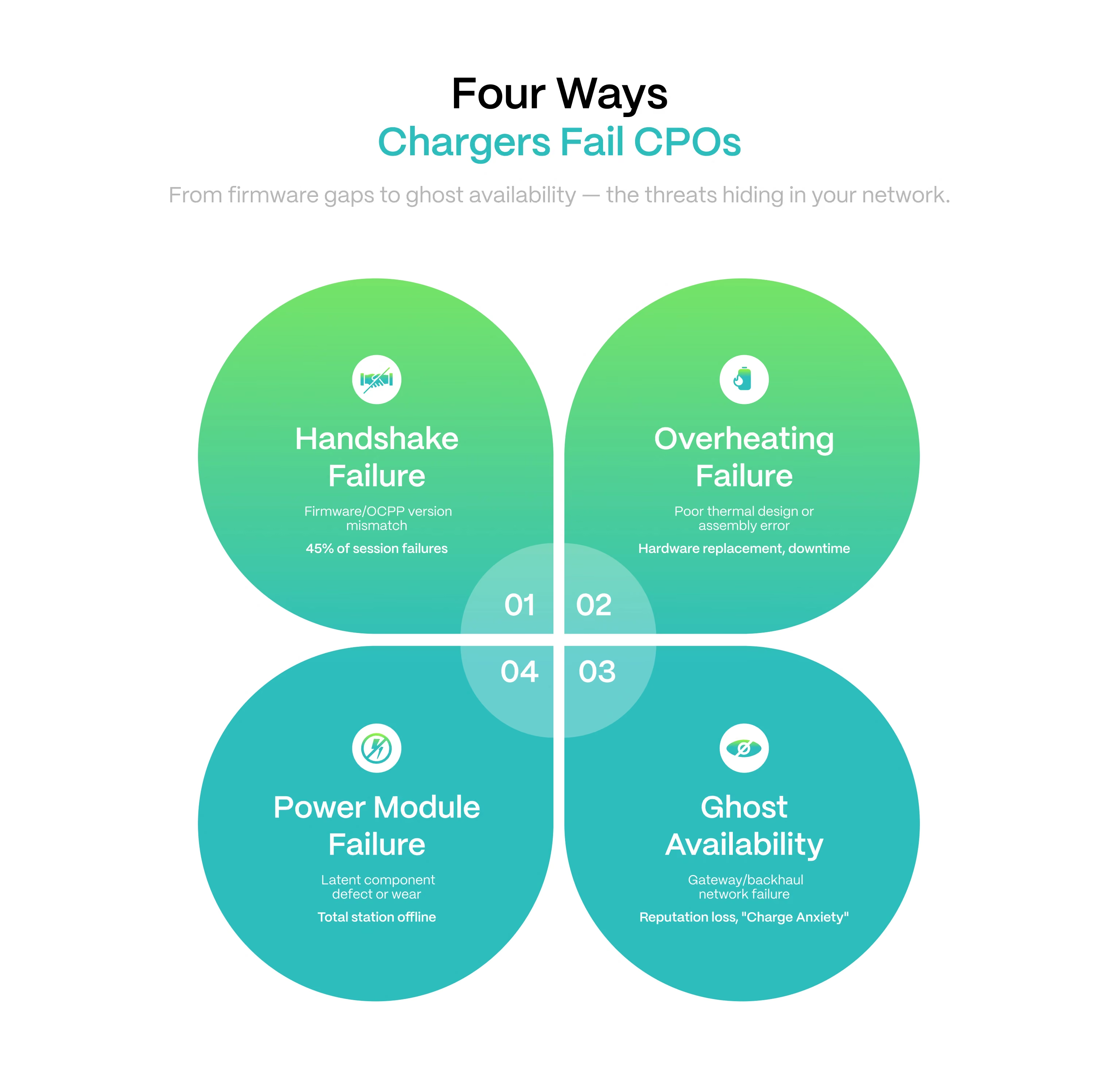
Traceability is not just about what has already happened; it's about what will happen in the future. The 45% failure rate due to vehicle-protocol mismatch has led Exicom to set up the first EV charger interoperability testing center in Hyderabad, India.
Real-world validation is performed here, proving chargers for different manufacturers against real vehicles, as is the “handshake” process based on ISO 15118 and OCPP protocols. All products are validated through this process before they leave the plant. A CPO's home here is a much better “First-Time Charge Success Rate” and fewer “authorization failures”, which lead customers away.
Deep traceability empowers CPOs with rapid root-cause analysis
In the fast-moving landscape of 2026, the differentiator for a successful Charge Point Operator is how many chargers successfully deliver power every single time. As we’ve seen, the industry is shifting from simply "detecting" failures to "preventing" them, and that starts with the data-driven foundation we’ve built at our Hyderabad facility.
By moving from traditional records to Traceability 4.0, we give you forensic-level control over your network. This is about providing you with a "digital twin" for every asset. When a fault occurs, a parent-child data architecture allows you to look past the symptoms and identify the exact component lot or assembly step responsible. For a CPO, this means the difference between a panicked, network-wide inspection and a surgical, targeted fix that can reduce recall scope by up to 60%.
Ultimately, this level of precision is what we mean by "Beautifully Engineered." We are giving you the tools to meet reliability mandates with ease, slash O&M costs by up to 30%, and, most importantly, win the absolute trust of your drivers.
Frequently Asked Questions
Lorem ipsum dolor sit amet, consectetur adipiscing elit, sed do eiusmod tempor incididunt ut labore et dolore magna aliqua. Ut enim ad minim veniam, quis nostrud exercitation ullamco laboris nisi ut aliquip ex ea commodo consequat. Duis aute irure dolor in reprehenderit in voluptate velit esse.
Lorem ipsum dolor sit amet, consectetur adipiscing elit, sed do eiusmod tempor incididunt ut labore et dolore magna aliqua. Ut enim ad minim veniam, quis nostrud exercitation ullamco laboris nisi ut aliquip ex ea commodo consequat. Duis aute irure dolor in reprehenderit in voluptate velit esse.
Lorem ipsum dolor sit amet, consectetur adipiscing elit, sed do eiusmod tempor incididunt ut labore et dolore magna aliqua. Ut enim ad minim veniam, quis nostrud exercitation ullamco laboris nisi ut aliquip ex ea commodo consequat. Duis aute irure dolor in reprehenderit in voluptate velit esse.
Lorem ipsum dolor sit amet, consectetur adipiscing elit, sed do eiusmod tempor incididunt ut labore et dolore magna aliqua. Ut enim ad minim veniam, quis nostrud exercitation ullamco laboris nisi ut aliquip ex ea commodo consequat. Duis aute irure dolor in reprehenderit in voluptate velit esse.
Lorem ipsum dolor sit amet, consectetur adipiscing elit, sed do eiusmod tempor incididunt ut labore et dolore magna aliqua. Ut enim ad minim veniam, quis nostrud exercitation ullamco laboris nisi ut aliquip ex ea commodo consequat. Duis aute irure dolor in reprehenderit in voluptate velit esse.


%20(1).webp)

