


How EV Charging Quietly Lifts Your Property Valuation

How many cars does your property host today, and how many will it need to support tomorrow? What was once a question of only parking capacity is now also becoming a question of infrastructure readiness. As electrification of vehicles accelerates, charging-enabled parking spaces in properties are becoming essential.
Over the past decade, car ownership in the middle three income quintiles has increased by 2.2 to 2.8 times, with electric vehicle adoption growing to 30%. Residential complexes, office parks, malls, and campuses already accommodate a large number of EVs, making charging-enabled parking essential.
It’s clear that more reliable and convenient charging makes a property more attractive to higher-income tenants and strengthens its revenue potential. Today, EV charging for real estate has moved from a “nice-to-have” convenience to a new revenue stream that helps builders simplify regulatory alignment and contribute to Scope 3 emissions-reduction goals.
So, what does a property risk by skipping EV charging as vehicle electrification continues to rise?
The rise of EVs and what it means for urban properties
Urban EV adoption is accelerating at a pace that is beginning to influence real estate decisions directly. In India, electric passenger vehicles reached 156,455 units in 2025, growing 57 percent from 99,429 units a year earlier. This growth is concentrated in urban areas where premium residential and commercial properties are located.
This has a direct implication for future-ready real estate. While location and luxury amenities remain key to the buying decision, access to EV charging is increasingly seen as a valuable addition that supports evolving mobility needs.
The shift in expectations can be seen here:
- 93% of Indian consumers charge their EVs at home, primarily overnight, to align with their daily routines.
- Across major Indian cities, nearly 90% of EVs are charged at home for convenience.
This demand is not limited to residential spaces. It extends across:
- Commercial property EV charging amenities for office tenants and across malls
- Hospitality EV charging solutions for hotels
- Campus EV charging infrastructure for educational institutions and hospitals
For developers and asset managers, this changes the baseline. EV charging amenities are moving from optional features to expected infrastructure.
At the same time, regulatory alignment is becoming clearer. In 2024, the Ministry of Power issued consolidated “Guidelines for Installation and Operation of Electric Vehicle Charging Infrastructure 2024,” applicable across private, semi-public, and public spaces, including housing societies, office buildings, hospitals, and commercial complexes. These guidelines bring clarity to implementation and remove ambiguity for stakeholders.
The direction is consistent. EV-ready buildings are becoming part of how urban infrastructure is defined.
How EV charging can serve as a revenue and value driver
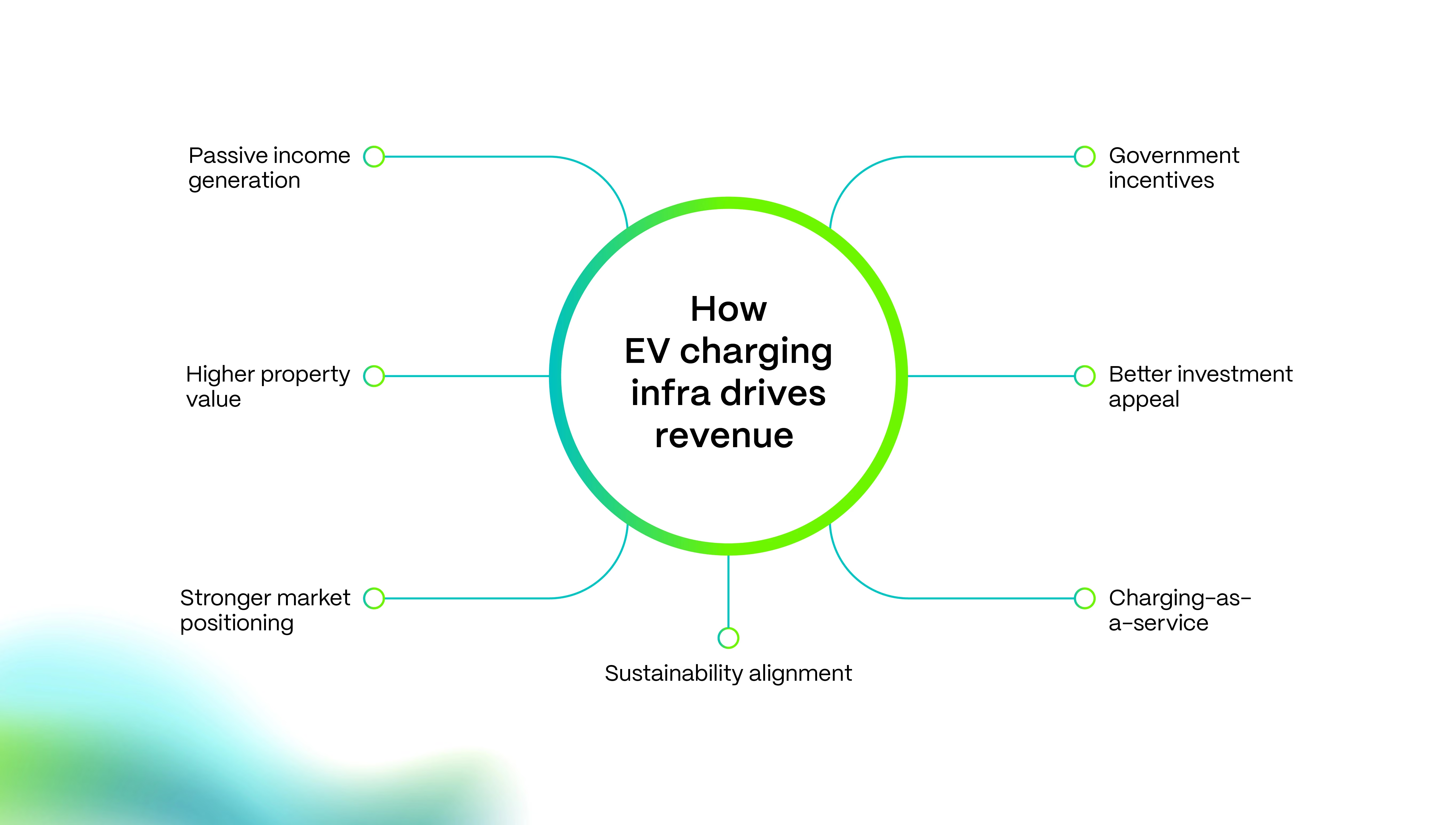
The opportunity around EV infrastructure for developers extends far beyond meeting demand. It has a direct and long-term impact on revenue generation and asset positioning.
A) Monetization potential
EV charging introduces new income streams that did not exist earlier. As stated by Nobroker, the simplest forms of EV charging revenue include:
- Pay-per-use billing based on electricity consumption OR
- Monthly subscription fees per vehicle OR
- Time-based charging models to optimize utilization
For RWAs (Residential Welfare Associations) and property managers, this creates a scalable RWA EV charging business model. Passive income generation becomes possible while improving resident satisfaction.
B) Asset valuation and differentiation
The link between property valuation and EV charging is becoming clearer. Properties with EV infrastructure are already seeing higher perceived value. According to Nobroker, EV charging can, in some cases, enhance property value by up to 7 percent.
This ties directly into real estate asset valuation. As more tenants and buyers transition to EVs, properties that support charging infrastructure become more attractive. Higher-income early adopters actively prefer such developments, which improves occupancy and retention.
From a positioning standpoint, EV readiness strengthens:
- Real estate differentiation
- Premium positioning in competitive markets
- Alignment with ESG real estate strategy
C) ESG and sustainability alignment
EV charging also supports broader sustainability goals. It contributes to:
- Scope 2 and Scope 3 emission reduction strategies
- Alignment with sustainable building infrastructure goals
- Integration into green building EV integration frameworks
For institutional investors and ESG-focused stakeholders, this becomes a signal of forward-looking infrastructure planning.
D) Government incentives and ecosystem support
The financial ecosystem is also enabling this shift:
- ₹1,000 crore has been allocated under FAME II for charging infrastructure
- Under the PM E-DRIVE scheme, government premises, including offices, residential complexes, hospitals, and educational institutions, receive 100% subsidy for upstream infrastructure and EVSE, with chargers mandated for unrestricted public access
- GST on EV chargers reduced from 18 percent to 5 percent
These interventions make EV infrastructure planning more viable and attractive for developers and asset owners.
The implications of skipping EV charging
The cost of installing EV infrastructure is visible. However, the hidden cost of skipping it builds over time and affects multiple aspects of property performance.
Demand and occupancy impact
When 78 percent of gated community residents expect EV infrastructure, the absence of it directly affects demand. Properties without charging access risk losing:
- Potential homebuyers and tenants in residential projects
- Tenants in commercial developments
- Guests in hospitality environments
This impacts occupancy rates and long-term utilization of the asset. Research shows that properties that offer EV charging for apartments can see valuation premiums of up to 3.3% compared to those that do not.
Legal and regulatory friction
With the government’s push toward electrification, the regulations are evolving in the same direction. Housing societies are expected to allocate a minimum share of parking capacity for EV charging. Model Building Bye Laws recommend 20 percent of parking spots to include chargers.
Recent judicial developments reinforce this direction. The Bombay High Court has directed authorities to finalize EV charging installation rules and ensure that housing societies do not deny permissions arbitrarily.
At the same time, the right to a clean, unpolluted environment is recognized under Article 21. This creates an indirect obligation to modernize property in line with cleaner mobility.
Retrofit cost and operational disruption
Delaying EV integration increases complexity later. Retrofitting leads to:
- Higher capital expenditure
- Electrical redesign and capacity upgrades
- Operational disruption for tenants and residents
Integrating residential EV charging solutions or facility-management EV charging systems at the design stage avoids these challenges and reduces lifecycle costs.
Competitive disadvantage and valuation drag
As urban EV adoption continues to rise, properties without EV readiness begin to lag. This creates:
- Reduced competitiveness in premium segments
- Lower perceived value among buyers and investors
- Long-term impact on real estate asset valuation
The absence of EV infrastructure is no longer invisible. It gradually reflects in lower demand, weaker positioning, and slower growth.
Treating EV charging as a strategic infrastructure investment
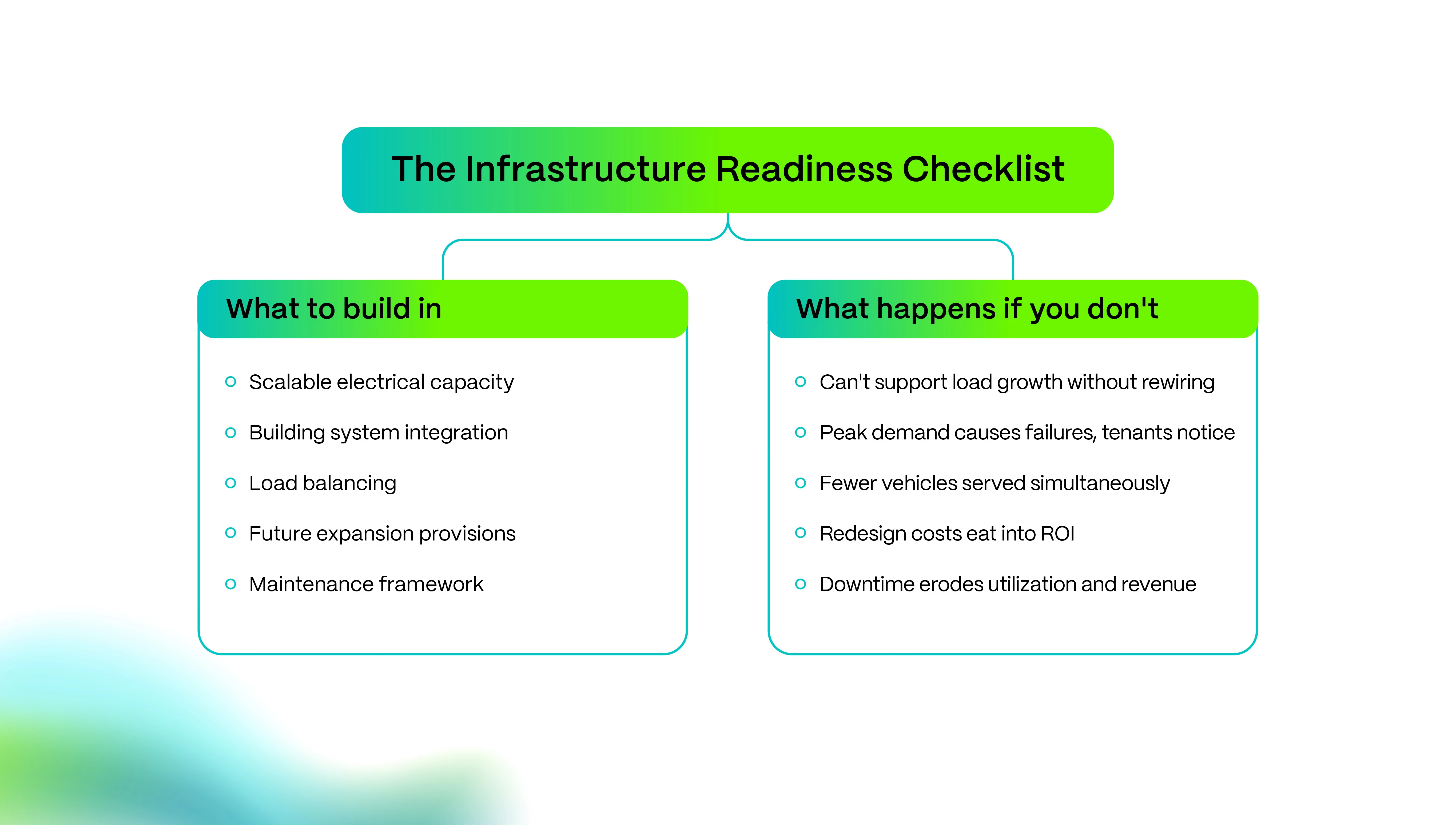
As EV chargers are steadily becoming a standard, the real differentiator will shift to how robust and ready your EV charging infrastructure is. Real estate stakeholders who treat and design charging infrastructure as a long-term investment will gain a competitive edge.
Your charging infrastructure needs to account for scalable electrical capacity from the design stage, so as EV adoption increases, your property can support a higher load without performance issues. This directly impacts how many vehicles you can serve and how much revenue you can generate.
It also needs to be integrated with overall building systems, including energy distribution and load balancing. This ensures consistent performance during peak demand, avoids system failures, and protects tenant experience, which in turn influences retention and occupancy.
Future expansion should be built into the system.
- The ability to add more chargers without redesign reduces future capital expenditure
- It ensures you can meet rising demand without operational disruption
For facility management EV charging, operational readiness becomes critical.
- Reliable operations ensure chargers remain available, supporting utilization and revenue
- Load management distributes power efficiently, allowing more vehicles to charge simultaneously
- Maintenance frameworks reduce downtime and protect long-term asset performance
When designed this way, EV charging infrastructure supports consistent utilization, predictable monetization, and stronger positioning for commercial property EV charging and campus EV charging infrastructure, where demand is steady and scalable.
The future of real estate is EV-ready
EV readiness has moved into the core of how modern real estate is evaluated. It influences demand, revenue potential, ESG alignment, and long-term value. Developers and asset owners who integrate EV-ready buildings into their strategy position themselves for stronger occupancy, better monetization, and sustained relevance.
The next step is to treat EV charging as a planned part of infrastructure. Early integration reduces cost, avoids disruption, and protects value over time.
If you are looking to future-proof your property, explore Exicom's EV charging solutions that enable scalable, reliable EV charging for real estate and support long-term performance.
Frequently Asked Questions
Lorem ipsum dolor sit amet, consectetur adipiscing elit, sed do eiusmod tempor incididunt ut labore et dolore magna aliqua. Ut enim ad minim veniam, quis nostrud exercitation ullamco laboris nisi ut aliquip ex ea commodo consequat. Duis aute irure dolor in reprehenderit in voluptate velit esse.
Lorem ipsum dolor sit amet, consectetur adipiscing elit, sed do eiusmod tempor incididunt ut labore et dolore magna aliqua. Ut enim ad minim veniam, quis nostrud exercitation ullamco laboris nisi ut aliquip ex ea commodo consequat. Duis aute irure dolor in reprehenderit in voluptate velit esse.
Lorem ipsum dolor sit amet, consectetur adipiscing elit, sed do eiusmod tempor incididunt ut labore et dolore magna aliqua. Ut enim ad minim veniam, quis nostrud exercitation ullamco laboris nisi ut aliquip ex ea commodo consequat. Duis aute irure dolor in reprehenderit in voluptate velit esse.
Lorem ipsum dolor sit amet, consectetur adipiscing elit, sed do eiusmod tempor incididunt ut labore et dolore magna aliqua. Ut enim ad minim veniam, quis nostrud exercitation ullamco laboris nisi ut aliquip ex ea commodo consequat. Duis aute irure dolor in reprehenderit in voluptate velit esse.
Lorem ipsum dolor sit amet, consectetur adipiscing elit, sed do eiusmod tempor incididunt ut labore et dolore magna aliqua. Ut enim ad minim veniam, quis nostrud exercitation ullamco laboris nisi ut aliquip ex ea commodo consequat. Duis aute irure dolor in reprehenderit in voluptate velit esse.