


Your Home Has a Regular Socket. Is That Enough to Charge Your EV?
Every Indian kid has asked to eat out at least once and got the same reply: "Bahar ka kyun? Ghar pe bana dungi."
Bring home an electric car, ask about a home EV charger, and you'll hear the 2026 version: "Charger? Ghar pe socket hai na."
That socket is usually the 15-amp point near the parking. It has run the geyser, survived three summers of the AC and powered 40 metres of Diwali lights. As far as the family is concerned, it has just been promoted.
And honestly? They're half right.
Unlike petrol cars, electric vehicles can be charged at home using an existing electricity connection. In fact, many EVs sold in India come with a basic Type 1 harger, technically called an EVSE (Electric Vehicle Supply Equipment). It is a cable with a control box that plugs into a suitable 230V, 15A socket and can deliver up to approximately 3.3 kW.
The Ministry of Power's 2024 guidelines also recognize home charging through existing electricity connections.
So, can you change your electric car using a regular power socket? In many cases, yes. But there's a catch.
The socket must be properly rated, fixed 15A or 16A points with suitable wiring, earthing and electrical protection. A regular 5A socket, extension board, or multi-plug adapter is not a substitute.
So yes, that socket can do the job. But being able to charge your EV and having a convenient, reliable everyday charging arrangement are two different things.
Can a Regular Power Socket Handle the Everyday Charging Needs of an Electric Car
The difference becomes clearer when you look beyond whether your car charges at all. How long does it take? Can your electrical setup handle the load? And how much control do you have over the process?
Let's look at three things that matter when charging becomes part of your daily routine.
Charging Through a Regular Socket Can Take Longer
A basic Type 1 charger on a 15A socket delivers up to about 3.3 kW. A wall-mounted AC charger (a "wallbox") on a single-phase connection delivers around 7.4 kW, and three-phase models go up to 22 kW.
For a 20% to 80% top-up on a 40 kWh battery (about 24 kWh):

The onboard charger (the part inside the car that turns the wall's AC into DC for the battery) sets the ceiling, whatever's on the wall.
Seven hours overnight is fine if you drive 30 km a day. It feels very different when you get home at 10 pm on 15% with a 6 am airport run.
Prolonged EV Charging Requires the Right Electrical Infrastructure
A geyser heats a bucket of water and switches off. An EV on a basic Type 1 charger pulls around 14A (3.3 kW at 230V) for hours at a stretch, night after night.
Continuous load finds the weak spots: a loose terminal, a worn socket, old wiring, an earth pin connected to nothing useful. Each one turns current into heat, which is how plugs melt, and fires start. UK safety charity Electrical Safety First tells EV owners to never charge through a domestic multi-socket extension lead.
Indian rules set the baseline. The CEA Safety Regulations, 2023 require homes to use a residual current device (RCD, a switch that cuts power when current leaks to earth) of no more than 30 mA.
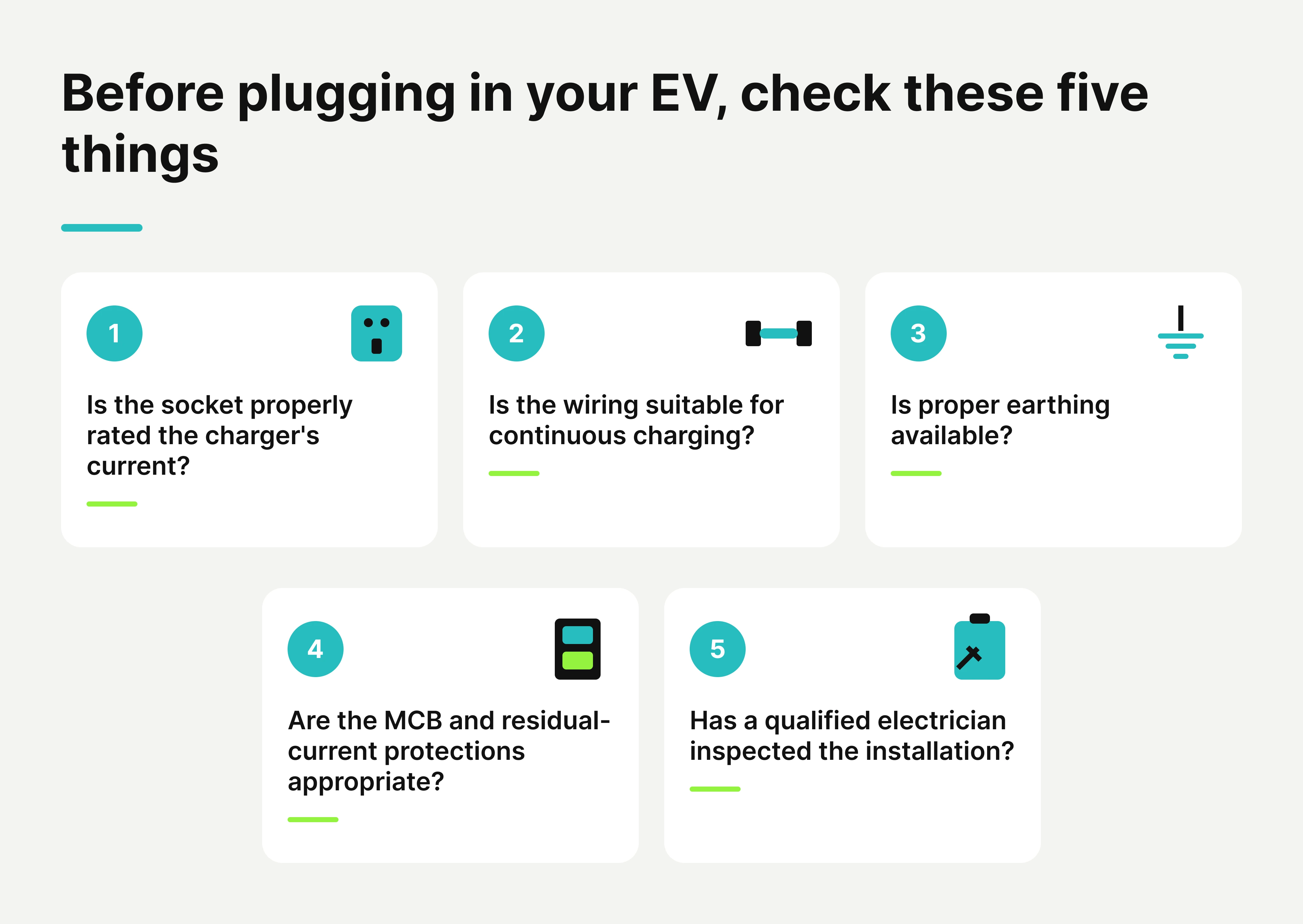
Plenty of 15A sockets cope fine. You can't tell which by looking, so have a licensed electrician check the socket, wiring, earthing, MCB and RCD before it becomes your daily charger.
Basic Type 1 Charging Equipment May Offer Limited Control
Many basic Type 1 chargers just plug in and charge. Depending on the model, there's no app, no way to schedule cheaper off-peak charging, no record of units used, and no easing off when the AC, washing machine and induction cooktop all come on.
Fine for a lazy weekend maybe but for 300 nights a year, the practical question is whether that socket can carry your car every day, for years, without you having to think about it.
A Dedicated Home EV Charger Setup Makes Every day Charging More Convenient
A dedicated home EV charger can address these limitations by offering higher charging capacity, purpose-built electrical protection and, in smart models, greater control over every day charging.
More power. Faster top-ups, within what your car and your sanctioned load (the maximum load your DISCOM has approved) allow.
Protection designed for EV charging. Its own circuit, cable sized for continuous current, and its own breaker and earth-leakage protection, all checked at installation. No more depending on a socket wired for a geyser in 2011.
Control. Smart home EV chargers add an app for monitoring, scheduling, and energy tracking.
How Exicom Spin Air Makes Home EV Charging Smarter
Exicom Spin Air is a smart, wall-mounted AC home EV charger. Here's what its specs mean in practice.
Up to 22 kW, sized to your home. Spin Air comes in single-phase (about 7.4 kW) and three-phase (11 kW and 22 kW) versions. The higher ratings need three-phase supply, and your car's onboard charger still sets the final speed.
Type 2 connector. Spin Air uses Type 2, a widely adopted AC charging standard. Check that your car has a compatible AC inlet.
Built-in 6mA DC and 30mA AC ground-fault detection. A ground fault is current leaking where it shouldn't, like into the car body. The 30mA AC detection matches CEA's residual-current limit for homes. The 6mA DC detection catches the smooth DC leakage EV electronics can produce, which a standard Type A RCD isn't built to detect.
IP66 rating. Dust-tight and protected against powerful water jets, so Spin Air is designed for indoor and outdoor installation. Open porch, monsoon, summer dust: covered.
Spin Control app. Start, stop and schedule charging, see live status and alerts, and track energy from anywhere. Set off-peak charging once and forget about it.
Dynamic load management. Spin Air monitors your supply and adjusts the charging current to what your home can spare. AC, geyser and induction all on? The car takes less. When they switch off, it takes more. Your connection stays within limits, and nobody fights over the 15A socket.
Frequently Asked Questions
Lorem ipsum dolor sit amet, consectetur adipiscing elit, sed do eiusmod tempor incididunt ut labore et dolore magna aliqua. Ut enim ad minim veniam, quis nostrud exercitation ullamco laboris nisi ut aliquip ex ea commodo consequat. Duis aute irure dolor in reprehenderit in voluptate velit esse.
Lorem ipsum dolor sit amet, consectetur adipiscing elit, sed do eiusmod tempor incididunt ut labore et dolore magna aliqua. Ut enim ad minim veniam, quis nostrud exercitation ullamco laboris nisi ut aliquip ex ea commodo consequat. Duis aute irure dolor in reprehenderit in voluptate velit esse.
Lorem ipsum dolor sit amet, consectetur adipiscing elit, sed do eiusmod tempor incididunt ut labore et dolore magna aliqua. Ut enim ad minim veniam, quis nostrud exercitation ullamco laboris nisi ut aliquip ex ea commodo consequat. Duis aute irure dolor in reprehenderit in voluptate velit esse.
Lorem ipsum dolor sit amet, consectetur adipiscing elit, sed do eiusmod tempor incididunt ut labore et dolore magna aliqua. Ut enim ad minim veniam, quis nostrud exercitation ullamco laboris nisi ut aliquip ex ea commodo consequat. Duis aute irure dolor in reprehenderit in voluptate velit esse.
Lorem ipsum dolor sit amet, consectetur adipiscing elit, sed do eiusmod tempor incididunt ut labore et dolore magna aliqua. Ut enim ad minim veniam, quis nostrud exercitation ullamco laboris nisi ut aliquip ex ea commodo consequat. Duis aute irure dolor in reprehenderit in voluptate velit esse.