



What is EV Charging? Everything You Need to Know in 2026
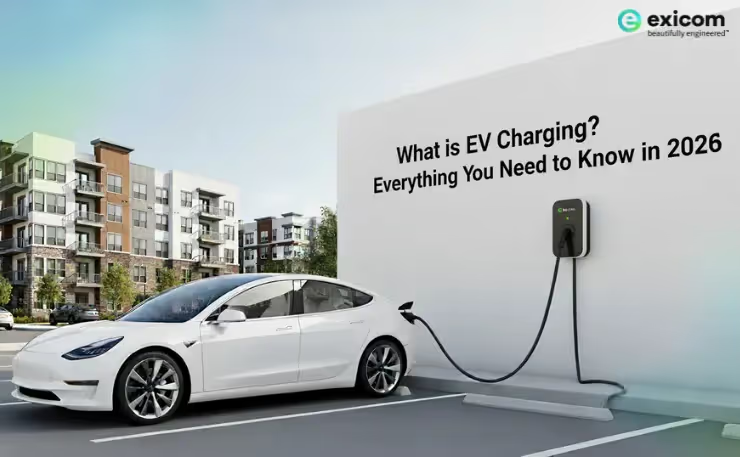
What is EV Charging? Full Form & Simple Definition
EV Charging is the process of supplying electrical energy to an electric vehicle's battery pack to restore its driving range, similar to how you refuel a petrol car, but using electricity instead.
When you plug an EV into a charger, electrical energy flows from the grid (or a local source like solar) into the vehicle's battery management system (BMS), which controls how fast and safely the battery charges. Once full, or charged to your desired level, you unplug and drive.
That's the simple version. But if you are a fleet operator managing 50 EVs, a CPO building a public charging network, or a corporate facility manager deciding how many chargers your parking needs, the details matter a great deal. This guide covers all of it.
How Does EV Charging Actually Work?
At its core, EV charging is the direct transfer of electrical power into the electric vehicle's battery system. The speed of this process depends on two main factors: the charger's power output (measured in kilowatts, or kW) and the EV battery's capacity (measured in kilowatt-hours, or kWh). A higher kW charger delivers energy faster, while a larger kWh battery can store more energy for a longer driving range.
Here's the actual flow when you plug in:
For AC charging (Level 1 & 2), the vehicle's onboard charger converts AC to DC before storing it in the EV battery. For DC fast charging (Level 3), the conversion happens inside the charger unit itself bypassing the onboard charger which is why DC charging is so much faster.
EV Charging Types: AC vs DC What's the Difference?
There are two fundamental types of EV charging based on the kind of electricity used: AC (Alternating Current) and DC (Direct Current).
EV Charging Levels Explained: Level 1, Level 2, Level 3
Beyond AC vs DC, EV charging is categorised into three levels , each with a different speed, cost, and use case. Here's what each actually means on the ground:
Home EV Charging vs Public EV Charging
Most EV owners charge at home 80% of the time. Home charging handles your daily needs cheaply and reliably. But the moment you operate a fleet, manage corporate parking, or run vehicles across cities, public charging becomes non-negotiable infrastructure. The question isn't home or public; it's knowing exactly when your business needs which one. Here's a clear breakdown:
EV Charging Cost in India The Real Numbers
Fuel bills are killing fleet margins. That's exactly why businesses across India are switching to EVs , and the numbers justify it completely. EV charging cost in India ranges from as low as ₹5/kWh at home to ₹25/kWh at a DC fast charger. Either way, you're spending a fraction of what petrol costs. Here's the full, transparent breakdown every fleet operator and CPO needs to see.
Assumes ~5 km/kWh average efficiency. *Assumes petrol at ₹105/litre, 12 km/litre.
Fleet Cost Implication: A fleet running 200 vehicles at 100 km/day each saves approximately ₹2.4 to ₹4 crore per year in fuel costs by switching from petrol to depot AC charging. That is the scale at which EV charging becomes a strategic financial decision.
EV Charging for Businesses, Fleets & CPOs
Scaling EV charging across a business is not one size fits all. A fleet operator’s biggest concern is depot utilisation. A CPO’s concern is network uptime. A corporate facility manager focuses on load balancing and employee billing. Getting this wrong leads to overspending, underperforming infrastructure, and frustrated users. Here is a clear role-by-role breakdown of what EV charging looks like and what it demands at the business level.
For Fleet Operators
Fleet electrification is accelerating fast. The key operational decisions include: depot charging vs en-route charging, charger-to-vehicle ratios, load management to control electricity demand charges, and OCPP-compliant hardware that integrates with fleet telematics. (Rule of thumb: Plan for 1 charger per 3 to 5 EVs for depot charging, with smart scheduling.)
For CPOs (Charge Point Operators)
CPOs are the backbone of India's public network. With the government targeting 72,000 new chargers by FY2025-26, the market opportunity is massive. Operational complexity requires uptime guarantees, billing accuracy, multi-network interoperability (OCPP 1.6 / 2.0), and real-time monitoring.
For Corporate Offices
Installing Level 2 chargers in office parking is a top employee benefit and talent retention tool. The model requires smart chargers with RFID/app access, load balancing for electricity management, and automated billing software.
Real EV Charging Challenges And How to Solve Them
Every business considering EV charging infrastructure runs into friction points. Here is how to solve them:
Final Thought
EV charging is no longer a "nice to have" it is the infrastructure backbone of India's electric mobility future. Whether you're a fleet operator trying to cut fuel costs, a CPO building a network, or a corporate facility manager planning your parking lot: the right charging strategy, the right hardware, and the right partner make all the difference. The window to build early is now.

