


India DC Fast Charging Reliability Report 2026
Executive Summary
The scale–reliability gap in India’s EV charging network
India’s target of 30% EV penetration by 2030 has accelerated charger deployment, but scale has outpaced reliability. Public DC fast chargers often report strong uptime figures, but in real-world use, they are not always available or functioning when drivers actually need them.
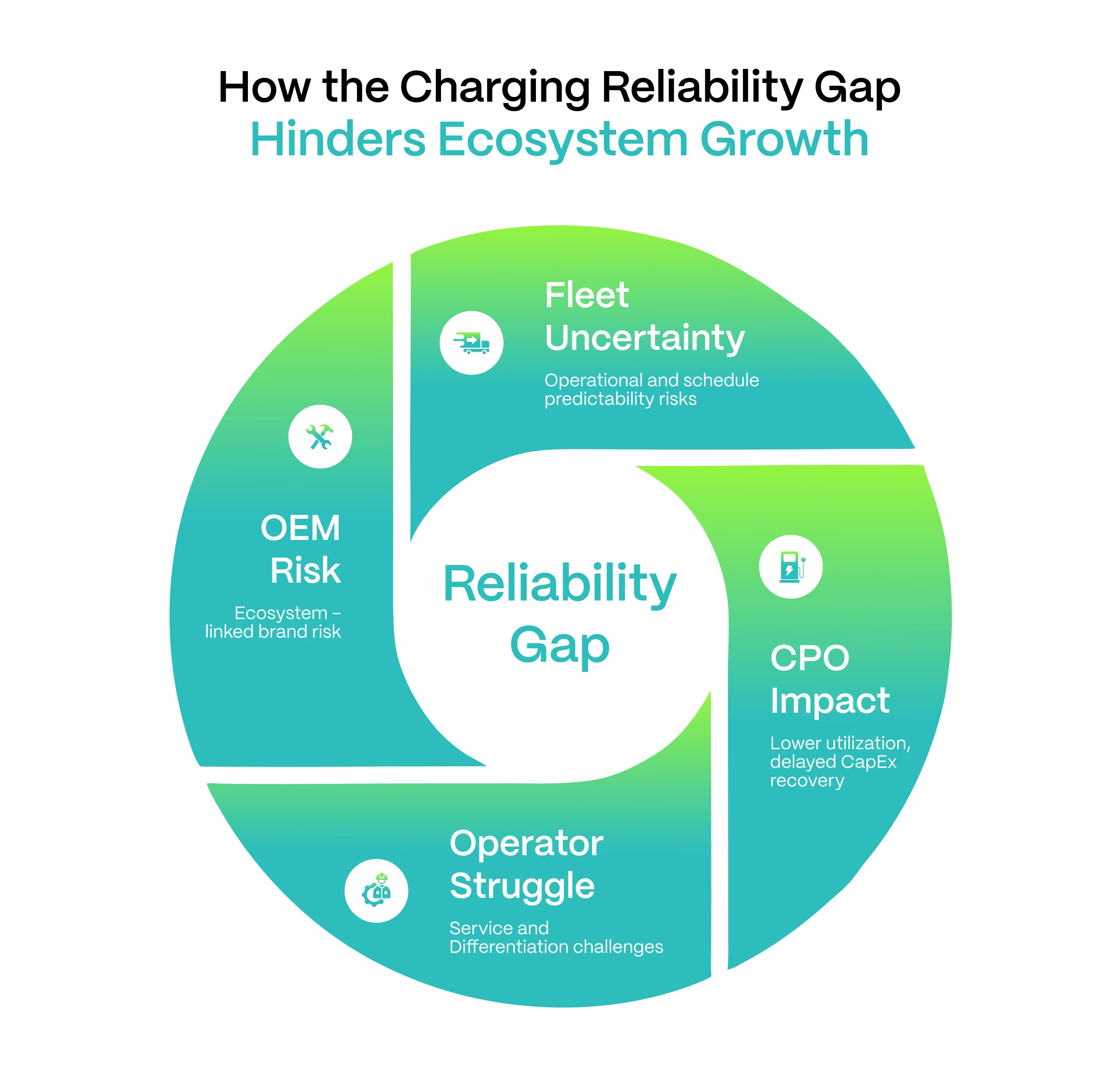
This reliability gap affects the entire ecosystem: CPOs face lower utilisation and delayed CapEx recovery; mid-tier and small operators struggle with service and differentiation; OEMs confront ecosystem-linked brand risk; fleets experience operational uncertainty.
Global EV leaders have already shifted from deployment-led growth to reliability-led optimization, a transition India must follow. This whitepaper examines India-specific reliability challenges and outlines practical pathways to build trust at scale.
1. From availability to trust: How the charging challenge has changed
1.1 The Scale-Up Phase Is Here
For years, India’s EV narrative was defined by a supply–demand paradox. Consumers hesitated to buy EVs due to limited access to charging, while infrastructure expansion slowed because adoption remained low. However, now EV adoption has picked up momentum, supported by policy incentives, OEM investments, and a growing range of vehicle models
EV adoption has scaled rapidly, with the total parc crossing 2.1 million vehicles by 2025, growing at over 30% CAGR since 2022. Charging infrastructure has expanded in parallel, from ~5,000 public stations in 2022 to over 29,000 by late 2025, creating strong visibility across metros, highways, and emerging cities.
At a surface level, the problem of availability has been addressed.
2. Current market reality: EV growth is outpacing charging confidence
The expansion phase has largely addressed geographic coverage. There is now a pressing question of operational maturity.
As of February 2024, nearly half of public chargers, approximately 12,100 out of 25,000, were reported as non-functional at a given point in time. Around 25% of stations experience frequent downtime due to technical faults, limited grid connectivity, or delayed maintenance intervention.
Even where chargers are operational, performance gaps persist. The average charging time of 1.5 to 2 hours significantly exceeds global fast-charging benchmarks of 30 minutes to 1 hour. Users often navigate 17 to 20 different mobile applications to locate a working charger, while digital payment friction continues to affect elderly users and chauffeur-driven vehicle segments.
The lack of a reliable, consistent charging experience erodes confidence amongst users. It is not surprising that 73% of non-EV drivers in India believe ultra-fast charging infrastructure is insufficient.
Reliability is the new cause behind charging and range anxiety
A survey found that 88% of EV owners identified locating an accessible, safe, and functioning charging station as a primary source of anxiety. This signals a structural issue: range anxiety today is not driven by charger visibility, but by uncertainty around charger performance.
These reliability constraints directly suppress utilization rates, weaken infrastructure economics, and erode OEM brand confidence (covered in-depth later in the paper).
3. Why reliability matters as much as the charger count
Charger count and reported uptime were built to measure network expansion. They show how many units exist and whether they are technically online, but they do not reflect whether charging sessions actually work in real conditions.
A charger that appears available but fails due to software errors, payment issues, connector faults, or compatibility problems delivers no value to the user. In practice, a failed session is equivalent to no charger at all. This performance gap directly shapes user trust.
Charger reliability has a direct influence on EV users’ behaviours:
- Drivers prefer a small set of “trusted” stations, leaving others underused
- Users restrict trip distance to predictable charging zones
- Fleets add buffer time, which then lowers vehicle productivity
When charging cannot be relied upon, it affects utilisation, economics, and long-term confidence across the value chain.
4. What is causing the charging performance to fall short
To understand what is still holding the ecosystem back, it is important to examine where the gaps persist beneath the surface.
Structural gaps: India’s charging network remains uneven both geographically and numerically. 5 states (Karnataka, Maharashtra, Uttar Pradesh, Delhi, and Tamil Nadu) host over 55% of public chargers, creating regional concentration.
Nationally, there is only one public charger per 235 EVs, contributing to long wait times and persistent range anxiety.
System reliability failures: Operational downtime in India’s charging network is typically a result of frequent system-level issues such as connector wear, software and protocol mismatches, payment processing failures, environmental conditions, and unstable connectivity. Most of these faults develop gradually and can be detected in advance, indicating that a large share of downtime is preventable.
User-side friction and safety risks:Discovery, monitoring, and payment systems remain fragmented, with users relying on as many as 17-20 different apps for charger location and payments. Safety concerns are persistent, too: 99% of battery fires are caused by short circuits that create uncontrolled current.
5. Implications for key stakeholders
When charging reliability falters, the erosion of trust affects each of these players across the system.
CPOs and network operators
Many operators still track uptime and connectivity; however, charging reliability gaps are cutting into network economics. Although 14,008 chargers support CCS2 and Type 2 standards, many remain concentrated in metro areas, and about 4,565 are out of service or unreliable. Session failures, delayed fault resolution, and software integration issues directly reduce repeat usage and throughput. Lower network reliability reduces returns and, in turn, extends infrastructure payback periods. The impact is visible in utilisation: fewer than 10% of public stations see meaningful usage. Reliability-led design, proactive maintenance, and interoperability improvements can shorten payback to under five years.
OEMs
Charging reliability now poses a dual risk for OEMs: retention and future demand. Surveys indicate that 51% of EV owners are considering returning to internal combustion engine (ICE) vehicles, and 88% cite charging anxiety as their primary concern. Reliability also shapes purchase economics. 36% of consumers prioritise fast charging, and differences in perceived reliability can lead to a 32% price difference. As charging performance becomes inseparable from vehicle experience, OEMs need deeper involvement in infrastructure quality and fast-charging consistency to protect demand.
Fleet operators
Unreliable charging sessions weaken fleet operators’ economics. As reported in May 2025, India’s EV cab shift is slowing, with operators struggling with long charging times. As InDrive’s India manager, Pratip Mazumder, noted, longer charging times directly cut daily trips and earnings. Drivers also report environmental challenges: hot weather and heavy rains can interfere with charging, and batteries may disconnect during sessions, causing delays and operational disruption. For fleets, slow or failed charging, payment issues, and interruptions translate into idle vehicles, missed routes, and a higher total cost of ownership.
6. What mature EV markets get right
Global markets offer useful reference points, and Indian players can use the approaches that translate effectively across local policy environments, climate conditions, grid constraints, and travel patterns.
China scaled fast charging while improving performance
China’s charging network is scaling with operational discipline. Expansion is supported by standardized equipment, centralized visibility, and real-time diagnostics, so reliability improves alongside network growth. Today, over 40% of public chargers are fast chargers, well ahead of other EV markets.
Performance is reinforced through renewable integration, IoT platforms, and AI systems that forecast demand, regulate charging speeds, detect faults early, optimize pricing, and maintain interoperability and data security.
European networks are making charging more dependable for everyday users
Europe has crossed 1 million public chargers, supported by regulatory frameworks such as AFIR that explicitly link network growth with interoperability, transparent pricing, performance monitoring, and minimum uptime expectations. Norway maintains one of the world’s highest charger densities, with over 400 chargers per 100,000 people, reducing wait times and improving everyday usability. Meanwhile, Sweden is piloting long-term infrastructure innovation, including the world’s first permanent electric road enabling wireless charging.
While these examples reflect different market contexts, they highlight practical directions India can adapt. From reducing charging time to focusing on real-time network optimization and improving charger density, a multi-pronged approach can help establish trust in the Indian EV charging infrastructure.
7. How India can ensure trusted charging performance
The following priorities outline how Indian operators, OEMs, utilities, and policymakers can collectively move toward a mature, reliability-led ecosystem.
Design and material changes
India’s charging network is entering a phase where performance consistency will determine long-term adoption outcomes. Strengthening reliability now is less about reinvention and more about systematically tightening design, monitoring, and operational discipline across the ecosystem. Bridging the gap between infrastructure rollout and real ease of use, therefore, requires a shift toward user-centred design alongside a stronger engineering discipline.
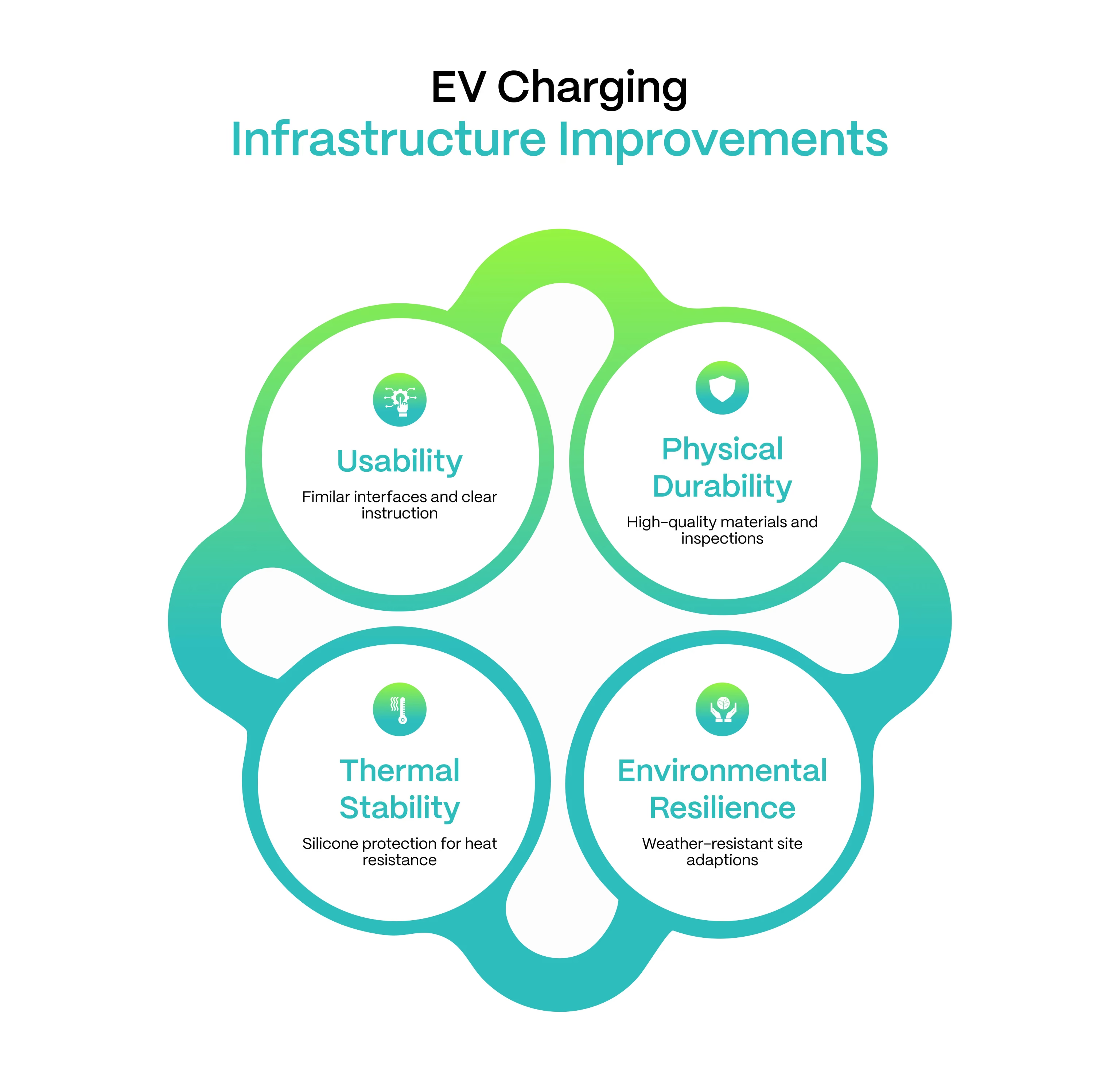
A useful way to think about this transition is in terms of four overlapping design layers: usability, physical durability, thermal stability, and environmental resilience.
1. Designing chargers that feel familiar to use
Public charging is becoming an everyday task, and everyday tasks must be simple. Selecting a connector, activating a session, pairing with an app, and completing payment should not feel like operating specialised equipment. Chargers should behave more like familiar consumer technology, with clean screen layouts, clear status indicators, and predictable workflows.
Small design improvements, such as clearer instructions, better lighting, and intuitive layouts, can reduce user errors, shorten session start times, and improve confidence at unsupervised sites.
2. Strengthening hardware durability and material quality
Reliability also depends heavily on how well hardware survives repeated real-world handling. Routine inspections and structured maintenance cycles remain essential to detect wear, damaged connectors, and early-stage component failure before they escalate into downtime.
Material choices matter here. High-quality electrical components, reinforced connectors, and durable enclosure systems reduce the probability of failure over time. Silicone-based protection and assembly materials in charging guns help maintain insulation integrity, improve sealing, and stabilise performance across temperature fluctuations. These material decisions may seem minor individually, but collectively they determine whether chargers continue functioning after thousands of use cycles.
3.Reliable OS at the core of Charger Intelligence
Many charging issues: failed sessions, app crashes, payment errors—stem from fragmented software layers. An in-house OS changes this fundamentally.
Instead of relying on multiple third-party integrations, a unified OS tightly controls the charger, communication protocols, payment systems, and user interface. This leads to:
- Faster and more reliable session initiation
- Better handling of poor mobile networks, common across India
- Seamless OTA (over-the-air) updates without downtime
- Improved compatibility across vehicles (Bharat DC-001, CCS2)
Think of it as the difference between a loosely assembled system and a well-engineered machine. The charger no longer “waits” for different systems to respond - it acts as a single, coordinated unit.
The result feels almost like a eureka moment: plug in, tap once, and it just works.
4. Designing for India’s environmental realities
Charging infrastructure must also withstand the conditions in which it operates. Weather-resistant housings and protective materials suited for Indian weather conditions, heat, dust, humidity, and rainfall are essential for long-term performance.
Site-level design adaptations, such as enclosure protection, reinforced seals, cable strain relief, and sun-exposed component shielding, can significantly extend equipment life in India’s climate. These measures can reduce the frequency of faults triggered by environmental stress and lower the operational burden on service teams.
Advanced diagnostics
Deep transfer learning–based fault detection models now exceed 99% identification accuracy under variable operating conditions, while digital-twin-enabled predictive maintenance can reduce unplanned downtime by up to 45% and maintenance costs by around 30%.
Predicative Maintenance via Remote Monitoring Systems
Remote monitoring, over-the-air (OTA) software updates, and continuous equipment health tracking allow operators to intervene before users experience failures, shifting maintenance from reactive repair to planned performance management.
Alongside equipment diagnostics, predicting when and how often users charge is becoming equally important for reliability planning. For Indian charging networks, predictive modelling can play a direct role in planning efficiency. Research suggests that combining inputs such as traffic flow, weather patterns, user charging behaviour, and historical load data can increase charging demand forecast accuracy from about 78.1% to 88.7%, while significantly reducing energy estimation error. For operators, this means better anticipation of peak usage windows, smarter load balancing across nearby stations, and more targeted preventive maintenance scheduling.
Instead of reacting to congestion, overload, or sudden faults, companies can plan interventions in advance, protect hardware from stress, and deliver more consistent charging availability using the infrastructure already in place.
Strengthening grid, siting, and home charging readiness
Geographic balance remains important, since infrastructure concentration still skews toward major states and urban corridors.
National guidelines already recommend:
- At least one charging station per 1 km × 1 km grid in urban areas
- One station every 20 km on highways
- Site selection based on land use, traffic flow, vehicle density, and activity hotspots
Grid readiness must also keep pace with charging expansion. Voltage fluctuation, weak earthing, and informal connections in smaller towns continue to pose safety risks. Power quality monitoring using analyzers on chargers and medium-voltage lines can help track voltage instability, consumption patterns, and component health.
For home chargers, bundling them with EV sales is emerging as a commercially viable approach to improve charging reliability and adoption. When manufacturers or dealers provide standardized charger packages with verified installation support, it reduces dependence on fragmented third-party setups, improves safety compliance, and ensures better integration between vehicle and charging hardware.
Improving visibility, service networks, and smart operations
Reliability improves when performance is continuously tracked, transparently measured, and operationally supported.
States and operators increasingly need to move beyond counting chargers to tracking:
- Utilisation rates
- Session success metrics
- Fault frequency and repair timelines
- Site-level performance patterns
Developing state-level EV dashboards that track utilisation and performance alongside installation numbers can help guide future investment decisions and improve network efficiency.
Smart charging systems are already demonstrating how digital infrastructure can support this shift. IoT-enabled chargers allow remote monitoring, real-time fault detection, and dynamic energy management. Cloud-connected platforms can integrate renewable energy, optimise load distribution, and improve user experience through accurate availability data.
Reliability also depends on physical service readiness. A strong field service network with clear response timelines, spare parts availability, and preventive maintenance capability remains essential to sustain performance at scale.
Upskilling, reskilling, and training personnel
Infrastructure reliability ultimately depends not only on hardware quality but also on the people responsible for installing, maintaining, and operating it. India’s EV transition faces a growing shortage of trained technical personnel capable of supporting charging infrastructure at scale.
According to the Society of Indian Automobile Manufacturers, India will require between 1,00,000 and 2,00,000 skilled professionals by 2030 to meet the national target of 30% EV adoption. Annual intake of EV-ready workers needs to rise from roughly 15,000 to 30,000, with emphasis on hands-on technical capability rather than only classroom training. The reliability challenge, therefore, becomes as much a workforce challenge as a technology one.
Currently, around 43% of technical competencies required for EVs have little overlap with those used in Internal Combustion Engine (ICE) vehicles, meaning entirely new skills must be developed, while about 27% of competencies overlap significantly, making re-skilling of the existing workforce both possible and necessary.
Sector bodies are beginning to respond. The Automotive Skills Development Council has developed curriculum frameworks and certification pathways for EV roles, but implementation scale remains uneven, and industry adoption still lags behind projected workforce demand.
Private sector participation is gradually expanding. For example, Tata Motors has announced plans to upskill 50% of its workforce in EV technologies within five years. In FY23 alone, the company invested ₹25 crore and logged roughly 3,40,000 hours in employee upskilling, signalling how large manufacturers are beginning to treat workforce capability as core infrastructure.
8. Where stakeholders go from here: Turning reliability insight into action
Charging reliability has emerged as one of the most important factors that will determine how confidently India’s EV market scales from early growth to mass adoption. Understanding problems on the ground makes the path forward actionable.
CPOs will need to focus on charging session quality, service networks, functionality, and site performance. OEMs will need to integrate charging experience into vehicle strategy, partnerships, and customer assurance models. Fleet operators will require predictable charging outcomes to protect utilization and margins.
At the system level, government, utilities, and private players will need to work together to strengthen grid conditions and improve siting discipline. They must also enable centralized monitoring and drive continuous performance improvement.
To explore how reliability-focused charging solutions are being engineered in practice, talk to Exicom.
Frequently Asked Questions
Lorem ipsum dolor sit amet, consectetur adipiscing elit, sed do eiusmod tempor incididunt ut labore et dolore magna aliqua. Ut enim ad minim veniam, quis nostrud exercitation ullamco laboris nisi ut aliquip ex ea commodo consequat. Duis aute irure dolor in reprehenderit in voluptate velit esse.
Lorem ipsum dolor sit amet, consectetur adipiscing elit, sed do eiusmod tempor incididunt ut labore et dolore magna aliqua. Ut enim ad minim veniam, quis nostrud exercitation ullamco laboris nisi ut aliquip ex ea commodo consequat. Duis aute irure dolor in reprehenderit in voluptate velit esse.
Lorem ipsum dolor sit amet, consectetur adipiscing elit, sed do eiusmod tempor incididunt ut labore et dolore magna aliqua. Ut enim ad minim veniam, quis nostrud exercitation ullamco laboris nisi ut aliquip ex ea commodo consequat. Duis aute irure dolor in reprehenderit in voluptate velit esse.
Lorem ipsum dolor sit amet, consectetur adipiscing elit, sed do eiusmod tempor incididunt ut labore et dolore magna aliqua. Ut enim ad minim veniam, quis nostrud exercitation ullamco laboris nisi ut aliquip ex ea commodo consequat. Duis aute irure dolor in reprehenderit in voluptate velit esse.
Lorem ipsum dolor sit amet, consectetur adipiscing elit, sed do eiusmod tempor incididunt ut labore et dolore magna aliqua. Ut enim ad minim veniam, quis nostrud exercitation ullamco laboris nisi ut aliquip ex ea commodo consequat. Duis aute irure dolor in reprehenderit in voluptate velit esse.
%20(1).webp)