


Why EV Charging Station Setup is Harder Than You Think
.avif)
If you’ve read our blogs before, you probably know that we frequently harp on how exponentially the EV market is growing and how the number of EV charging stations is also growing, but not enough. The question is, why is it not enough? Yes, we are believers in positive outcomes. But in this blog piece, we give ourselves a reality check. Setting up an EV charging station is way harder than it looks.
EV charging infrastructure presents a deceptively complex deployment challenge. With global EV sales exceeding 17 million units in 2024 and public fast-charging capacity growing at roughly 55% annually (okay, we cannot help but insert data), the tolerance for sequencing errors has reduced sharply.
EV charging deployment is often assumed to be linear: procure chargers, install them, and enable usage. This view underestimates the operational reality. Deployment spans multiple stakeholders and decisions that remain interdependent throughout the project lifecycle. Complexity emerges as early choices constrain later outcomes.
Setting Up an EV Charging Station Is a Multi-Factor Project
In early-market deployments, charger utilisation commonly remains near 10% in the first operational years. This is not driven by a lack of EV adoption, but by poor sequencing, underestimated power timelines, and misaligned stakeholder expectations.
For example: A CPO anticipating a three-month rollout may encounter six-month delays if power approvals are delayed unexpectedly. Selecting connectors without aligning them to site electrical layouts can trigger mid-project retrofitting. When EPC contractors coordinate several vendors without clear accountability frameworks, integration disputes often surface during commissioning. This ultimately ends up delaying go-live.
Successful deployment of an EV charging station depends on disciplined execution across multiple tightly linked stages. Each stage introduces dependencies that, if missed, multiply delays and cost overruns. Understanding this structure early determines whether a charging project evolves into a scalable, revenue-generating asset or struggles with persistent underperformance.
Here are 7 uncomfortable truths:
1. Not every site is immediately EV-ready
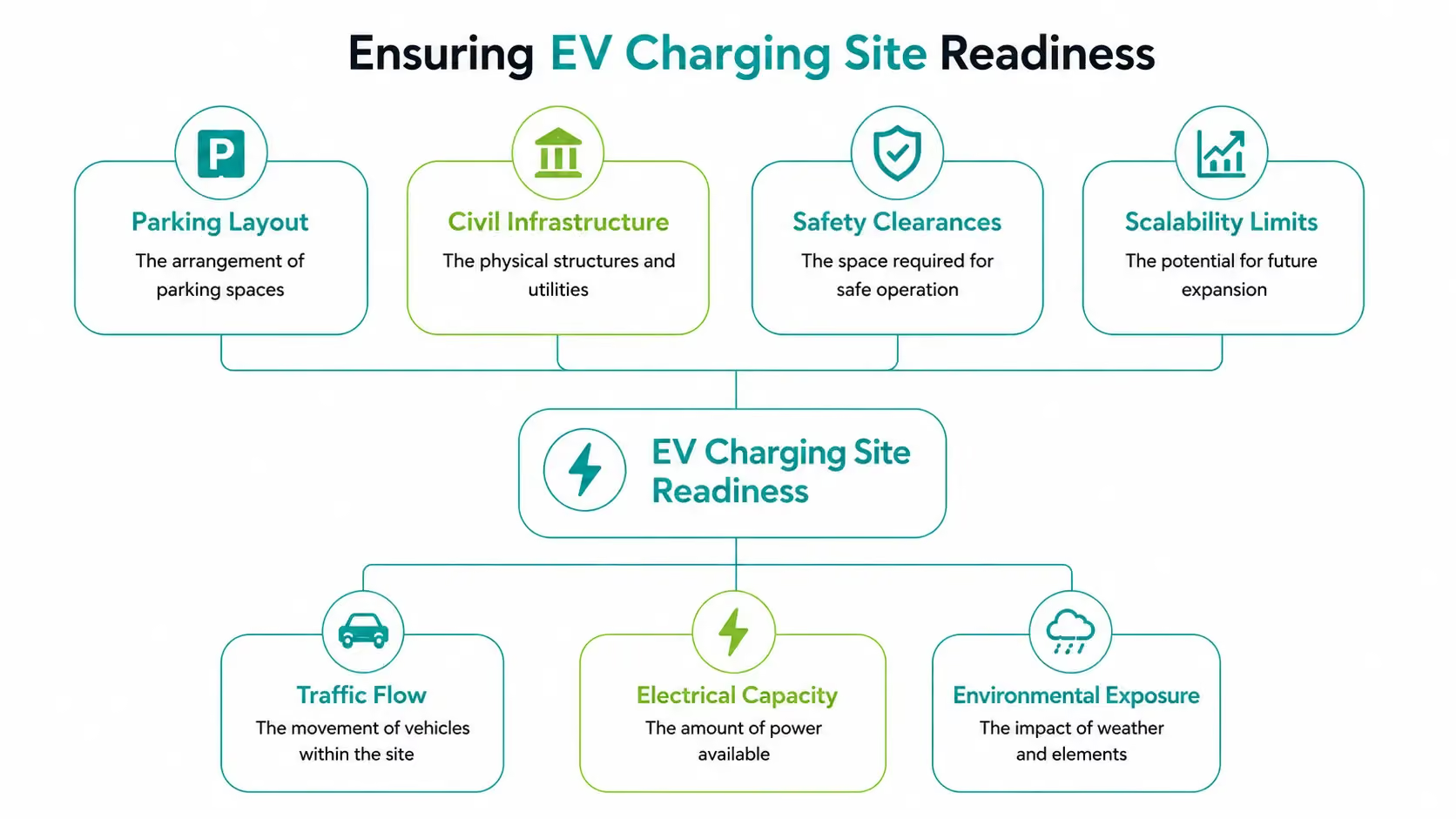
Not all locations are immediately suitable for EV charging. Before installation begins, site readiness must be thoroughly evaluated.
Multiple Factors Determine Site Readiness
Key dimensions include:
- parking layout
- traffic flow,
- civil infrastructure conditions,
- available electrical capacity,
- safety clearances,
- environmental exposure,
- scalability limits.
These factors determine feasible charger placement, achievable power levels, and long-term expansion potential. Skipping or rushing this phase increases the likelihood of redesigns later in the project.
Existing Infrastructure May Constrain Charger Placement and Capacity
Legacy infrastructure frequently limits what can be deployed. For instance, a parking facility with single-phase distribution cannot support high-power fast chargers without upgrading to a three-phase supply. Limited underground conduit space can cap the number of chargers, regardless of surface availability. Sites experiencing frequent power disruptions may require battery energy storage systems (BESS) and solar-compatible configurations to maintain reliability.
In regions with grid reliability challenges, alternative models such as battery swapping have emerged to offset limited charging density. Modular EV charging systems can adapt to local constraints where conventional expansion is restricted.
Early assessment decisions directly affect future flexibility. Underestimating demand leads to relocation or capacity retrofits, while over-specifying infrastructure increases capital expenditure without proportional near-term returns. Research highlights that charging speed and availability remain the primary concerns for EV owners, reinforcing the need to align infrastructure scale with realistic five-year demand forecasts before finalising the design.
2. Power Availability Is Rarely Straight Forward
Once site feasibility is confirmed, power planning becomes the most schedule-critical phase. Engineers must calculate connected loads, submit utility applications, undergo technical reviews, secure sanctions, and, where required, wait for grid reinforcement. These steps occur sequentially and depend on external utilities and regulators.
Power Approval Requires Multiple Sequential Steps
Utility approval timelines often dictate overall project schedules. In jurisdictions governed by regulatory mandates such as AFIR in the European Union, increased infrastructure demand has lengthened review cycles. Delays at this stage cascade through civil works, installation, and commissioning, regardless of execution efficiency elsewhere.
Constrained Grids Impose Demand Management and Energy Storage Requirements
Where grid capacity is limited, utilities may impose demand management, time-of-use restrictions, or grid-interactive charging requirements. India’s National Smart Grid Mission emphasises smart metering and the integration of energy storage to manage peak demand. If such requirements surface late, they introduce unplanned system complexity and cost.
Projections from the International Energy Agency indicate that public chargers must scale from about four million today to nearly thirty-five million by 2030. Early utility engagement and parallel planning significantly reduce power-related risks.
3. EV Charging EPC Is a Coordinated Effort, Not a Single Activity
Engineering, procurement, and construction for EV charging integrates civil works, electrical systems, earthing, and safety design. Each discipline relies on accurate sequencing. Foundations must align with conduit routes, wiring cannot be energised without verified grounding, and charger installation depends on completion of upstream work.
Design Success Requires Coordination Across Multiple Technical Disciplines
Small execution gaps, such as undersized conduits or inadequate earthing, often delay commissioning by weeks. Project outcomes depend less on individual task completion and more on coordination discipline across teams.
Site Conditions Necessitate Context-Specific Engineering Decisions
Site conditions frequently require customised engineering responses. Overhead power distribution alters routing strategies compared to underground systems. Coastal locations demand corrosion-resistant materials, while high-traffic areas require reinforced cable protection.
This was about the strategy and architecture for the EV charging station. But even after the site layout is correct and finalised, operational execution is a whole different process. Each stage of deployment involves coordination with multiple vendors. As the deployment scope expands, vendor involvement multiplies.
4. Too Many Vendor Handovers Can Lead to Too Little Ownership
Typical projects involve hardware suppliers, software providers, system integrators, EPC contractors, and operations partners. Each operates under separate contracts and schedules.
Multiple Vendors Increase Coordination Complexity
When failures arise, resolution requires cross-vendor coordination, which is slower than internal decision-making. Software-hardware incompatibilities, spare-parts delays, or sequencing conflicts frequently stall commissioning when accountability is unclear.
Responsibility Becomes Obscured Across Fragmented Vendor Boundaries
Fragmentation dilutes ownership. Determining whether faults originate in firmware, power supply, connectivity, or backend systems is a lengthy process. Projects with clearly defined governance or single-point accountability consistently achieve faster commissioning, even when initial costs appear higher.
After you’ve figured out station layout and operations, what needs another careful consideration, is the device that’ll be at the centre of the EV charging station: The EV charger itself.
5. EV Charger selection needs to be as per the use case
Different deployment contexts require different EV charger types, with varied power ratings and combinations.
Usage Patterns Fundamentally Drive EV Charger Selection
Residential and office locations align with AC charging and longer dwell times. Fleet depots and highways require DC fast or ultra-fast charging to support rapid turnaround. Misalignment between charger power and user behaviour results in underutilised assets or dissatisfied users, significantly reducing repeat usage.
Site Environment and Conditions Shape Hardware Specifications
Environmental and regulatory factors influence hardware choices. Connector standards, safety certifications, weatherproofing, vandalism protection, and thermal management requirements vary by region. Hardware that lacks flexibility limits future expansion and increases the risk of replacement if site conditions or grid availability change.
We often do not pay enough attention to the software aspects of the EV charger, because we are carrying over the same image as a petrol pump.
6. EV Chargers Need a Digital Backbone
Refuelling is more of a ‘manual’ job in our eyes, and we often end up seeing an EV charger like a random electrical equipment. But it goes deeper than that.
Multiple Platform Functions Are Essential for Operational Control
Installed EV chargers require backend platforms to enable monitoring, access control, billing, diagnostics, load management, and analytics. Without software integration, CPOs lack visibility into performance, utilisation, and revenue, reducing operational effectiveness.
Hardware-Software Compatibility Must Be Validated During Design
Integration issues discovered after installation create expensive rework. Chargers that do not integrate cleanly with selected platforms may require custom middleware or coordinated firmware upgrades. Validating compatibility during design prevents disruption and enables immediate operational readiness.
7. Installed Does Not Always Mean Operational
This is something that has unfortunately happened multiple times across the country. A new EV charging station goes live, and within weeks, chargers are found offline, damaged, with the station itself sometimes vandalised. Crores of rupees, months of time invested, only to become another defunct station adding to the frustration of EV users.
Comprehensive Testing Across Multiple Domains Must Precede Go-Live
Commissioning verifies electrical integrity, software workflows, safety mechanisms, integration performance, and power delivery. Each domain must pass validation before revenue operations begin. Incomplete commissioning directly impacts uptime and reliability. Data from mature markets shows that reliability below 90% accelerates user migration.
Clear Commissioning Protocols Prevent Delays
When responsibilities are fragmented, commissioning stalls. Defined response timelines, escalation protocols, and payment milestones tied to successful commissioning create incentives for rapid issue resolution and prevent prolonged asset idling.
Reliability Is the Real Measure of Success
EV charging station deployment spans several interdependent stages. Each stage shapes the next. Overlooking any one stage can introduces compounding delays, cost escalation, and utilisation risk. Insights echoed by multiple studies reinforce the same thing.
Long-term success of an EV charging station is defined by reliability rather than installation speed.
CPOs that enable disciplined sequencing, early utility engagement, coordinated vendor governance, context-specific engineering, and focus on operational reliability can deploy long-term profitable EV charging stations.
We are happy to introduce Exicom One, an all-in-one EV charging ecosystem combining that combines hardware, software, and all services under one trusted partner, which makes a CPOs life infinitely easier while setting up an EV charging station.
Speak to us here.
Frequently Asked Questions
Lorem ipsum dolor sit amet, consectetur adipiscing elit, sed do eiusmod tempor incididunt ut labore et dolore magna aliqua. Ut enim ad minim veniam, quis nostrud exercitation ullamco laboris nisi ut aliquip ex ea commodo consequat. Duis aute irure dolor in reprehenderit in voluptate velit esse.
Lorem ipsum dolor sit amet, consectetur adipiscing elit, sed do eiusmod tempor incididunt ut labore et dolore magna aliqua. Ut enim ad minim veniam, quis nostrud exercitation ullamco laboris nisi ut aliquip ex ea commodo consequat. Duis aute irure dolor in reprehenderit in voluptate velit esse.
Lorem ipsum dolor sit amet, consectetur adipiscing elit, sed do eiusmod tempor incididunt ut labore et dolore magna aliqua. Ut enim ad minim veniam, quis nostrud exercitation ullamco laboris nisi ut aliquip ex ea commodo consequat. Duis aute irure dolor in reprehenderit in voluptate velit esse.
Lorem ipsum dolor sit amet, consectetur adipiscing elit, sed do eiusmod tempor incididunt ut labore et dolore magna aliqua. Ut enim ad minim veniam, quis nostrud exercitation ullamco laboris nisi ut aliquip ex ea commodo consequat. Duis aute irure dolor in reprehenderit in voluptate velit esse.
Lorem ipsum dolor sit amet, consectetur adipiscing elit, sed do eiusmod tempor incididunt ut labore et dolore magna aliqua. Ut enim ad minim veniam, quis nostrud exercitation ullamco laboris nisi ut aliquip ex ea commodo consequat. Duis aute irure dolor in reprehenderit in voluptate velit esse.

.webp)