



Our story behind Exicom One
.avif)
With each passing day, we are spotting more EVs on Indian roads. Not just e-bikes, e-rickshaws and e-buses, but trendy 4 wheelers and luxury models too. Adoption has gained a certain momentum, and the industry no longer wonders whether we’re going electric. The question is, how soon?
That, dear readers, depends on how easy it is to charge our EVs. Which further depends on how many EV charging station stations are available, which eventually leads us to the root of the issue: how can one deploy more EV Charging stations?
Here’s what we need.
Deploying an EV charging station needs 4 things
An EV charging station is shaped by many connected elements that influence every outcome across its lifecycle. While the EV charger is definitely the star of the show, no star can deliver a blockbuster alone. Similarly, an EV charging station essentially needs hardware, software, EPC, and service support.
1. Hardware
Hardware is where most EV charging conversations begin, and it is where many assumptions are made. This is not about the EV charger alone. Construction materials, connectors, conduits, cables, everything is important for an EV charging station to operate seamlessly and safely.
Of course, the EV chargers can be AC, DC or a mix of both, depending on where you’re deploying the station. You can find this topic extensively covered in these previous blogs. But ultimately, hardware component choices are about resilience than just meeting headline specifications. Hardware decisions should be made keeping in mind what survives year three, not what looks like a steal deal on day one.
2.Software
Hardware defines what an EV charging station can technically deliver. Software determines whether it actually does. EV chargers are integrated with robust softwares to identify issues and report them. The idea is to remove the possibility of any operational blind spot, and to minimize repair costs. Be it downtime due to load imbalance, billing mismatch, or a simple end-of-day revenue report; software serves as the digital backbone of EV charging stations.
3. EPC
EPC (Engineering, Procurement, Construction) is where most EV charging station plans meet reality. Site inspection, layout design, civil and electrical works, power planning – all of this comes under EPC teams. In a way, one can say that this is when the tech that excelled in labs gets deployed in the real world.
It requires precise sequencing, shared accountability, and decisions that take into account downstream implications. Without that, even well-designed stations may struggle to go live on time.
4. Service Support
Service support is often addressed only after commissioning, yet it ultimately determines whether a charging station remains relevant. Service support ensures sustained reliability through continuous monitoring, defined response timelines, trained field teams, and constant feedback into deployment and design.
While these 4 pillars are often treated as separate workstreams in a project plan, ideally, they should function as a single chain. Over years and years of on-ground experience doing EV charger installation, we have seen many ups and downs. And we’ve seen patterns.
4 things do not need to be fragmented
Across customers, locations, and use cases, the same problems recurred. The issue was rarely immature technology. It was fragmentation. Hardware choices changed once real operating conditions became visible. Software priorities shifted too. EPC assumptions evolved after repeated sequencing delays. Hardware vendors blamed software platforms. EPC contractors pointed to power delays. Power approvals slipped. Commissioning timelines doubled. Service partners entered only after problems had escalated to a stalemate. Chargers went live but remained offline. Utilization stayed low despite visible EV demand.
What CPOs struggled with most was ownership. Every handover added a delay. Every delay reduced confidence. Costs kept rising due to lack of visibility. Even strong components could not compensate for weak coordination and monitoring. Add on top of this, the need to scale. Even with the current rate of adoption, there are barely 1-2 EV charging stations for 250 vehicles. If we are to meet adoption targets, we must have 4 million EV charging stations operational by 2030.
This is what pushed us onto the ground. We saenite assessments, power coordination, EPC execution, commissioning, and service could not be separated among different owners if outcomes were to improve. To successfully build a scalable ecosystem, all our workstreams must function as ONE. And that’s how we came up with Exicom One.
Exicom One is an end-to-end solution for everything EV Charging
Exicom One integrates hardware, software, EPC, and service support under a single accountable framework. From site surveys, electrical planning and civil work, to installation, monitoring, and service operations, we take complete ownership for the rollout of an EV charging station using tech driven solutions.
Exicom’s AC and DC fast chargers already cover a broad power range from 3.3kW - 400kW, supporting residential, commercial, fleet, and highway use cases. Distributed charging architectures, smart load balancing, peak-hour optimization and integration with battery energy storage systems help address grid and cost constraints that limit expansion.
Our charging management software (CMS) platform leverages AI-driven real-time monitoring. Diagnostics, billing, load management, and analytics, everything can be supported remotely for hundreds of EV charging stations.
Our nationwide EPC and service operations team is made up of engineers who care about long-term uptime, not just commissioning milestones.
Exicom One handles deployment from the beginning, till the end, to provide the CPO/EV manufacturer with a turnkey solution.
There are 6 steps in the working process
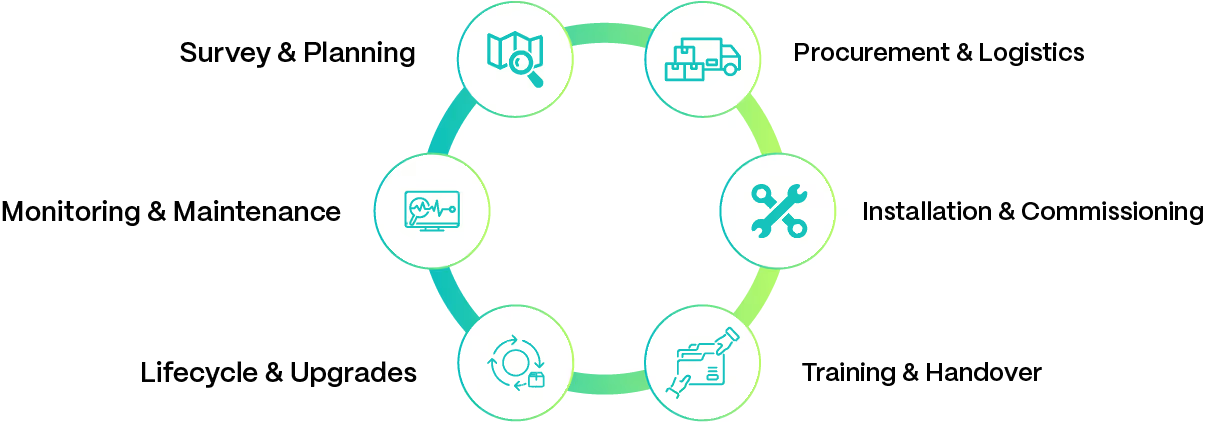
- Survey & Planning
Site evaluation, capacity analysis, and layout designs that meet all safety standards and local regulations.
- Procurement & Logistics
Timely sourcing and delivery of chargers, electrical components, and other key elements to ensure smooth project rollout.
- Installation & Commissioning
Full civil and electrical setup, rigorous safety inspections, grid integration, and live testing prior to handover.
- Training & Handover
Hands-on staff training, digital operating procedures, and user manuals for effortless daily management.
- 24×7 Monitoring & Maintenance
Centralized ops hub for live monitoring, predictive alerts, and scheduled preventive maintenance.
- Lifecycle & Future Upgrades
Ongoing software updates, expansion readiness, renewable integrations, and adaptation to emerging standards.
The impact is reflected in metrics that indicate execution maturity. We have sold over 1,33,000 chargers globally across the AC and DC segments. Deployments span multiple regions, supported by service operations across more than 25 states and 2000 cities. Manufacturing capacity continues to expand to support scale, while installed EV chargers are monitored remotely to enable predictive maintenance and consistent uptime.
These numbers matter because they reflect infrastructure that continues to function after installation. They represent EV charging stations that stay operational; networks that scale, and lessons learned the hard way, having spent over 30 years in power electronics.
EV charging stations are complex systems. Miss one dependency and delays compound; costs escalate and revenue declines. Exicom One exists because EV charging cannot be addressed piecemeal.
EV charging partners must own the hardware, software, EPC, service support, and everything else that comes with the process, in a unified manner.
Learn more here.
Frequently Asked Questions
Lorem ipsum dolor sit amet, consectetur adipiscing elit, sed do eiusmod tempor incididunt ut labore et dolore magna aliqua. Ut enim ad minim veniam, quis nostrud exercitation ullamco laboris nisi ut aliquip ex ea commodo consequat. Duis aute irure dolor in reprehenderit in voluptate velit esse.
Lorem ipsum dolor sit amet, consectetur adipiscing elit, sed do eiusmod tempor incididunt ut labore et dolore magna aliqua. Ut enim ad minim veniam, quis nostrud exercitation ullamco laboris nisi ut aliquip ex ea commodo consequat. Duis aute irure dolor in reprehenderit in voluptate velit esse.
Lorem ipsum dolor sit amet, consectetur adipiscing elit, sed do eiusmod tempor incididunt ut labore et dolore magna aliqua. Ut enim ad minim veniam, quis nostrud exercitation ullamco laboris nisi ut aliquip ex ea commodo consequat. Duis aute irure dolor in reprehenderit in voluptate velit esse.
Lorem ipsum dolor sit amet, consectetur adipiscing elit, sed do eiusmod tempor incididunt ut labore et dolore magna aliqua. Ut enim ad minim veniam, quis nostrud exercitation ullamco laboris nisi ut aliquip ex ea commodo consequat. Duis aute irure dolor in reprehenderit in voluptate velit esse.
Lorem ipsum dolor sit amet, consectetur adipiscing elit, sed do eiusmod tempor incididunt ut labore et dolore magna aliqua. Ut enim ad minim veniam, quis nostrud exercitation ullamco laboris nisi ut aliquip ex ea commodo consequat. Duis aute irure dolor in reprehenderit in voluptate velit esse.

%20(1).webp)

