



Residential Charging
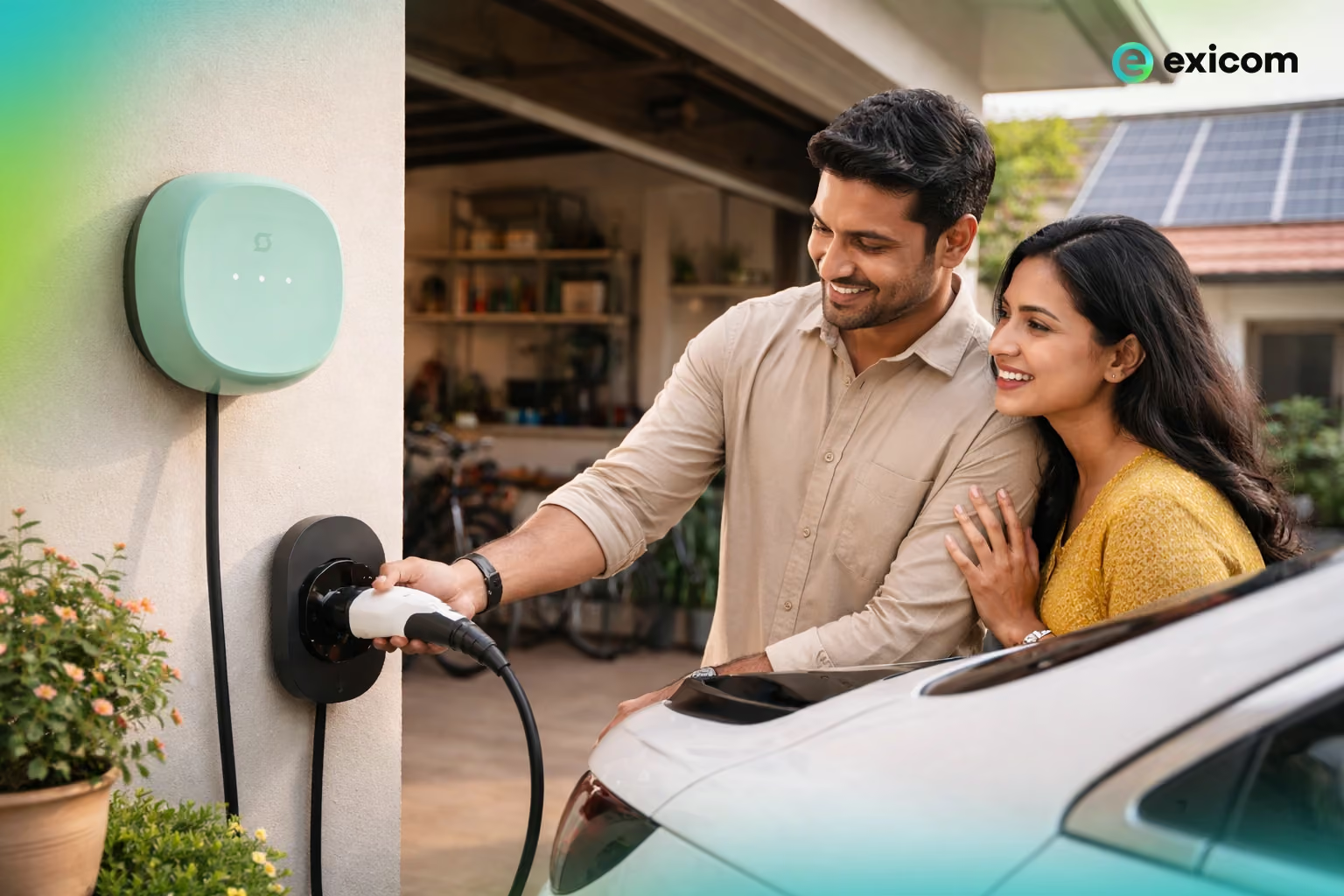
What is Residential Charging
Residential charging involves recharging an electric vehicle's battery at a personal residence with specialized equipment or regular electrical outlets. It serves as the main energy provider for many EV owners, guaranteeing that vehicles have a fully charged battery each morning for travel.
The mechanics of home charging
For most drivers, charging at home is similar to charging a smartphone. You connect your car when you get home and disconnect it when you leave. In the background, the method consists of transforming AC power from the grid into the DC power held in the battery.
From a technical standpoint, residential configurations are categorized into two levels. AC Level 1 connects to a regular wall outlet, offering slow, trickle charging that is perfect for limited daily distances. AC Level 2, the standard for residential infrastructure, employs specific wall boxes or pedestals that pull higher current to greatly minimize downtime.
How home charging systems work
A residential charging system consists of three core components: the source (your home grid), the supply equipment (EVSE or wall box), and the vehicle's onboard charger.
- Supply equipment: This interacts with your EV to regulate power distribution and guarantee safety.
- Grid connection: For an apartment or house, this necessitates an evaluation of electrical loads to confirm the system stays within the building's limits.
- Communication protocol: The EVSE determines the highest power consumption allowed by considering the vehicle's onboard limitations and regional safety standards.
Comparison: ac charging variants
Practical applications in real life
Home charging serves distinct segments differently.
- Consumers: Homeowners depend on home charging for 80% to 90% of their energy requirements. It’s the least expensive method to have an EV.
- Apartment complexes: Management of buildings encounters the issue of balancing loads. Implementing smart chargers that connect with the building's primary panel helps avoid grid overload.
- Fleets: Delivery or logistics providers emphasize overnight turnaround. A group of 10 vans needs synchronized charging plans to prevent high utility costs.
Performance metrics and cost efficiency
The context of India
Residential charging in India is quickly advancing as urban density increases. In urban areas such as Delhi and Mumbai, BSES EV charging station projects are advocating for uniform grid integration within residential communities.
- Cost: Home charging electricity rates typically reflect household slab prices. Charging during non-peak times (typically 11 PM to 6 AM) greatly reduces the cost for each kilometer.
- Policy: The central government provides subsidies through initiatives such as FAME-II/PM E-DRIVE for the installation of private charging infrastructure.
- Market Adoption: A majority of new residential developments currently offer "EV ready" parking, equipped with pre-installed conduits to facilitate future setups.
Views from the industry
- Fleet operators: Focus on chargers with remote monitoring systems (RMS) to track energy consumption per vehicle.
- CPOs (Charge Point Operators): Prioritize hardware that supports OCPP (Open Charge Point Protocol), allowing for interoperability across different vehicle brands.
- Enterprises: Focus on hardware reliability and weather-proof ratings (IP65+) to handle India’s varied climatic conditions.
Overcoming infrastructure hurdles
Infrastructure as a future pillar
Residential charging is the backbone of the EV revolution. As the number of vehicles on the road grows, the grid must transform from a passive consumer to an active participant. Future-proofing buildings now with scalable charging hardware is not just a convenience, it’s a necessary move for urban resilience.

