





How to Integrate Solar and Industrial ESS for EV Charging Infrastructure
Why Are Businesses Shifting to On-Site Commercial Solar for EV Charging?
EV charging infrastructure is spreading into regions that were never planned around high electricity demand.
That shift is easy to see once projects move outside major urban centres. In metro cities, utility upgrades are already underway in many locations. Elsewhere, the pace is slower. Charging operators expanding into industrial corridors, highways, and emerging business districts often encounter grid capacity constraints.
Technical Sizing Parameters for Industrial C&I Sites
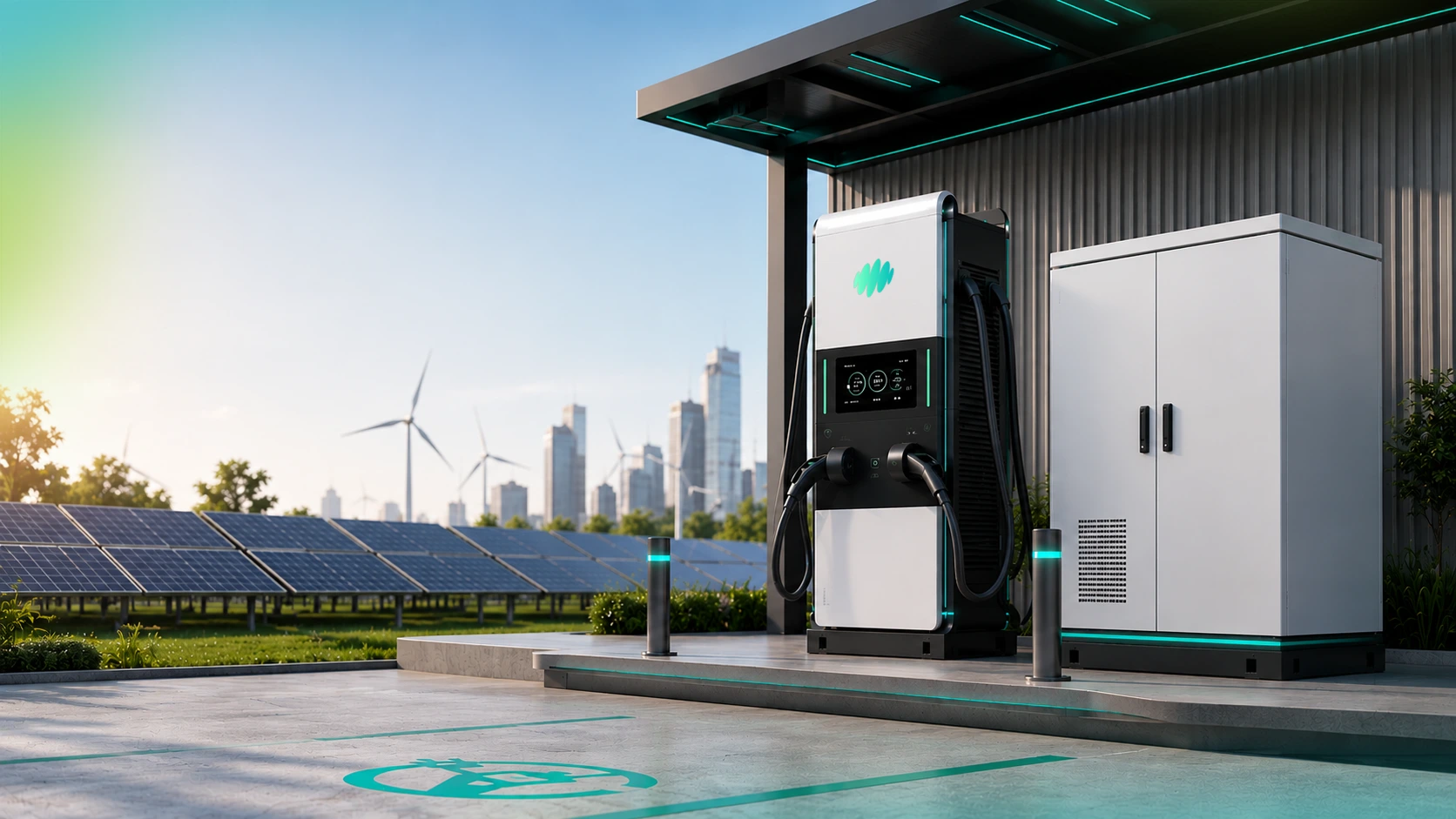
When deploying high-output infrastructure across Commercial & Industrial (C&I) facilities, operators must look past the chargers to evaluate the system's core energy architecture. A modern energy deployment comprises a Battery Energy Storage System (BESS), an intelligent Energy Management System (EMS), and a Power Conversion System (PCS) featuring bi-directional AC-to-DC inverters.
Real-world data reveals the extreme operational leverage of a unified infrastructure system:
- Grid Upgrade Capital Expenditure: BESS integration yields up to an 89% reduction in upfront grid upgrade costs, allowing operators to run heavy high-power chargers on existing low-voltage connections.
- Operating Expenditure Optimization: Smart EMS load management controls peak demand spikes, resulting in a direct 20% drop in annual OPEX.
- Grid Input Buffer Ratio: Advanced systems can seamlessly supply up to a 400 kW high-speed DC charging output while drawing a steady, safe 60 kW input connection from the utility grid.
- Solar Capture Threshold: Integrated solar Maximum Power Point Tracking (MPPT) architectures seamlessly accept up to 80 kW of photovoltaic generation input to recharge internal stationary cells directly.
Charging operators expanding into industrial corridors, highways, and emerging business districts often encounter:
- Grid capacity constraints
- Delays in obtaining additional sanctioned load
- Voltage fluctuations
- Inconsistent power supply conditions
All these situations are familiar to infrastructure operators. The concern is less about isolated incidents and more about how often they occur over longer operating cycles.
That is happening at the same time EV adoption is accelerating across multiple markets.
Strain Leads the Search for Alternatives
As these issues become more frequent, charging operators are reassessing long-term energy planning.
A few years ago, most operators focused on three things:
- Installing chargers
- Securing power connections
- Keeping stations operational
That approach is now changing.
Businesses are looking to reduce dependence on a single electricity source, especially in locations where supply conditions remain uncertain.
That shift has increased interest in on-site power generation across charging projects.
Generating electricity on-site changes the equation slightly. Operators become less dependent on grid availability during peak hours and gain greater control over everyday energy use.
Among the available options, solar has become the most practical fit for many charging deployments.
Why Are Businesses Shifting to On-Site Commercial Solar for EV Charging?
Solar has gradually become part of that conversation for fairly practical reasons.
A few years ago, many businesses still treated commercial solar installations as an additional sustainability expense. That perception has changed steadily. Installation costs have decreased, financing has improved, and long-term operating savings are easier to evaluate now than earlier.
Electricity costs also become harder to ignore once charging networks expand across multiple locations. For operators managing large deployments, even small differences in long-term energy expenditure can influence overall project economics.
Solar adoption is gaining attention because:
- Installation costs have fallen
- Financing options have improved
- Long-term savings are easier to calculate
- Energy costs can be controlled more effectively
There is also a timing advantage in several commercial environments. Charging demand inside office parks, retail developments, and logistics facilities often rises during the same hours when solar generation is strongest.
At the same time, solar generation has limits. Vehicle charging activity often continues into the late evening, particularly in busy commercial corridors and on highways.
What is the Role of a Battery Energy Storage System (BESS) in Unstable Grids?
The limitations of solar-only infrastructure become clearer once charging activity extends into late evenings and peak usage windows.
In practical terms, many charging stations generate excess solar energy during the afternoon hours, when utilisation is relatively low. A few hours later, the situation reverses. Vehicle inflow increases, solar generation declines, and operators begin to rely more heavily on external supply.
This imbalance between generation and consumption is one reason storage infrastructure is becoming more common across renewable charging projects.
Storage systems offer several operational advantages:
- Excess daytime energy can be stored for later use
- Peak-hour electricity dependence can be reduced
- Energy costs become easier to manage
- Charging operations remain more consistent during supply disruptions
The operational impact is equally important. Peak-hour electricity is expensive, which becomes a problem when charging demand rises across multiple stations. Storage helps reduce some of that pressure. Operators can use stored energy instead of drawing all power from the grid during costly hours.
The difference is more noticeable in areas with unstable supply. A power cut or voltage fluctuation does not disrupt operations as severely when backup energy is already available. Charging stations continue functioning with fewer interruptions.
As a result, many companies have changed how they plan their charging infrastructure. Chargers, storage, and energy management are no longer treated as separate systems. They are being designed together from the start.
Storage Redefines How Charging Works
Adding storage changes the way charging infrastructure functions.
Electricity generated earlier in the day no longer has to be consumed immediately. It can be stored and redistributed later depending on charging demand.
This flexibility becomes particularly useful in regions where supply conditions are less predictable. Instead of relying solely on real-time availability, operators can distribute stored energy according to demand.
Over time, that contributes to more stable charging operations during periods of higher vehicle activity.
How Do EMS Platforms Optimize Coordinated Commercial Energy Systems?
Renewable charging infrastructure generally performs more efficiently when generation, storage, and charging systems are planned together from the beginning.
Several factors influence operational stability:
- Solar generation capacity
- Storage capacity
- Charging demand patterns
- Grid interaction
- Site-specific operating conditions
A setup designed for a highway corridor may behave very differently from one located inside a commercial complex or logistics facility.
Certain locations experience sudden surges in vehicle activity over short periods, while others follow more predictable patterns tied to office schedules or commercial fleet activity. These differences influence everything from storage sizing to energy distribution planning.
Site conditions also shape infrastructure decisions, including:
- Available installation space
- Environmental exposure
- Future expansion requirements
- Layout constraints
When these elements are planned together from the beginning, the charging network functions more like a coordinated energy system than a collection of independent assets.
Station Economics Begin to Shift
Cost remains one of the first questions in almost every discussion about renewable charging.
Adding solar and storage does increase upfront investment. That part has not changed. What has changed is the way operators evaluate long-term returns.
A few years ago, many businesses were hesitant because renewable charging infrastructure was still perceived as carrying a higher financial risk. Today, the market looks more mature. Equipment costs have decreased, financing options have broadened, and commercial adoption has become more visible across multiple sectors.
Government incentives have also helped improve project viability in certain cases, especially for larger commercial deployments.
Long-term financial benefits often come from:
- Reduced dependence on grid electricity
- Lower diesel backup usage
- Better management of peak-hour tariffs
- More predictable operating expenditure
The operational savings usually appear gradually rather than immediately.
For many operators, stability in operating expenditure has become an equally important factor alongside direct savings.
Shift Brings Renewable Charging into Focus
Renewable energy is steadily becoming part of mainstream EV charging infrastructure rather than remaining limited to pilot projects or sustainability-focused installations.
The shift is not happening for one single reason. Several factors are shaping charging infrastructure decisions:
- Cost management
- Operational reliability
- Long-term scalability
- Energy flexibility
Solar generation supports part of the daily electricity requirement. Storage systems help manage fluctuations in supply and demand. Grid connectivity remains important, but operators are gradually reducing complete dependence on it.
In several markets, the discussion has already moved beyond simply increasing the number of charging stations.
The greater challenge now is building infrastructure that can continue to operate efficiently as EV usage rises year after year.
Frequently Asked Questions
Lorem ipsum dolor sit amet, consectetur adipiscing elit, sed do eiusmod tempor incididunt ut labore et dolore magna aliqua. Ut enim ad minim veniam, quis nostrud exercitation ullamco laboris nisi ut aliquip ex ea commodo consequat. Duis aute irure dolor in reprehenderit in voluptate velit esse.
Lorem ipsum dolor sit amet, consectetur adipiscing elit, sed do eiusmod tempor incididunt ut labore et dolore magna aliqua. Ut enim ad minim veniam, quis nostrud exercitation ullamco laboris nisi ut aliquip ex ea commodo consequat. Duis aute irure dolor in reprehenderit in voluptate velit esse.
Lorem ipsum dolor sit amet, consectetur adipiscing elit, sed do eiusmod tempor incididunt ut labore et dolore magna aliqua. Ut enim ad minim veniam, quis nostrud exercitation ullamco laboris nisi ut aliquip ex ea commodo consequat. Duis aute irure dolor in reprehenderit in voluptate velit esse.
Lorem ipsum dolor sit amet, consectetur adipiscing elit, sed do eiusmod tempor incididunt ut labore et dolore magna aliqua. Ut enim ad minim veniam, quis nostrud exercitation ullamco laboris nisi ut aliquip ex ea commodo consequat. Duis aute irure dolor in reprehenderit in voluptate velit esse.
Lorem ipsum dolor sit amet, consectetur adipiscing elit, sed do eiusmod tempor incididunt ut labore et dolore magna aliqua. Ut enim ad minim veniam, quis nostrud exercitation ullamco laboris nisi ut aliquip ex ea commodo consequat. Duis aute irure dolor in reprehenderit in voluptate velit esse.