



Per-Bay Metering
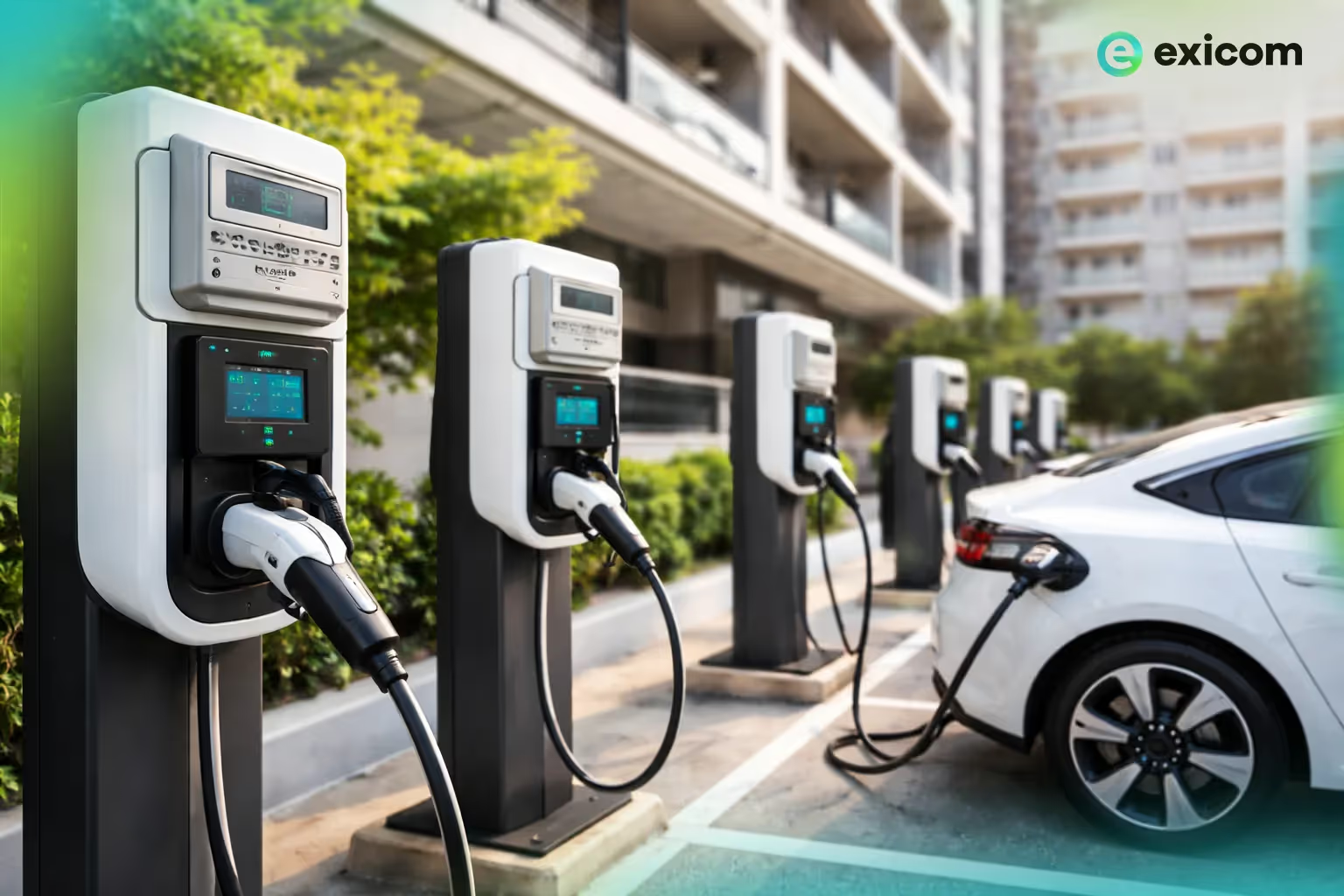
Per-Bay Metering
What is per-bay metering in EV charging? It is a specialized sub-metering infrastructure that tracks electricity consumption at the individual parking-space level rather than the building’s main grid connection. By deploying precise meter data management software, it enables accurate, fair, and automated billing for residents in apartment complexes.
Expanded Explanation
In high-density residential complexes, the traditional method of billing electricity involves a single master meter for the entire society. When multiple residents install EV chargers, this "pooled" energy consumption makes it nearly impossible to distinguish between household usage and EV charging.
Per-bay metering solves this by installing an independent, smart measuring device at every parking bay. This transition shifts EV charging from a "common area expense" to an "individual utility." Technically, this involves integrating hardware sensors with a meter data management system (MDMS) that communicates energy usage to the building's central server. It transforms the parking bay into a standalone billing unit, ensuring that each resident pays exactly for what they consume, regardless of the vehicle's battery size or charging frequency.
How It Works
An effective per-bay metering ecosystem consists of four primary components:
- Smart Metering Hardware: Installed at the individual parking bay or adjacent to the charger circuit.
- Communication Gateway: Uses PLC (Power Line Communication) or Wi-Fi to transmit real-time data.
- Meter Data Management Software (MDMS): The central brain that collects, aggregates, and stores usage logs.
- Billing API: Automatically pushes usage data into the society's maintenance portal or accounting software, eliminating manual reading.
Comparison: Metering Approaches
Real-world Use Cases
- Consumers: Residents gain autonomy. They can charge their EV whenever they need without seeking RWA approval for billing adjustments.
- Businesses (RWAs): Societies transition from manual, error-prone spreadsheets to automated digital billing, protecting common area funds from being drained by high EV energy costs.
- Fleet/Infra Players: Charge Point Operators (CPOs) use these systems to manage high-volume turnover in large gated communities, ensuring seamless billing for diverse user types.
Data and Metrics: Performance and Cost
Accurate metering optimizes the society's grid. Implementing smart, per-bay systems can reduce grid maintenance overhead by up to 25%.
India Scenario
India, the emphasis on sustainable infrastructure has resulted in a focus on EV charging in residential complexes and uniform billing systems. The guidelines from the Central Electricity Authority (CEA) emphasize safety, while numerous states are currently investigating "Time-of-Day" (ToD) tariffs to promote off-peak charging. A basic residential connection typically ranges from ₹5,000 to ₹10,000 for standard load, whereas adopting a smart per-bay meter system requires an upfront cost of ₹15,000 to ₹25,000 for each bay. The adoption of the market is now speeding up in major cities such as Delhi, Bengaluru, and Mumbai.
Business and Industry Section
- Fleet Operators: Need high-uptime, per-bay data to calculate cost-per-kilometer for employee or delivery fleets.
- CPOs: Rely on MDMS to manage "Plug & Charge" experiences that handle automated authentication and billing.
- Enterprises: Integrate per-bay data into their ESG reports to track the exact carbon footprint of their corporate fleets.
Real-World Challenges with Effective Solutions
Final Thought
Per-bay metering is not just an accounting upgrade; it is the backbone of urban electrification. As India shifts toward high-density living, infrastructure that provides transparency and fairness is essential to remove the "EV adoption barrier" in group housing. Intelligent, data-backed charging is the only way to ensure the grid remains resilient and sustainable for the future.

