



Commercial EV Charging Stations
What is Commercial EV Charging?
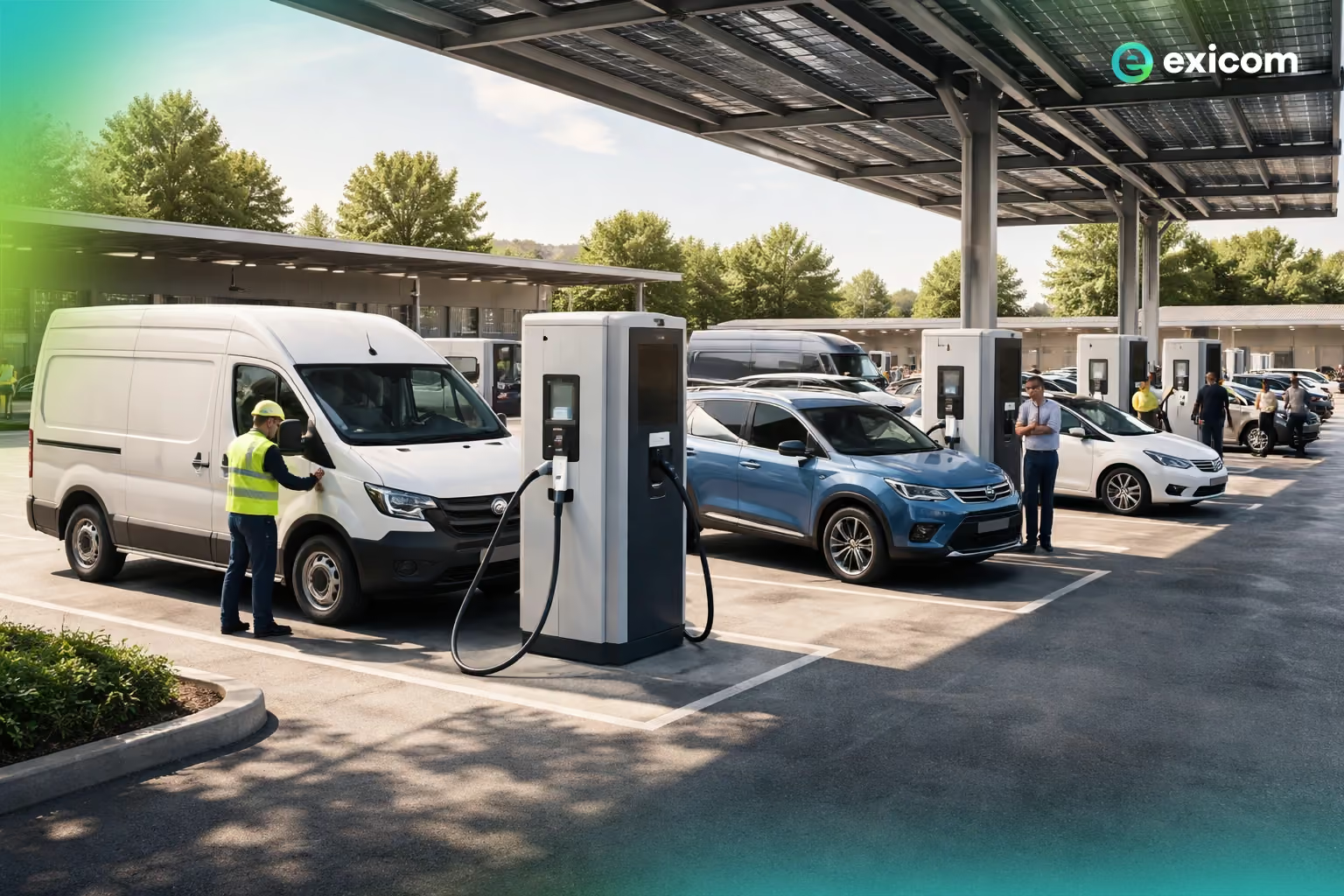
Commercial EV Charging involves the installation and usage of dedicated, high-capacity Electric Vehicle Supply Equipment (EVSE) in public, semi-public, or business settings. It employs intelligent software systems, secure transaction methods, and strong safety frameworks to reliably provide Alternating Current (AC) or Direct Current (DC) power to fleet vehicles, personnel, and the general public.
Expanded Explanation of Infrastructure Economics
For businesses expanding into the electric mobility landscape, financial planning is often split into two distinct pillars: Capital Expenditure (CAPEX) and Operating Expenditure (OPEX). While CAPEX covers the one-time upfront injection needed to buy hardware and complete civil engineering work, OPEX dictates the long-term operational viability and profitability of the asset over its multi-year lifecycle.
At a basic level, establishing commercial EV charging stations is akin to running a conventional retail operation. The physical station needs to be consistently powered, linked to the internet, and routinely maintained to stay functional. From a technical standpoint, an EV charging hub functions as a high-capacity, software-driven unit within the local utility grid. Each charging session initiates accurate communication between the battery management system of the vehicle and the controller of the station. Managing OPEX involves monitoring variable demand charges, reducing transmission efficiency losses, and implementing remote firmware updates to avoid costly, reactive on-site maintenance calls.
How Commercial EV Charging Systems Work
Operating public infrastructure smoothly requires continuous data and power alignment across four critical layers:
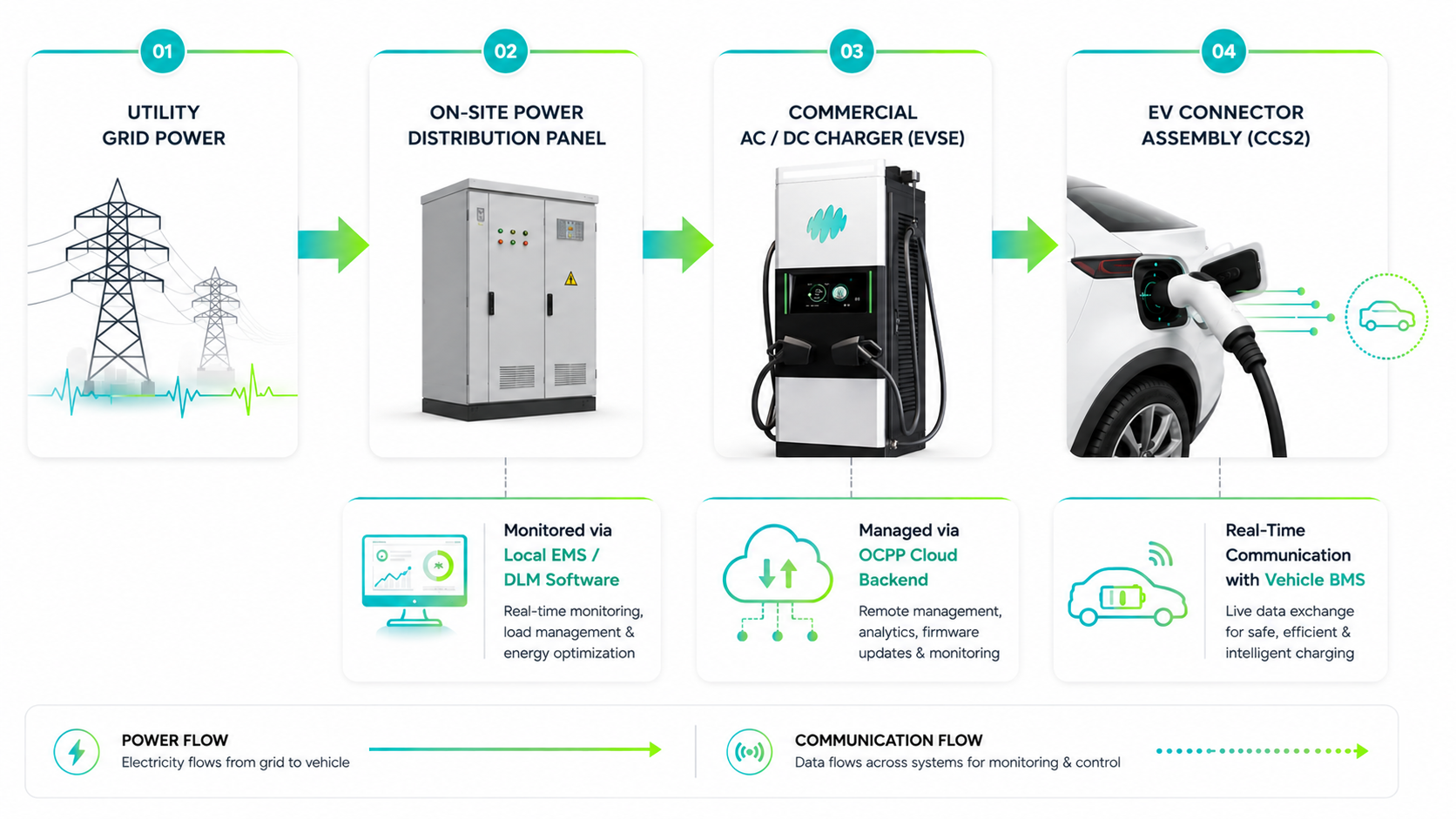
- Utility Grid Power: Alternating Current (AC) is drawn from the local power grid through a sanctioned high-capacity utility line.
- On-Site Power Distribution Panel: Houses the circuit breakers, protective earthing, and safety switchgear. It integrates with dynamic energy management software to monitor site-wide demand.
- Commercial Charger (EVSE): Regulates the energy flow. AC units deliver power directly to the car's onboard converter, while heavy-duty DC units convert AC to Direct Current (DC) internally to feed the car's battery pack rapidly.
- EV Connector Assembly: The physical interface (typically the European and Indian standard CCS2) that transfers power and handles safety feedback strings with the vehicle.
Strategic Asset Analysis: AC vs DC Commercial Chargers
Building a highly defensible infrastructure network requires balancing upfront installation costs against daily running speeds and requirements.
Real-World B2B Use Cases
- Consumers: Act as end-users utilizing public EV charging stations during transit. They demand high uptime, seamless mobile application booking, and standardized payment integrations.
- Businesses: Retail centers, hotels, and corporate offices deploy destination charging setups. This model monetizes driver dwell time, transforming a raw utility cost into a customer retention engine.
- Fleets & Infrastructure Players: Last-mile logistics providers and high-volume Charge Point Operators (CPOs) run ultra-dense charging clusters. They rely on highly scalable, heavy-duty configurations to guarantee rapid vehicle turnaround times.
Financial Performance Metrics
The financial performance of public charging infrastructure is highly utilization-dependent. Operational data from commercial sites shows how costs scale between different power ratings:
Competitive Landscape
The commercial electric mobility ecosystem in India has entered a mature, fast-growth phase.
- Leading EV Charging Firms in India: The infrastructure framework is primarily supported by key technology suppliers and operators, such as Exicom Tele-Systems, Tata Power (EZ Charge), Delta Electronics, ABB India, Jio-bp Pulse, and Statiq.
- Franchise Network: Exploring the ideal EV charging station franchise in India entails evaluating complete solutions from networks like Tata Power, Jio-bp Pulse, and Statiq, all of which provide site selection support and comprehensive software integration. The initial investment for a high-speed DC hub in the EV charging station franchise generally ranges from ₹25 Lakhs to ₹31 Lakhs, offering a comprehensive approach to local infrastructure ownership.
- Regulatory & Standards Framework: The Ministry of Power explicitly classifies EV charging as a "service" rather than the resale of electricity, eliminating the need for a distribution license. All hardware must strictly comply with BIS IS 17017 safety standards, utilizing the universally adopted CCS2 connector protocol for public DC charging.
Operational Strategies by Industry Segment
- Fleet Operators: Focus on predictable total cost of ownership (TCO) models. They combine depot hardware with software-driven energy scheduling, choosing off-peak utility hours to recharge commercial vans without triggering grid capacity penalties.
- CPOs: Prioritize high uptime and rapid scaling. To minimize real estate OPEX, leading CPOs frequently opt for revenue-sharing models with property owners instead of high, fixed long-term leases.
- Enterprises & Commercial Real Estate: Install destination charging bays to boost their corporate sustainability index. They implement smart billing software to offer subsidized charging for employees while executing full-tariff public pricing for external visitors.
Final Thought
The electrification of commercial vehicles is closely connected to grid intelligence. Establishing a successful charging network necessitates managing initial investment costs alongside a rigorous strategy for daily operational expenses. Operators that combine durable hardware with intelligent energy management software are optimally positioned to achieve steady returns as worldwide transport infrastructures shift permanently to clean energy.

