



RFID
Definition: What is RFID?
Radio-Frequency Identification (RFID) is a wireless, contactless technology that identifies, tracks, and communicates information from a microchip embedded in a transponder to a special reader. It is Radio-Frequency Identification, in which data is transmitted seamlessly without exposure to radio frequency or direct contact. It's a fundamental backbone for contemporary access control, electronic toll collection (ETC), and secure electric vehicle charging authentication.
To grasp RFID, it's useful to consider it as an evolution of the old barcode, but with a twist of non-optical technology. Unlike barcodes that need precise physical alignment and line-of-sight visual scanning, RFID systems are able to capture data without the need to penetrate paper, plastic, or extreme ambient dust or moisture.
Technically, there are two main modes of physical coupling that are used to provide the operation of an RFID: inductive coupling and electromagnetic backscatter coupling. Inductive coupling is used in networks with a short range (near field) where the magnetic field of the reader's antenna is coupled directly to the tag's antenna. For longer-range (far-field) networks, the tag receives the radio frequency wave and changes the impedance of its antenna to return a new signal to the reader.
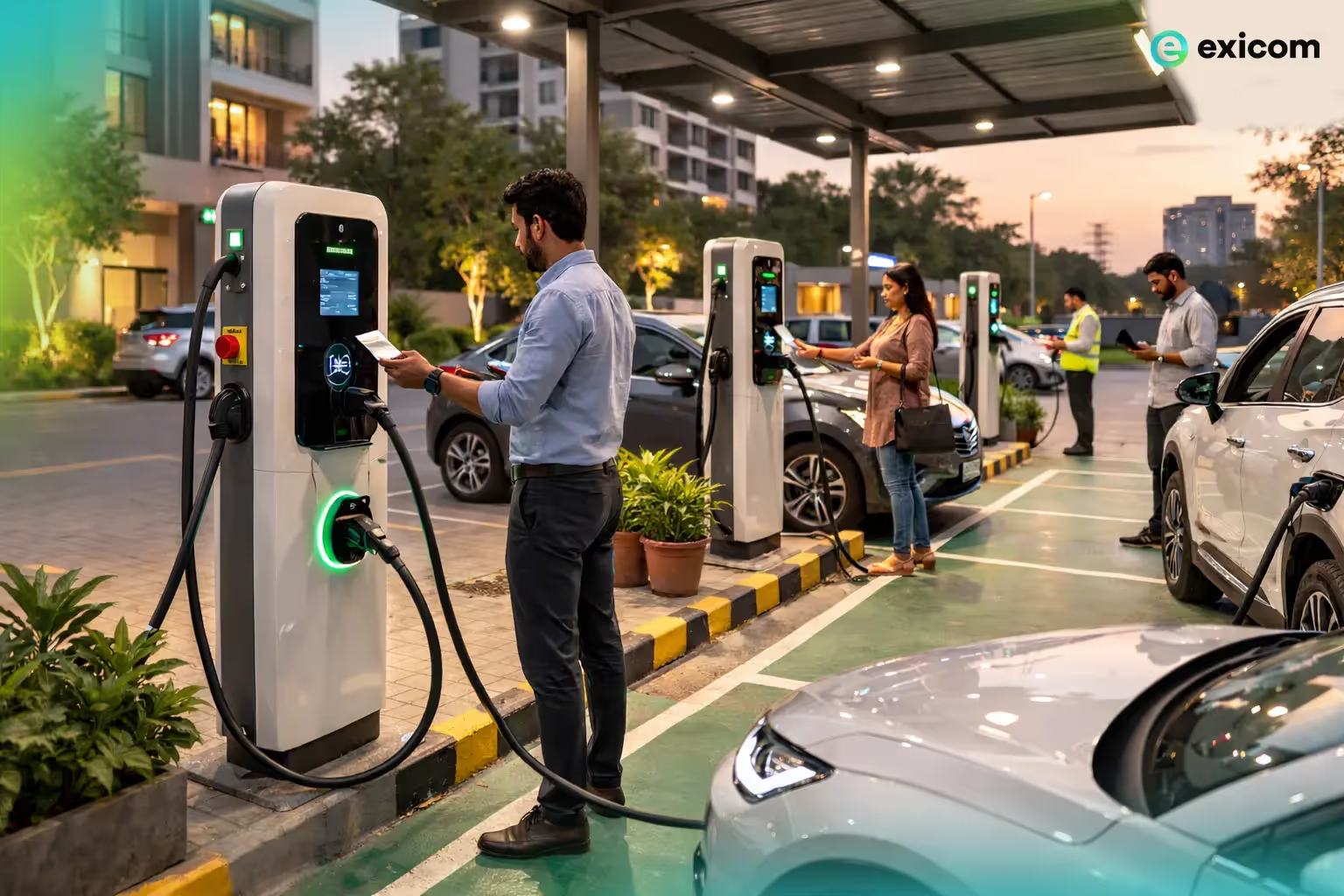
These interactions operate across globally regulated radio frequency bands. When an authorized card or transponder enters the active interrogation zone, a secure handshake occurs. In the e-mobility landscape, this wireless connection triggers a rapid RFID login process. The charger reads the tag's stored credentials, validates the identifier via local or cloud-based directories, and authorizes power distribution to the vehicle.
How It Works: Deconstructing System Components
An operational RFID ecosystem relies on four fundamental components that operate in a continuous, automated sequence:
- RFID Tag (Transponder): It is a part that includes integrated circuit (IC) microchip for storing data and an antenna to generate signals. They are used in commercial applications in rugged key fobs, PVC smart cards or windshield stickers.
- RFID Reader (Interrogator): This includes a transmitter/receiver module that sends radio frequency signals, receives the return data payload, and decodes the stored transponder parameters.
- RFID Antenna: This element establishes the physical read zone by radiating electromagnetic energy generated by the reader and capturing the returning signals reflected from nearby tags.
- Middleware and Backend Software: This layer receives raw data from the reader, filters out duplicate tag reads, and routes the validated credentials to core management systems—such as Exicom’s ChargeX platform or Harmony Connect Remote Monitoring System (RMS)—to complete billing and session management.
Types and Variants: Passive HF vs. Passive UHF RFID
Selecting the correct frequency class is critical for optimizing system performance, reading range, and security parameters across different commercial deployments.
RFID examples and use cases
An analysis of the current commercial settings shows that it is imperative to develop an RFID tag that is fundamental to the implementation of automated working and secure logistics networks.
- Consumers: The dominant consumer-facing RFID use case centers on contactless transactions. Smart home chargers, such as the Exicom Spin Air, utilize integrated high-frequency readers. This allows residents to tap their key fob or access card to immediately initiate an AC charging cycle, avoiding the delays of using a mobile app in parking structures with poor cellular connectivity.
- Businesses: Enterprises use RFID technology for access control and IT asset management. High security cards enable businesses to manage access to high-security data centers, to secure hazardous zones, and to track the precise location of high-value physical resources in real time.
- Fleets and Infrastructure Players: In commercial logistics, passive UHF windshield identification is used. At the depot, when a truck arrives, a reader mounted overhead provides automatic class identification, which unlocks the gates and synchronizes with software to distribute the power to a truck and its class in a balanced way, using a modular charger such as the Exicom Harmony Direct 2.0.
Data and Metrics: The Operational Advantage
Deploying automated wireless identification systems delivers measurable efficiency and accuracy improvements compared to manual or optical tracking methods.
According to the big-box trials, the amount of time you spend on physical inventory audits can be cut by up to 80% once you switch to RFID systems, which can be recorded in real-time rather than be performed over a period of days.
India Context: Market Adopting and Policy & Costs
RFID technology has moved from niche applications in Indian warehouses to being a mandated infrastructure.
The Breakdown of costs (₹) of a standard high-frequency card used across various public vehicle charging networks (e.g., Tata Power EZ Charge, Zeon, or GOEC) is between ₹300 and ₹370. In terms of equipment, entry-level security access readers are around ₹2,000 each, and industrial-grade long-range fixed UHF tolling antennas are ₹25,000 to ₹1,50,000 per unit.
The Government Policy: The Government of India has announced the adoption of Passive UHF RFID tags on all motor vehicles under the national FASTag programme under the National Electronic Toll Collection (NETC) policy. This policy standardized the 865–867 MHz frequency band, significantly lowering hardware procurement costs across the region.
Market Adoption: National charging equipment is being regulated by the Bureau of Indian Standards (BIS) with the IS 17017 series for interoperability and safety. Public charging stations are increasing beyond 26,000 stations in operation, and operators are using high-frequency RFID cards to enable payment to proceed effortlessly and offline.
Fleet Operators
When you use the UHF RFID tags, fleet depots can automatically check in vehicles, unlock secure terminal gates, and monitor vehicle energy consumption. This information can be used to dynamically balance load to prioritize charging the highest priority vehicles first while charging lower priority vehicles at off-peak periods to avoid high costs from grid demand charges.
Charge Point Operators (CPOs)
For CPOs, minimizing session failures is critical to maintaining site loyalty and maximizing infrastructure ROI. Basement parking structures and remote highway corridors often suffer from poor cellular coverage, causing mobile application logins to fail. Standardizing RFID card authentication allows CPOs to offer a reliable backup. Chargers can store encrypted whitelists locally, verifying the user's secure credentials and starting the charging session even when the station is offline.
Enterprises
Corporate RFID readers are used by enterprises to merge access to their facilities and the services provided to the employees. The integration enables workers to use their corporate security badges to open parking gates, enter offices, and turn on EV chargers. The enterprise backend records these transactions, simplifying billing management and providing detailed energy reports for corporate ESG audits.
Challenges and Solutions: Engineering a Secure Network
To ensure reliability at scale, infrastructure operators must address several common physical and digital challenges.
Final Thought: Strategic Grid and Infrastructure Integration
As the world moves to electric cars, the security of the grid is becoming a critical need, and digital authentication is moving from being just a nice-to-have to a must-have. To prevent unauthorized energy theft, secure and speedy verification is essential to protect charging stations from this harm, as well as the power grid during a peak hour.
At Exicom, this focus on reliability is central to our hardware and software design. Our AC Spin Air charger series and high-power DC Harmony terminals feature integrated, weather-resistant RFID readers compliant with standard industrial security protocols. Exicom's physical security strength and digital authentication capabilities with offline security support ensure energy infrastructure operators can enjoy superior uptime and expand their networks with confidence into the future.

